

Audio By Carbonatix
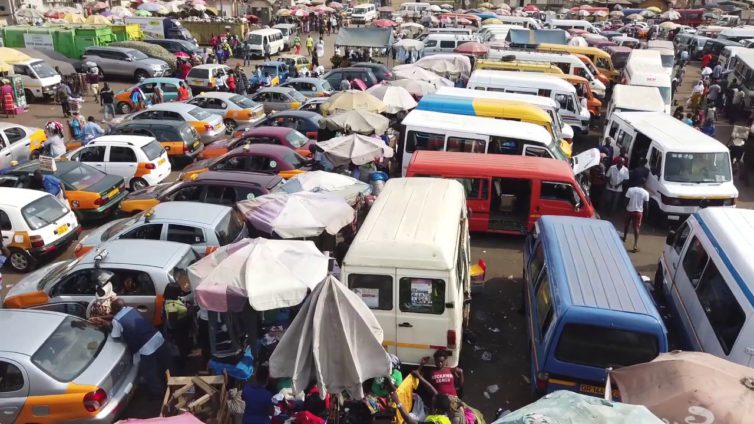
The Ghana Private Road Transport Union (GPRTU) has defended its decision not to reduce transport fares despite a slight drop in fuel prices, stating that fare adjustments depend on multiple cost factors beyond just fuel.
Speaking on Joy News’ PM Express on Tuesday, March 18, the Deputy PRO of GPRTU, Samuel Amoah, explained that spare parts, insurance, DVLA charges, and other operational costs play a critical role in fare determination.
“Before December, we had plans of increasing transport fares, first because of the high cost of spare parts, where the fuel price was also running to, the cost of lubricants, insurance, and DVLA taxes,” Amoah stated.
“But then we held it. We held on, thinking that things would come down because of the promises we had that going forward, things were going to get better.”
He acknowledged that fuel prices have seen a slight reduction but argued that it is not enough to warrant a fare decrease.
“Yes, we have seen that fuel prices are coming down a little bit. But what I can say is that it has not gotten to where it will call for a reduction in transport fares.”
Amoah stressed that fuel prices are just one of many variables considered when deciding on fare adjustments.
“We don’t only consider fuel prices to determine our transport fares,” he explained.
“We have some other components, like the cost of spare parts, as I earlier mentioned. We have the cost of lubricants, taxes, and other petroleum products as well.”
He outlined the process GPRTU follows before making any fare changes.
“We normally have a 10% threshold that we check on,” he said. “We compare where the fuel price was and where it has gotten to.
"Then, we send a team to the market to check where the prices of these other components have moved to. Based on their reports, we determine whether there should be a percentage reduction or an increment.”
According to Amoah, the last time transport fares were increased, fuel prices were around ¢12 per litre.
“If you check the previous time we increased transport fares, I believe the fuel price was around ¢12 per litre, thereabout—I stand to be corrected,” he said.
“Looking at it now, diesel is about ¢15.49, and petrol is about ¢14.99.”
He made it clear that until fuel prices drop significantly, fare reductions remain unlikely. “We are praying that fuel should come down to at least around ¢12 per litre,” he stated.
“If it comes down to that level, we will also check where the spare parts prices have gotten to. But with where the cost of spare parts is now, it will be difficult for us to reduce transport fares.”
His remarks highlight the complex nature of transport fare adjustments, reinforcing GPRTU’s stance that reducing fares is not solely dependent on fuel prices but also on other operational costs affecting transport operators.
Latest Stories
-
Asha Bhosle: The sound of Bollywood dies aged 92
26 minutes -
Fire destroys section of 4-bedroom apartment at Tantra Hill
28 minutes -
Safe city: Unnoticeable protection
35 minutes -
North East Regional Police Commander raises alarm over burning of checkpoints
44 minutes -
Free Primary Healthcare Programme set for take-off — Health Ministry confirms readiness
59 minutes -
3 co-wives, 5 children perish in canoe disaster – Maritime Authority insists life jackets use mandatory for all water transport
2 hours -
Iran war lands ‘triple blow’ to flood-ravaged Sri Lankans
2 hours -
Gunmen kill at least 11 people at Afghanistan picnic spot
3 hours -
Woman, 25, in court for stealing baby at Bogoso
3 hours -
Trump unveils giant gold-accented victory arch design for US capital
3 hours -
We spoke to the man making viral Lego-style AI videos for Iran. Experts say it’s powerful propaganda
3 hours -
Hungarians vote in big numbers on whether to end Orbán rule and elect rival
3 hours -
At least 30 feared dead in crush at Haitian tourist site
3 hours -
Boxing: Abdul Ahmed wins WBA Africa Cruiserwight title after dispatching Nigeria’s Eradeye
3 hours -
Nearly 2,000 displaced, schools damaged as windstorm wreaks havoc in Gushegu
3 hours