

Audio By Carbonatix
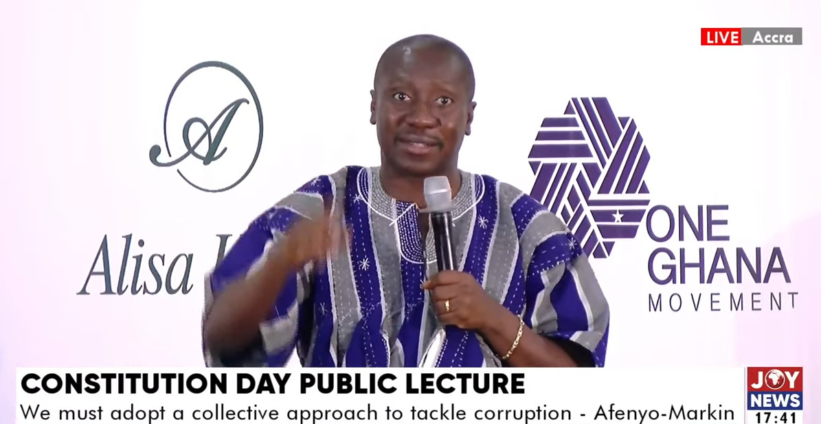
Minority Leader, Alexander Afenyo-Markin, has called for a collective approach in addressing corruption, urging Ghanaians to broaden their perspective on the issue rather than limiting it to politicians alone.
Speaking at the Constitution Day Public Lecture on Friday, February 28, he questioned the need to blame only politicians for corruption.
"Do we often narrow the issue of corruption and limit it to the political class, or perhaps we have to broaden it and look at it as part of the general life of all of us as a people?" he quizzed.
He explained that corruption is often influenced by cultural and societal expectations, which sometimes push leaders into unethical decisions.
“As part of our culture, don’t we make ourselves vulnerable to what we call corruption? Our cultural lifestyle and how we relate to ourselves makes the leader very vulnerable, and in trying to meet those expectations, if you don’t have the resources, you may end up acting wrongly.”
Mr Afenyo-Markin further highlighted that tackling corruption requires a joint effort from citizens, businesses, civil society, and the media, rather than just placing the burden on government officials.
“It is not enough to talk about corruption, we must look at a collective approach in how to deal with it. We cannot lay blame on one side, we have to be very collective and tackle it head-on.”
He also encouraged civil society to play a more active role in holding leaders accountable, noting that public scrutiny could serve as a deterrent.
“I encourage discussions by civil society all aimed at cracking the whip on the political class. If somebody knows that on the radio, people will be talking about his lifestyle, he will be careful when he gets into office.”
He concluded by emphasising that corruption is not just a government problem but a societal issue that requires all stakeholders to take responsibility.
"The laws are just not enough, it is our collective will. And in the process as citizens we must never give up because giving up will mean leading us to a failed state, that cannot help us as a nation. Let us continue to crack the whip, let us continue to be hard on the political class but at the same time other actors in that chain of corruption, because if you leave the other actors and focus on the political class, dealing with the canker will still remain a big headache on our heads as a country," he concluded.
Latest Stories
-
Photos: Mahama leads wreath-laying ceremony honouring enslaved Africans in New York
45 seconds -
Sulemana Braimah urges probe into ‘Big Push’ contracts
13 minutes -
Honda Football Championship 2026 officially launched
16 minutes -
Salah to leave Liverpool at end of season
19 minutes -
Photos: President Mahama’s high-level session on reparatory justice at United Nations
48 minutes -
‘Likely to cause financial loss’ – Minority demands OSP, CHRAJ probe into old BoG office contract
54 minutes -
Ghana is home to most slave structures in Africa – Mahama
1 hour -
Scrutinise sole-sourced contracts beyond percentages – Edem Senanu cautions gov’t
1 hour -
5 secrets that will make your living room look expensive, according to pro designers
1 hour -
Recording Encounters with Security Forces in Ghana Wrong? – Forced Deletion of Evidence?
1 hour -
About 1,200 businesses in Burma Camp to start paying for electricity as gov’t scraps exemption
2 hours -
Ghana’s Next Big Reform should be Migration
2 hours -
There’s no such thing as a slave – Mahama urges global rethink at UN
2 hours -
EOCO’s case crumbles as High Court clears Gabriel Tanko Kwamigah-Atokple
2 hours -
UN slavery resolution a pathway to healing and justice – Mahama
2 hours