

Audio By Carbonatix
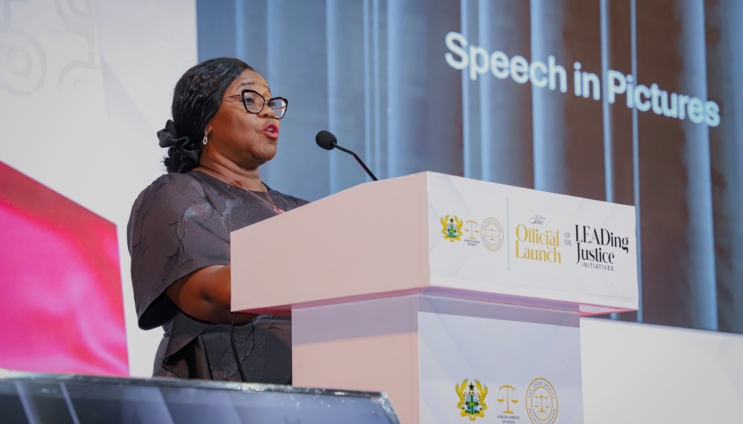
Chief Justice Gertrude Araba Esaaba Sackey Torkornoo says there is an urgent need to build a modern archive centre to store all records.
She said that would ensure easy retrievals whenever citizens and court users needed them.
The Chief Justice was speaking at the launch of an initiative dubbed ‘LEADing Justice’, a strategic framework for increasing Legality, Ethics, Assets, Digitalisation, and due process in justice delivery.
The new reforms form part of her vision for improved capacity of all workers within the justice delivery system and a continuous drive towards efficiency.
She said as the documents were being stored, they must be digitised for electronic storage and easy retrieval.
“Again, it is only after digitisation that we can even remotely anticipate effective e-justice. Because virtual trials cannot be conducted without electronic dockets,” she added.
The Chief Justice said it was a strong goal of the vision statement to move registries into paperless modes as soon as possible.
She said the LEADing Justice vision was anchored on the high use of technology to increase speed and transparency in the justice delivery process.
Justice Torkornoo said goals had been set for digital libraries so that all staff and judges would have access to learning, notwithstanding, which part of the country they were.
“Goals have also been set to obtain centrally managed transcription rooms for the early processing of court proceedings so that requests for court processes cannot be affected by localised interests within the courtroom,” she added.
She said that would remove the burden of court users paying courtroom recorders to produce transcripts of proceedings.
The Chief Justice said it would also ensure that records were made available to stakeholders without unnecessary waste of time and costs through travelling to a registry, queuing to pay for a record, and being told to go and come back.
The Chief Justice said land mapping, verification of property details from records on property rates with District Assemblies, verification of details of vehicles from DVLA, and verification of account holding in banks during execution processes, could all be easily done via dedicated and authenticated e-processes between the courts and the relevant institution.
“This can save staff from institutions spending productive time in court just to relay information,” she added.
She said many of those electronic verification processes would cut out the horrible spectre of forgeries that the courts sometimes experienced.
Latest Stories
-
Health Ministry engages Ga Mantse ahead of Free Primary Healthcare launch
9 seconds -
We can tackle multiple priorities – Sam George defends Anti-LGBTQ Bill push
35 minutes -
Statement: Ghana Chamber of Mines’ Response to Claims in Joe Jackson’s “Ananse Stories about the Economy of Ghana”
36 minutes -
GES opens 2026 teacher recruitment for licensed B.Ed graduates
39 minutes -
Ghana must value skilled trades, build resilient learners — Ibn Chambas
47 minutes -
Ghana must rethink education around relevance, resilience and responsibility — Ibn Chambas
50 minutes -
Prince Harry faces defamation lawsuit from charity he co-founded
52 minutes -
South Korea deploys thermal cameras to track escaped zoo wolf
53 minutes -
Calls for royal meeting with Epstein survivors grow ahead of US visit
56 minutes -
Ibn Chambas advocates blend of technology and human values in education
58 minutes -
UMA improves healthcare access in Asutifi North with GH₵700k ‘Kim Taylor Legacy’ Walkway
1 hour -
Scholarships Authority and Fanaka University offer sponsorship for procurement and supply chain studies
1 hour -
Bisa Kdei drops new single ‘Go N Look’ featuring Medikal
1 hour -
Benin facing rising terrorism in north as French military presence faces growing criticism
1 hour -
UEW Public Lecture Series 2026: Education debate ‘about the soul of Ghana’s future’ — Dr Ibn Chambas
1 hour