

Audio By Carbonatix
An academic historian at the University of Cape Coast in Ghana has made a bold declaration that Pan-Africanism, in today’s context, demands frank discussions about credible leadership in Africa and alternatives to the governance structures adopted from abroad, which have produced little development.
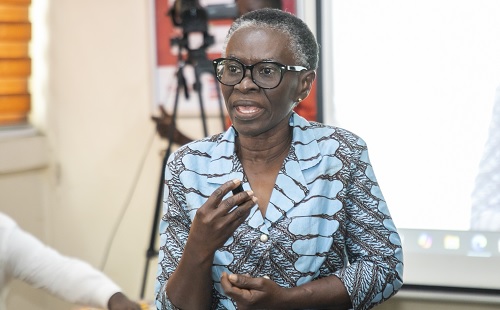
“The standard liberal democracy has not yielded the desired results, at least in Africa,” said Professor Akua Opokua Britwum.
She cited South Sudan, Libya, and Somalia as examples of failed African states whose governance systems were designed to mimic Western-style liberal democracies.
Speaking in an interview ahead of Tuesday’s 80th anniversary of the Fifth Pan-African Congress in Manchester in 1945, Prof. Britwum, who also serves as Chairperson of Ghana’s National Media Commission (NMC), said the Pan-African ideology, as articulated by Dr Kwame Nkrumah, one of the foremost Pan-Africanists, remains relevant today amid renewed debates about neo-colonialism and imperialist interests in Africa.
The International Conference of Pan-African Progressive Forces Commemorating the Fifth Pan-African Congress will take place in Ghana’s capital, Accra, on 18 and 19 November 2025, under the theme “From Historical Memory to Economic and Political Justice.”
Organised by the Pan-African Progressive Front (PPF), an international non-governmental organisation based in Accra, the commemoration will conclude with the signing of a document dubbed “The Accra Declaration.” The declaration will outline the position of Pan-African progressive forces on demands for reparations to Africa and Africans for centuries of slavery, colonisation, exploitation, and other injustices perpetrated by Western powers.
Ultimately, the conference aims to rekindle the Pan-African spirit and inspire a stronger, more assertive Africa capable of standing shoulder to shoulder with the rest of the world as an equal partner.
Prof. Britwum said it was this sense of clarity that leaders like Kwame Nkrumah brought to Pan-African activism, making the Manchester Congress so significant.
“There was an ideological clarity that Nkrumah had which others did not. He spoke of the demand for immediate independence for African nations, while others called for a gradual process,” she said.
She described the upcoming conference in Accra as a significant milestone that should prompt reflection on the alternatives Africa can present and a redefinition of Pan-Africanism.
She said the commemoration also offers an opportunity for the continent to rethink how it wishes to shape and tell its Pan-African story.
Prof. Britwum noted that while the Fifth Manchester Congress of 1945 was attended by grassroots Pan-African activists such as Dr Kwame Nkrumah, George Padmore, and W.E.B. Du Bois, the 80th anniversary would see participation by leaders in high-level positions, including heads of state—marking a significant evolution since Manchester.
Ghana’s President, John Dramani Mahama, is expected to open the conference alongside other African presidents and delegates from over 50 African countries and the diaspora.
Tracing the history of Pan-Africanism, Prof. Britwum said the Manchester Congress of 1945 served as the catalyst for Africa’s struggle for independence, racial equality, and other fundamental rights.
“The Fifth Manchester Congress was a turning point because it represented people from across the African continent. It had Africans from Africa—trade unionists, farmers’ organisations, students, and many others were well represented,” Prof. Britwum explained.
Coming at a time of severe political and economic challenges across the continent, she said the event became a rallying point to intensify the growing Pan-African movement for a common cause.
By then, the groundwork laid by early Pan-Africanists such as Henry Sylvester Williams, H.A. Nurse, and other diaspora Africans in the early 1900s had been inherited by a new generation of activists who believed in equal rights, Africa’s ability to govern itself, and the need to eliminate foreign domination—including the presence of foreign troops.
“The initial four congresses were elitist—they believed they could mobilise from among themselves,” said Prof. Britwum, who also serves as Convener for the Network for Women’s Rights in Ghana.
She noted that it was at the Fifth Congress in Manchester that delegates drafted a resolution demanding, among other things, African independence from British and French rule, the withdrawal of foreign troops from the continent, and voting rights for Black people in the United States. Dr Kwame Nkrumah played a central role in drafting that resolution.
The resolution was later submitted to the United Nations (UN), leading to significant transformations, including the creation of independent states and progress towards political and economic freedom from former colonial powers.
“Today, we understand that the struggle is not yet over—there is still much work to be done to achieve the Pan-African dream. The Accra Declaration will mark a new phase in the fight against the exploitative policies of neo-colonialism,” Prof. Britwum concluded.
Latest Stories
-
‘We’ve become quite experienced in negativity’ – Liverpool’s Slot
4 hours -
Legendary manager Lucescu dies days after resigning
4 hours -
One dead as train travelling 99mph collides with lorry in France
5 hours -
Airlines cut flights and hike fares as fuel prices surge
5 hours -
Kane inspires Bayern to first-leg advantage over Real Madrid at Bernabéu
5 hours -
Wireless Festival cancelled after Kanye West blocked from coming to UK
5 hours -
Wa West MP commissions five boreholes for the benefit of his constituents
5 hours -
Havertz’s late strike hands Arsenal narrow first-leg advantage over Sporting
5 hours -
Damang mine award: Minority not against Ghanaian participation; we’re asking for fair process – Konadu
6 hours -
NPA to enforce stricter registration rules for petroleum tankers
6 hours -
Manhyia South MP laments decline in hospitality operations in his constituency
6 hours -
How a simple clean charcoal innovation could benefit Ghana’s climate future
6 hours -
NPA, COMAC launch Safety Week 2026 to promote risk management in petroleum sector
6 hours -
Stakeholder engagement resolves onion trade impasse
6 hours -
Gender Ministry holds staff durbar, welcomes new Chief Director
7 hours