


Audio By Carbonatix
Happy new smartphone season to all who celebrate. It’s that time of year again, when the tech giants pull out all the stops to persuade you to upgrade your gadgets.
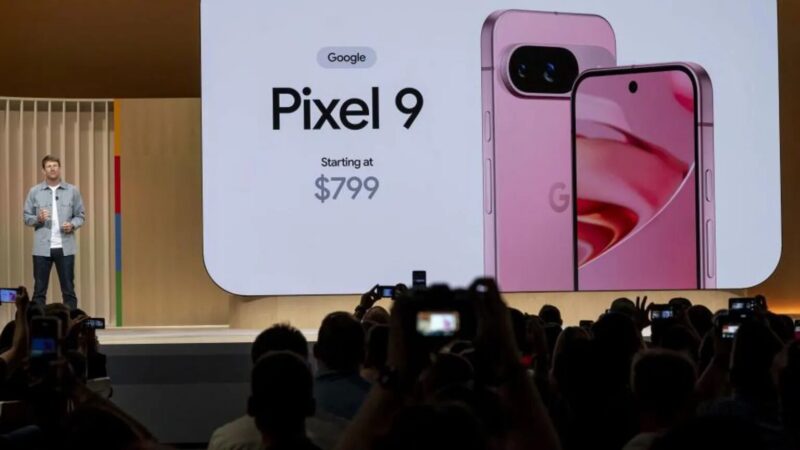
Recently we’ve seen Google launch the latest Pixel 9 handsets, followed by Apple unveiling the iPhone 16.
In July, Samsung released the latest versions of its foldable phones, the Z Flip6 and Z Fold6, and Huawei has just upped the ante in that department by unveiling a handset called the Mate XT, in China, which contains two folds, folding the screen into thirds.
With smartphone sales slowing worldwide, the marketing messages getting pushed out are increasingly dazzling.
Apple boss Tim Cook promised that the iPhone16 would “redefine what a smartphone would do”, whatever that means. Google product management vice president Brian Rakowski waxed lyrical about the “stunning” design of the “gorgeous” Pixel 9 (whisper it: it still looks a lot like a black rectangle to me).
Huawei now has its own consumer brand song, it says in its press material, which “powerfully expresses the pursuit of dreams, highlighting that every breakthrough and success the company has achieved stems from a belief in dreams”.
Yes, we are still talking about phones.
Both Apple and Google have gone big on baked-in AI features. Google’s new Magic Editor can add AI generated content into existing photos, as well as remove the bits you don’t want (with varying degrees of success, in my experience).
Apple Intelligence on the iPhone16 includes ChatGPT-maker OpenAI’s tech being embedded into the digital assistant Siri – which many argue has long been in need of an update.
But has anyone actually said that they want all of this stuff?
Mobile phone expert Ben Wood, from research firm CCS Insight, said that while AI features aim to make digital life easier, they’re not necessarily on top of everybody’s wish list.
“I think that most people now know what they want from a phone, with one of the most important things being the camera,” he says.
The phone designers also know this. The tech spec of every new handset camera is usually an improvement on the previous generation. But even this isn’t a guaranteed sales generator anymore.
“What is definitely happening is that people are holding onto their phones for longer. Back in 2013 there were 30 million phones sold annually,” adds Mr Wood. “This year it will be around 13.5 million.”
There is of course an ongoing cost of living crisis affecting people’s spending decisions. And there’s also an environmental price tag attached to every handset, all of which contain rare elements and precious metals.
In addition, there is a growing trend, especially among parents and young people, to try to step away from smartphones entirely.

A number of UK schools are reviewing their smartphone policies, and a few have already opted for an outright ban. Pupils starting at the public school Eton this term were issued feature phones (sometimes, rather unpopularly known as dumb phones), and I have heard of several other institutions, both in the private and state sectors, which are considering following suit.
The mobile phone network EE recommends that children below the age of 11 shouldn’t have smartphones at all.
Nova East leads the north and west London branch of the Smartphone Free Childhood campaign, which urges parents and schools to collaborate to delay the age at which children are given the devices.
“We are not anti-tech, we are just pro-childhood,” she says. “We would like to see tech companies develop a child friendly phone, offering only essential features such as calls, messaging, music, and maps, without any additional functionalities.”
Dr Sasha Luccioni, a research scientist at the AI firm Hugging Face, says that so far, this message does not seem to be getting through.
“There’s increased talk of ‘digital sobriety’ in the way we build and use technology – but it sounds like smartphone designers are going in the exact opposite direction,” she says.
I put this to Apple, Google and Samsung. The latter said: "Samsung users can choose how they use their Galaxy phones that best fits their needs. For example, digital wellbeing features allow users to select what features they use, when they use them and for how long, such as setting a screen time limit on specific apps they want to restrict."

One company that is listening to the growing calls for reduced phone functionality is the Finnish firm HMD – which still makes basic Nokia handsets. Last month it launched a Barbie-themed phone in collaboration with toymaker Mattel, and I tried it out. The two words I would use to describe it are: functional. And pink.
Like most feature phones, it has no apps, no app store, no selfie camera, and only one game. If you want to listen to music there’s an FM radio.
CCS Insight forecasts that around 400,000 feature phones are likely to be sold in the UK this year – nowhere near enough to knock the iPhone off the top of the list of the world’s most-sold handsets any time soon, but not a bad market space.
I just checked my own screen time over the past seven days, and I averaged around five hours per day, This is admittedly a sobering statistic – but it wasn’t all doomscrolling (honest). My phone is a work tool, it’s also what I use for banking, shopping, directions, health tracking and keeping track of family plans, as well as, yes, gaming and social media.
“I think the thing we always forget is that there's a tremendous amount of benefits from using smartphones,” says Pete Etchells, professor of psychology and science communication at Bath Spa University, who has written extensively about the issue of screen time.
“We tend to focus a lot more on the negatives. It's always worth bearing in mind that these are technologies of convenience. They help us. There are some good aspects to them as well.”
Latest Stories
-
YEA clears majority of beneficiary arrears, assures completion of outstanding payments
24 minutes -
AfCFTA key to building globally competitive African businesses – Zambia envoy urges Ghanaian CEOs
36 minutes -
Albert Kobina Mensah, soil pollution and remediation: Risk assessment, phytoremediation, revegetation
42 minutes -
GIFEC supports national rollout of One Million Coders Programme with laptop presentation
50 minutes -
Old Tafo MP rolls out street lights project to boost security and night-time economy
57 minutes -
Telecel Ghana CEO urges urgent education reform and stronger industry-academia partnership at UEW Public Lecture
1 hour -
Nigerian army general and several soldiers killed in assault on military base in northeast
1 hour -
Dagbamete chief urges completion of road project, expansion of vocational training
1 hour -
Urgently cancel Truedare AI Customs deal over cost concerns – Joseph Cudjoe to Mahama
1 hour -
Poor safety habits to blame for recurring boat fatalities — GMA boss, Kamal-Deen Ali
1 hour -
Owabi 75% blocked, Barekese loses 40% capacity as siltation, plastics threaten water supply crisis
2 hours -
Ashanti RCC seeks to clear unauthorised garages under new car mall initiative
2 hours -
DPS International steals spotlight at Ghana Interschool Festival Part 2
2 hours -
Republic Bank Ghana PLC leverages Kwahu Business Forum deliberations
2 hours -
Ghana and Artemis II: Hospitality, Love, and Conquest
2 hours