

Audio By Carbonatix
A sharp ideological divide erupted on the floor of Parliament on Friday, March 27, as the Minority and majority leadership clashed over the growing global movement for reparatory justice for the Transatlantic Slave Trade.
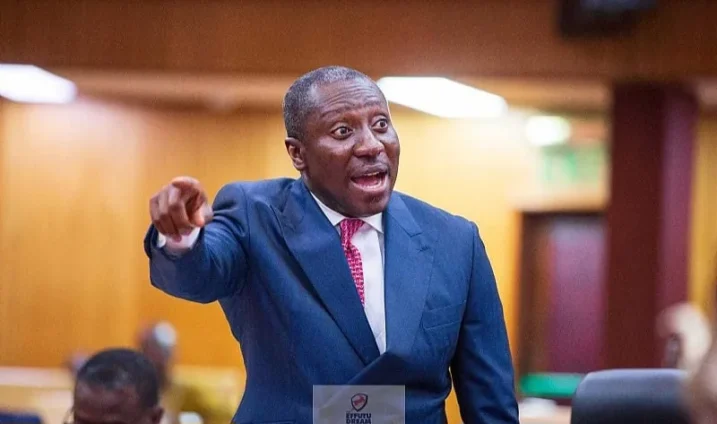
The debate, which touched on historical trauma and economic justice, saw the Minority Leader, Alexander Afenyo-Markin, challenge the current narrative of reparations. He argued that any conversation regarding compensation must confront the uncomfortable reality of domestic participation in the trade.
The Member of Parliament for Effutu cautioned against a one-sided historical account, suggesting that the role of some indigenous people in hunting and selling their own kin cannot be overlooked when discussing who bears the responsibility for compensation.
“When somebody berths a vessel at Cape Coast, and you decide to go to the North, Bono area, get to the Ashanti area, and to the Assin area, and you are chasing your strongest among your own people, then after 100 years, you say, ‘I should be compensated’," Mr Afenyo-Markin stated.
While acknowledging the brutality of the era, he questioned the logic of modern-day demands for financial redress without acknowledging internal culpability: “Who should compensate whom? We maltreated our own and told the whiteman that he should also maltreat our own. The story must be told and must be put in its proper context.”
Despite his stance on reparations, the Minority Leader was firm in his condemnation of the human rights violations of the period: “It is also a fact that the inhumane treatment, the unfortunate humiliation, the marginalisation, injustice and abuse of our ancestors who became victims of this slave trade must be condemned.”
In a swift rebuttal, the Majority Leader and MP for Bawku Central, Mahama Ayariga, defended the necessity of reparations. He argued that the current economic disparity between the Global North and South is a direct result of the capital accumulated through centuries of free, forced labour.
Mr. Ayariga maintained that modern capitalist nations owe their prosperity to the foundations laid by enslaved Africans on Western plantations.
“Many of those countries that have wealth can trace their wealth to slavery. Many of the capitalist countries that have become rich started from plantations that were worked on by slaves. It is the labour of these slaves that helped them to build capital,” Mr Ayariga argued.
He concluded that the demand for compensation is a demand for the fair distribution of that accumulated wealth: “As a result, there is the need to share that wealth in recognition of those who have been the foundation of the creation of that wealth.”
The Parliamentary clash mirrors a broader debate within the African Union and the Caribbean Community (CARICOM), where leaders are increasingly calling for formal apologies and financial settlements from former colonial powers.
This domestic friction comes just as President Mahama and Foreign Minister Samuel Okudzeto Ablakwa have been advocating for "reparatory justice" on the international stage at the United Nations.
Latest Stories
-
GES opens 2026 teacher recruitment for licensed B.Ed graduates
1 minute -
Ghana must value skilled trades, build resilient learners — Ibn Chambas
10 minutes -
Ghana must rethink education around relevance, resilience and responsibility — Ibn Chambas
12 minutes -
Prince Harry faces defamation lawsuit from charity he co-founded
14 minutes -
South Korea deploys thermal cameras to track escaped zoo wolf
16 minutes -
Calls for royal meeting with Epstein survivors grow ahead of US visit
19 minutes -
Ibn Chambas advocates blend of technology and human values in education
21 minutes -
UMA improves healthcare access in Asutifi North with GH₵700k ‘Kim Taylor Legacy’ Walkway
26 minutes -
Scholarships Authority and Fanaka University offer sponsorship for procurement and supply chain studies
29 minutes -
Bisa Kdei drops new single ‘Go N Look’ featuring Medikal
35 minutes -
Benin facing rising terrorism in north as French military presence faces growing criticism
36 minutes -
UEW Public Lecture Series 2026: Education debate ‘about the soul of Ghana’s future’ — Dr Ibn Chambas
37 minutes -
EU fingerprint and photo travel rules come into force from today
1 hour -
Anti-LGBTQ+ Bill: Ghanaians demand expedited passage, not dialogue – Ntim Fordjour to Mahama
1 hour -
EU airline industry warns of fuel shortages if Strait of Hormuz stays closed
1 hour