


Audio By Carbonatix
Bitcoin's eye-watering price surge over the past year is proving too tempting to resist despite fears that cryptocurrencies are a bubble floating towards an inevitable burst.
One group for whom it holds particular appeal is African millennials, writes the BBC's Catherine Byaruhanga from Uganda.
Thirty year-old Peace Akware in Kampala is a convert to the cryptocurrency craze.
Like any self-respecting middle class millennial here her smartphone is always within reach and with it her digital wallet.
"I check my Bitcoin every day and any chance I can get.
Any minute, any hour, anytime, as often as I can," she tells me from the small bungalow she rents on the outskirts of Kampala.
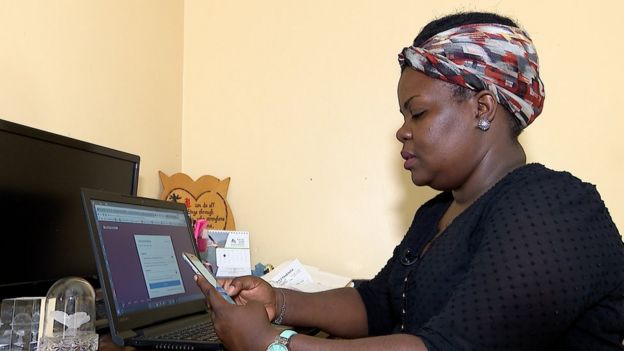
Peace Akware is hopint to buy a car with the money she makes from Bitcoin
Finding a job here is almost like a lottery for graduates so Ugandans often have so-called side hustles.
Peace has sold clothes and even got into money lending. Both failed.
But buying cryptocurrencies like Bitcoin appeals to her because it requires less of her time and there are no upfront costs.
She's bought more than a thousand dollars worth of Bitcoin.
So far the gamble is paying off and overall she is seeing her digital value rise.
"You know there's potential for it growing even further. I would like to buy a car. I would like to buy land. I would like to build with it."
Disrupting remittances
It's not just those hoping to get rich quick who are getting in on the action.
In parts of the continent - especially commercial hubs like Lagos, Nairobi and Johannesburg - a small but growing number of people are finding that cryptocurrencies offer a cheaper solution to an expensive problem - transferring funds across borders.
The technology platform Bitpesa uses Bitcoin as a medium to transfer cash across borders.
It is like a remittance company.
With traditional remittance companies like Western Union, when you transfer money initially it goes from your local currency into dollars then on the other side they receive dollars which are then converted into the local currency.
You lose a lot of money in that conversion.
What Bitpesa does is substitute the dollars with Bitcoin.
It is cheaper, especially when there is a shortage of dollars in the country or restrictions on accessing dollars.
It is also quicker because you don't have to go through long complicated bank approvals.
Elizabeth Rossiello is the CEO of Bitpesa. Even as someone who knows how the finance world works, she gets frustrated with traditional banking.
"I've been in Nairobi for the past month and I had three big banking things to do.
"All three of these operations with three different Kenyan banks were cancelled for different reasons, or had delays or needed additional information so it took almost two-and-a-half weeks per transaction to get them finalised and I'm an expert."
Bitpesa has been operating for four years now and has over 6,000 customers across the continent.
It focuses on big-ticket transfers - for example, paying suppliers in China or employees in another country.
In Nigeria, when the government placed controls on access to the US dollar during a financial crunch, Bitcoin made it much easier for businesses to transfer cash abroad, something that has increased interest in cryptocurrencies in the country.
In places like Zimbabwe, where there has been political and economic instability, Bitcoin has become a place to store value, buy goods and services from abroad and crucially a vehicle for remittances from the diaspora.
Many central banks are sceptical.
The Nigerian, Kenyan and Ugandan central banks have issued warnings about getting involved in the new and unregulated market.
The governor of the Central Bank of Kenya went as far as saying digital currencies are a type of Ponzi scheme because of the way their value often fluctuates.
Bitcoin classes
Martin Serugga, a sharply dressed currency trader in Kampala warns people to be cautious too.
He says unfamiliarity about the new financial instruments could lead to criminals duping customers out of their money.
Nevertheless, he has started weekly classes with over 50 people attending to learn about cryptocurrencies and how to trade them against traditional currencies like the US dollar or British pound.
He says high youth unemployment in Uganda is driving interest in Bitcoin and other products.
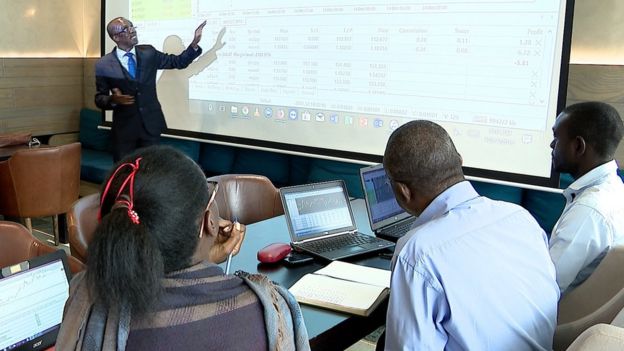
"If you don't have factory jobs and you don't have corporate jobs to serve the thousands of young people coming out of the universities this is an alternative," he says.
Mr Serugga's class is made up of equal numbers of men and women, who are mostly young.
They come to an upmarket coffee shop for their dose of the financial markets.
The bright projector on the screen flashes numbers, graphs and bright colours.
Joachim Ndhokero, a recent economics graduate, is still unemployed.
His father encouraged him to attend the classes to make some money but it has not been easy.
He lost over $900 (£664) in a trade gone wrong.
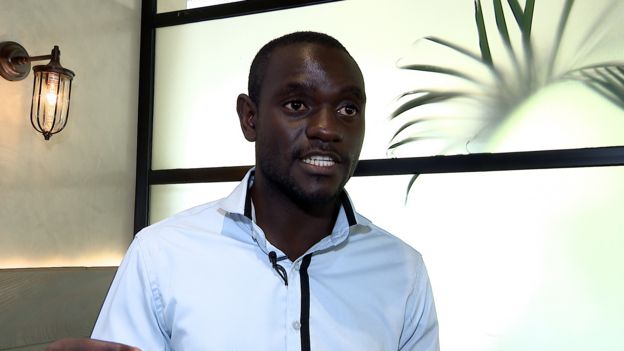
Mr Ndhokero lost everything within two hours
Before he lost all his money, he had just made a $200 profit.
Then he went to the cinema and lost everything.
"I think it was within like two hours.
"That day I learnt that for cryptocurrencies, since they have a bigger spread, they can easily bring in losses. If it's a loss, it's really a loss."
The expert advice here is "use what you can afford to lose".
Blockchain magic
But it's not just the currency aspect of this technology that people think will transform the continent.
Digital security expert Neil Blazevic sees the blockchain technology which underpins cryptocurrencies as the more important innovation.
Blockchain is a form of recording data that cannot be tampered with or hacked. It can be used for documents from contracts drawn up by lawyers to land registries.
He lists many more applications.
"If African developers, entrepreneurs, and governments can leverage blockchain technologies, they may have a shot at tackling some of the continent's most intractable problems of the unbanked masses, digital identities, untrusted voting systems, to name only a few applications," Mr Blazevic explains.
"With the right support for innovation, and collaboration Africa could once again leapfrog over the digital divide and become a market leader just like it did in the move from landline communications infrastructure to the mobile phone ecosystem."
One person who has fully embraced the African mobile phone revolution is Ms Akware.
She continues to watch over her digital wallet.
She knows that the value of Bitcoin could fall at any moment.
If all fails she will probably start again from scratch with a new venture.
For the moment she is holding on, hoping to buy her first car in two months.
Latest Stories
-
Mahama endorses ADB at Kwahu Business Summit
11 minutes -
Every gram will be tracked – Gold Board unveils traceability push to deal with illegally-mined gold
17 minutes -
Analysis: Why the Bank of Ghana sold half its gold reserves
25 minutes -
Buy wrong gold, face prosecution – Gold Board CEO cracks down on rogue dealers
27 minutes -
Africa pushes integrated health agenda ahead of One Health Summit in Lyon
1 hour -
We own the strategy, its not head office decision – GCB MD positions bank as engine of Ghana’s economy
1 hour -
No more waiting for head office – GCB boss pushes Ghana-first banking
2 hours -
Mahama lauds Julius Debrah for shaping Kwahu Business Forum
2 hours -
Why actors beg in difficulty – Patience Ozokwor on Nollywood financial struggles
2 hours -
Any man who apologises to woman deserves to suffer – Brymo
2 hours -
Nigerian artistes no longer put effort into making music – Omah Lay claims
2 hours -
‘I’m now skeptical about going into politics’ – Davido
3 hours -
Nigeria’s Seplat Energy resumes operations as oil workers halt strike action
3 hours -
Nigeria launches manhunt after abductions by bandits in northwest Zamfara
3 hours -
Kenya fuel executives resign as state probes supply chain irregularities
3 hours