


Audio By Carbonatix
The Ebola virus has reared its head again, this time in the Democratic Republic of Congo. While it is impossible to predict exactly where and when the next outbreak will occur, we now know much more about how to prevent a crisis.
The news of an Ebola outbreak in the town of Bikoro in north-west DRC instantly brings to mind the horror of the epidemic that took 11,000 lives and infected 28,000 people in West Africa between 2014 and 2016.
It is a nightmare no-one wants to relive - or should have to.
Since 4 April in the DRC, there have been more than 30 possible cases - involving 18 deaths - although only two incidents have so far been confirmed as Ebola.
So why does Ebola keep coming back and what work is being done to prevent a repeat of the tragedy in West Africa?
Out of control
Ebola can spread rapidly, through contact with even small amounts of bodily fluid of those infected. Its early flu-like symptoms are not always obvious.
Its appearance in Bikoro - a market town close to other local towns, well connected by major rivers and near the national border - is a cause for concern.
This is an area where people connect, trade and travel - an environment ripe for spreading disease.
The West African epidemic of 2014-16 began in a small border village in Guinea, its first victim thought to be a two-year-old boy who died in December 2013.
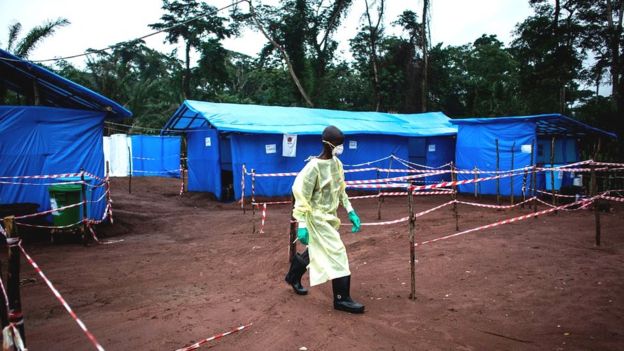 Image copyrightGETTY IMAGES
Image captionThe last Ebola outbreak in the DR Congo was in 2017 and killed four people
The disease spread quickly across Guinea and neighbouring Sierra Leone and Liberia, spiralling out of control when it reached urban centres.
DRC is thousands of miles from the West African countries devastated by that epidemic.
That it should reappear so far away is not in itself a surprise.
The Ebola virus has been traced back to two simultaneous outbreaks in 1976 - 151 people died in the Nzara area, South Sudan, and 280 in the Yambuku area, near the Ebola river, from which the disease takes its name.
This latest outbreak is the ninth in DRC, which has seen all three Ebola outbreaks to have occurred since the 2014-16 epidemic.
In total, there have been 24 recorded outbreaks - in addition to the 2014-16 epidemic - in west and central Africa, including in DRC, Uganda, Sudan and Gabon. The number of deaths has ranged from one to 280.
While we can identify high-risk areas, it is unrealistic to expect that we could ever eradicate this disease and impossible to know when or where the next outbreak will occur.
Fruit bats are thought to be the main host of the disease, but it is also introduced into the human population through close contact with the blood, organs or other bodily fluids of other infected animals. These can include chimpanzees, gorillas, monkeys, antelope and porcupines.
Looking for 'patient zero'
We can, however, stop outbreaks becoming epidemics and we can better protect people.
A swift and well-co-ordinated response can ensure disease is contained early on, so as few people as possible become ill and die.
For example, an outbreak in DRC almost a year ago was quickly contained.
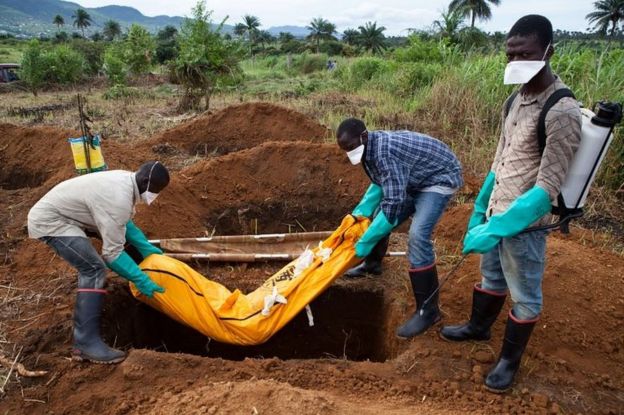 Image copyrightAFP
Image captionThousands died as Ebola hit West Africa in 2014-16
It was in a very remote area in the country's northern region, further from borders and so perhaps less of a risk than the current outbreak.
But an immediate response was still critical and meant the impact was limited to four deaths and four survivors.
Latest Stories
-
President Mahama to attend One Health Summit in France, hold bilateral talks with Macron
33 minutes -
Mahama endorses ADB at Kwahu Business Summit
2 hours -
Every gram will be tracked – Gold Board unveils traceability push to deal with illegally-mined gold
2 hours -
Analysis: Why the Bank of Ghana sold half its gold reserves
2 hours -
Buy wrong gold, face prosecution – Gold Board CEO cracks down on rogue dealers
2 hours -
Africa pushes integrated health agenda ahead of One Health Summit in Lyon
3 hours -
We own the strategy, its not head office decision – GCB MD positions bank as engine of Ghana’s economy
3 hours -
No more waiting for head office – GCB boss pushes Ghana-first banking
3 hours -
Mahama lauds Julius Debrah for shaping Kwahu Business Forum
4 hours -
Why actors beg in difficulty – Patience Ozokwor on Nollywood financial struggles
4 hours -
Any man who apologises to woman deserves to suffer – Brymo
4 hours -
Nigerian artistes no longer put effort into making music – Omah Lay claims
4 hours -
‘I’m now skeptical about going into politics’ – Davido
4 hours -
Nigeria’s Seplat Energy resumes operations as oil workers halt strike action
4 hours -
Nigeria launches manhunt after abductions by bandits in northwest Zamfara
5 hours