

Audio By Carbonatix
One in every two widows who have attempted to access a productive resource, such as farmland or credit, has been asked to provide sexual favours in exchange. This disturbing finding comes from a 2025 study conducted by the Widows and Orphans Movement (WOM) in the Nabdam District of the Upper East Region.
Over the years, national conversations on sexual and gender-based violence have focused largely on children and married women. While that work remains critical, the peculiar and deeply entrenched vulnerabilities of widows have received far less attention. Their abuse is often invisible to stakeholders, policymakers, traditional authorities, and sometimes even to the systems meant to protect them.
Yet invisibility does not mean non-existence.
Over the years, WOM and its partners have contributed to increased awareness that forcing a widow to remarry a surviving male relative of her deceased husband is unlawful and punishable under Ghanaian law. In many communities, families now formally “seek consent” before carrying out such customary practices.
However, a deeper analysis of violence reveals a troubling pattern: when one form of abuse is challenged, it sometimes mutates into another.
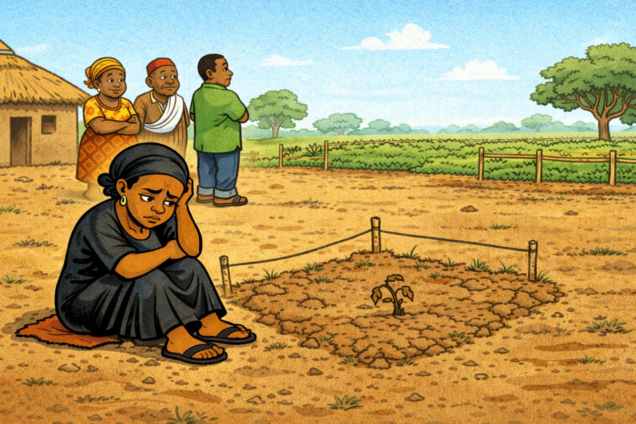
Today, many widows may not be physically forced into remarriage, but declining such arrangements often comes with dire consequences, including but not limited to the following:
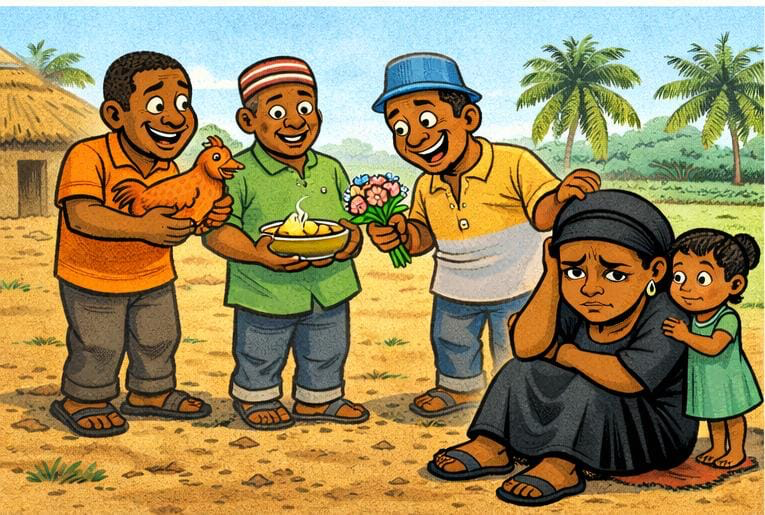
- She loses access to farmland that is crucial to her livelihood.
- She and her children are excluded from communal support systems.
- She may be physically or spiritually intimidated. For example, ritual acts were intended to frighten her off the land.
- She risks being labelled a witch.
- She becomes vulnerable to sexual exploitation by men who may or may not control resources.
The 2025 findings reveal a troubling shift: where forced remarriage is declining due to legal awareness, transactional sexual coercion is rising as a silent substitute.
These abuses are difficult to report and even harder to prove. How does a widow gather evidence that she was denied land because she refused sex? The perpetrator, often a landowner or power holder, can simply claim the land is unavailable. Even when a woman attempts to speak up, she risks retaliation, social isolation, and deeper trauma for herself and her children.
On the surface, it may appear that a widow is simply being “entitled” about land she does not own. But this framing ignores a crucial fact: in most communities, chiefs, clan heads, and tindaanas hold land in trust for the people. They are custodians, not absolute owners. Custodianship carries a moral and fiduciary duty of fairness, justice, and inclusion.
If land is routinely allocated to men under customary systems, what justifies denying access to widows who depend on it for survival? Death should not translate into dispossession. Widowhood should not become a gateway to exploitation.
This is a matter of morality. But it is also a matter of social good. Protecting widows’ land rights strengthens families, improves child welfare, reduces poverty, and enhances community stability. It is in the community’s and nation's collective interest.
The State must stop burying its head in the sand. The problem will not disappear through silence.
The Ministry of Gender, Children and Social Protection must move beyond policy rhetoric to targeted interventions addressing widows’ land access and sexual exploitation. The National House of Chiefs and the Upper East Regional House of Chiefs must place women’s land rights firmly on their agenda.
Concrete actions could include:
- Issuing public directives condemning sexual extortion linked to land allocation.
- Establishing customary dispute-resolution mechanisms that are safe for widows.
- Partnering with civil society to document and monitor abuses.
- Publicly affirming that custodians of stool and skin lands have a duty to ensure equitable access.
Ghana’s much-discussed “reset agenda” cannot exclude widows. A true reset must reach the margins.
We call on traditional leaders, policymakers, and the media to shine sustained light on this issue. Accountability must not wait for another study. The dignity of widows and the future of their children depend on decisive action now.
*****
The writer, Fati Abigail Abdulai, is the Executive Director for the Widows and Orphans Movement
Latest Stories
-
Calls for royal meeting with Epstein survivors grow ahead of US visit
2 minutes -
Ibn Chambas advocates blend of technology and human values in education
3 minutes -
UMA improves healthcare access in Asutifi North with GH₵700k ‘Kim Taylor Legacy’ Walkway
8 minutes -
Scholarships Authority and Fanaka University offer sponsorship for procurement and supply chain studies
12 minutes -
Bisa Kdei drops new single ‘Go N Look’ featuring Medikal
18 minutes -
Benin facing rising terrorism in north as French military presence faces growing criticism
19 minutes -
UEW Public Lecture Series 2026: Education debate ‘about the soul of Ghana’s future’ — Dr Ibn Chambas
20 minutes -
EU fingerprint and photo travel rules come into force from today
47 minutes -
Anti-LGBTQ+ Bill: Ghanaians demand expedited passage, not dialogue – Ntim Fordjour to Mahama
55 minutes -
EU airline industry warns of fuel shortages if Strait of Hormuz stays closed
58 minutes -
White House staff told not to place bets on prediction markets
1 hour -
Auctioneers petition Prez Mahama over ‘interference’ in public auctions
1 hour -
GEA, Mastercard Foundation drive market access for MSMEs at Kwahu Business Forum
1 hour -
Education Ministry begins review of Ghana Library Authority law
1 hour -
Ghana U-15 girls clinch back-to-back CAF Schools titles
1 hour