

Audio By Carbonatix
Wimbledon has made changes to its electronic line calling system to remove the possibility of "human error" after it was accidentally deactivated in a controversial episode on Sunday.
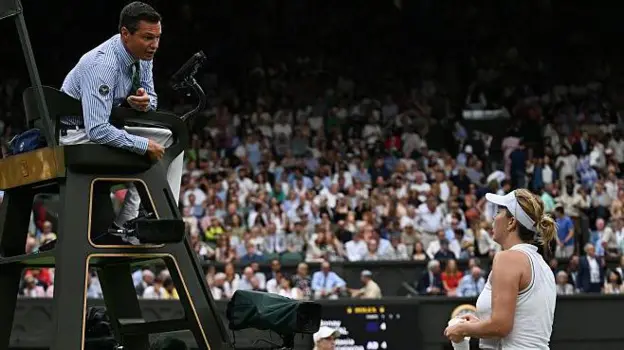
An "operator error" meant the ball-tracking technology was turned off for one game in the fourth-round match between Britain's Sonay Kartal and Russian Anastasia Pavlyuchenkova on Centre Court.
"Following our review, we have now removed the ability for Hawk-Eye operators to manually deactivate the ball tracking," the All England Lawn Tennis Club (AELTC) said in a statement to BBC Sport.
"While the source of the issue was human error, this error cannot now be repeated due to the system changes we have made."
Kartal sent a backhand long when game point down at 4-4, but this was not detected by the line-call system, which instead made two automated calls of "stop".
Umpire Nico Helwerth opted to replay the point - which Kartal won - but was criticised by Pavlyuchenkova and some pundits for not using his authority to overrule and call the ball out.
TV replays had shown the ball was well long and Pavlyuchenkova suggested there should be a video review system, similar to that in football, which would have enabled the umpire to make the call.
The AELTC said Helwerth had "followed the established process", but later added that the issue of video reviews would be "among the matters considered" at the end of the Championships.
Club chief executive Sally Bolton said earlier on Monday that Helwerth was "having a rest day".
"We have rotation of our umpires regularly. A little bit like the players, the umpires also need rest days throughout the tournament," Bolton told BBC Sport.
"He's having a rest day today. He's fine.
"It's really important to say that the umpire followed the protocols in place. He did what he needed to do on court and acted entirely correctly."
Electronic line calling is used at many top-level tournaments, and the US Open and Australian Open also have a video review system.
When there were line judges at Wimbledon, players could challenge the calls by using an electronic review. The new technology is an "enhanced" version of the Hawk-Eye system that was used for player challenges.
There are no challenges under the current system and video replays are not used.
At the moment, replays of points can be shown on the big screens - but they are essentially replays of what the technology has determined and only show that something was a "close call".
But with millions able to see the replays of points on their televisions at home, fans will always wonder why the umpire is not able to use that footage if they are unsure over a call.
Pavlyuchenkova suggested tennis should use video checks like football does "so that we can review the point".
"On such a big event I think it is necessary, since this isn't the first time this has happened," she told BBC Sport on Sunday.
The AELTC said: "We do not have a video review system as part of our suite of officiating tools.
"As we do every year, we will fully review all aspects of The Championships' operation following the event and this will be among the matters considered."
There is a line-calling hub inside Wimbledon's grounds, where 50 operators use 144 screens to monitor the ball-tracking footage from 12 cameras on each court.
'When it's activated, it works extremely well'
Wimbledon's first week of electronic line calling system has been a big topic of discussion.
Some players questioned its accuracy, others said the calls were too quiet - and some simply missed the 147-year-old tradition of smartly dressed officials around the court.
Former British number one and BBC pundit Tim Henman pointed to the accuracy of the technology as a reason why video reviews were not necessary.
"The technology, when it's activated, works extremely well," he said.
"There's another sort of narrative that the line calling has been inaccurate, and that's just absolute rubbish.
"When you're on the court, you're hoping that it goes out, because if it goes out, you win the point.
"But actually, 100 times out of 100 when you go back and look at it, the human - the player - gets it wrong. The technology doesn't."
The AELTC said it continued to have "full confidence in the accuracy of the ball-tracking technology".
In response to player concerns about not hearing the calls sometimes, the club added that it was "adjusting the volume all the time, given the ambient noise on court and around the grounds".
Latest Stories
-
Trump seeks $152m to reopen notorious Alcatraz prison
32 minutes -
Ex-Chelsea player Oscar retires with heart issue
41 minutes -
CA Foundation drives constitutional literacy in Kpone Katamanso municipality
46 minutes -
GPRTU to hold talks with Transport Ministry over rising fuel costs
49 minutes -
CUTS International urges gov’t to halt sachet water price hike pending cost review
54 minutes -
Chief Justice: Efficient Judiciary essential to reducing business costs
57 minutes -
Bayern grabs 99th-minute winner to cap superb fightback
57 minutes -
Ahmed Ibrahim urges Ghanaians to reflect Easter values in nation-building
1 hour -
ECG inefficiencies undermining power supply -Mahama outlines reforms
1 hour -
Lewandowski scores as Barca fight back to defeat Atletico
1 hour -
Lack of private sector consultation undermining economic growth – Jerry Ahmed Shaib
1 hour -
Real Madrid seven points adrift after Muriqi’s late Mallorca winner
1 hour -
Ghana must lead AfCFTA implementation by example – Trade Minister Ofosu-Adjare
1 hour -
Strong Judiciary key to business confidence – Chief Justice Baffoe-Bonnie
1 hour -
Mahama announces 60-Hectare irrigation project to boost tomato production
1 hour