

Audio By Carbonatix
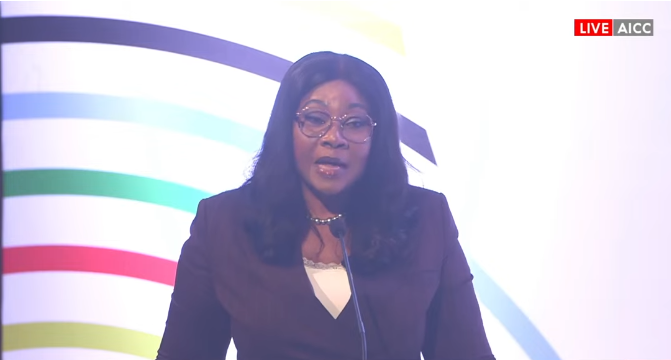
The second Deputy Governor of the Bank of Ghana (BoG), Matilda Asante Asiedu, has warned that Africa’s ambition of building a truly integrated continental market will remain unattainable without efficient, affordable and reliable cross-border payment systems.
Speaking at the 2026 Africa Prosperity Dialogue at the Accra International Conference Centre (AICC) on Wednesday, February 4, Mrs Asiedu said trade agreements alone are not enough to drive economic integration under the African Continental Free Trade Area (AfCFTA), stressing that payment systems are the backbone of trade.
According to her, the absence of secure and dependable mechanisms for transferring value continues to undermine Africa’s trade potential, despite the continent’s vast economic opportunities.
“Without secure, affordable, and reliable means of transferring value, the promise of a truly integrated African market cannot be achieved,” she stated, describing payment systems as strategic trade infrastructure critical to monetary stability, financial integration, and long-term economic transformation.
She noted that cross-border payments within Africa remain among the most expensive and inefficient globally, with transaction costs ranging between 7 and 10 per cent, compared to a global average of about 3 per cent.
She added that settlement times can take anywhere from several days to weeks, further constraining intra-African trade.
Mrs Asiedu, however, pointed to the AfCFTA as a major opportunity to reverse the trend, highlighting that the agreement brings together a market of more than 1.5 billion people with a combined GDP of approximately $2.8 trillion.
She said fully implementing the AfCFTA could potentially double intra-African trade in the medium term, but cautioned that such growth would only materialise if Africa’s payment systems are aligned with its trade ambitions.
Despite existing challenges, the second Deputy BoG Governor expressed optimism, noting that Africa has already demonstrated global leadership in digital finance and innovation.
She cited the continent’s dominance in mobile wallet usage, accounting for more than half of the world’s total, as evidence of its capacity to leverage technology for financial inclusion and economic transformation.
Ghana, she said, stands as a notable example of how digital finance can expand access to financial services and improve livelihoods.
"With more than half of the world's mobile wallets being on the continent, we've shown that with technology we can expand financial inclusion, transform livelihoods, and Ghana stands as a notable example.
"But for digital finance to be fully empowered, and for Africa's single market to explode, inclusion must not just be within borders. It must extend beyond individual country borders," she added.
Latest Stories
-
Health Ministry engages Ga Mantse ahead of Free Primary Healthcare launch
12 minutes -
We can tackle multiple priorities – Sam George defends Anti-LGBTQ Bill push
46 minutes -
Statement: Ghana Chamber of Mines’ Response to Claims in Joe Jackson’s “Ananse Stories about the Economy of Ghana”
48 minutes -
GES opens 2026 teacher recruitment for licensed B.Ed graduates
50 minutes -
Ghana must value skilled trades, build resilient learners — Ibn Chambas
58 minutes -
Ghana must rethink education around relevance, resilience and responsibility — Ibn Chambas
1 hour -
Prince Harry faces defamation lawsuit from charity he co-founded
1 hour -
South Korea deploys thermal cameras to track escaped zoo wolf
1 hour -
Calls for royal meeting with Epstein survivors grow ahead of US visit
1 hour -
Ibn Chambas advocates blend of technology and human values in education
1 hour -
UMA improves healthcare access in Asutifi North with GH₵700k ‘Kim Taylor Legacy’ Walkway
1 hour -
Scholarships Authority and Fanaka University offer sponsorship for procurement and supply chain studies
1 hour -
Bisa Kdei drops new single ‘Go N Look’ featuring Medikal
1 hour -
Benin facing rising terrorism in north as French military presence faces growing criticism
1 hour -
UEW Public Lecture Series 2026: Education debate ‘about the soul of Ghana’s future’ — Dr Ibn Chambas
1 hour