


Audio By Carbonatix
The record for the world's hottest day has tumbled twice in one week, according to the European Climate Change Service.
On Monday the global average surface air temperature reached 17.15C, breaking the record of 17.09C set on Sunday.
It beats the record set in July 2023, and it could break again this week.
Parts of the world are experiencing powerful heatwaves including the Mediterranean, Russia and Canada.
Climate change is driving up global temperatures as greenhouse gas emissions released when humans burn fossil fuels warm the Earth's atmosphere.
"While fluctuations are to be expected, as the climate continues to warm, we are likely to keep seeing records being broken, and each new record is taking us further into uncharted territory," says Prof Rebecca Emerton, a climate scientist at the Copernicus Climate Change Service.
The naturally-occurring climate phenomenon El Niño also added heat to the climate in the first six months of this year but its effects have now waned.
Extreme heat is a serious health hazard, with thousands of deaths attributed to high temperatures every year.
In 2000-2019, almost half a million heat-related deaths around the world occurred each year, according to the World Health Organization.
China has issued heat alerts this week, with central and northwestern areas of the country recording temperatures higher than 40C.
Russia has been battling wildfires in Siberia, and Spain and Greece also endured days of high temperatures.
In the US, more than 40 million people on Tuesday faced dangerous temperatures, and wildfires have broken out in western areas of the country.
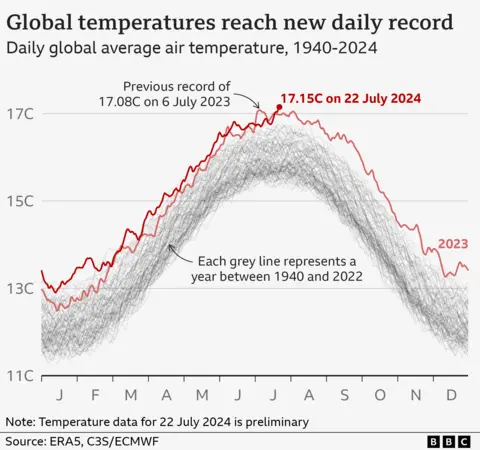
The global average temperature usually peaks in July or August during summer in the northern hemisphere.
The northern hemisphere has large land masses - like the US or Russia - that warm up faster than the oceans that dominate the southern hemisphere.
The recent sudden rise in temperatures is also down to significantly-above-average temperatures over large parts of Antarctica, according to Prof Emerton.
Large swings in temperature are not unusual in Antarctica at this time of year - they also contributed to record temperatures in 2023.
Sea ice in the region is almost as low as this time last year, which also leads to above-average sea temperatures in the Southern Ocean.
“The hottest day record has been broken once again because the world continues to burn huge amounts of oil, gas, and coal," says Friederike Otto, Senior Lecturer in Climate Science at Grantham Institute at Imperial College London.
“Every broken record is a warning that our climate is heating to dangerous levels. These warnings are becoming much more frequent; however, we have all the tools, technology and knowledge to stop things from getting worse – replace fossil fuels with renewable energy and get emissions down to net zero as quickly as possible," she added.
Latest Stories
-
Berekum Chelsea edge Aduana FC in Bono derby to boost survival hopes
3 hours -
‘They can’t control the team’ – Ernest Thompson doubts local coaches for Black Stars role
4 hours -
Ghana-born midfielder Seidu realises ‘dream’ with Atlético Madrid debut
4 hours -
GPL 2025/26: Bubakari strikes late to hand All Blacks vital win over Dreams FC
4 hours -
Fatal crash on Kintampo–Tamale highway claims four lives
4 hours -
2025–26 FA Cup Semifinal Draw: Chelsea, Man City Learn Wembley Opponents
5 hours -
GPL 25/26: Gold Stars back on top after beating Nations FC
5 hours -
GPL 2025/26: Heart of Lions roar back with victory over Vision FC in Kpando
6 hours -
Solomon Agbasi: Hearts keeper in stable condition after concussion
6 hours -
GPL 2025/26: Late Salim Adams penalty earns Medeama draw at Bechem
6 hours -
Hearts pip Young Apostles 1-0 to end 5-game winless run
7 hours -
Boakye Agyarko marks Easter Sunday with a call for Godly leadership ahead of nationwide campaign tour
8 hours -
Pepsi withdraws as UK festival sponsor after Kanye West backlash
8 hours -
Pope Leo calls for global leaders to choose peace in his first Easter Mass
8 hours -
Kpando MP highlights progress on road projects
8 hours