

Audio By Carbonatix
The world's oldest boomerang is older than previously thought, casting new light on the ingenuity of humans living at the time.
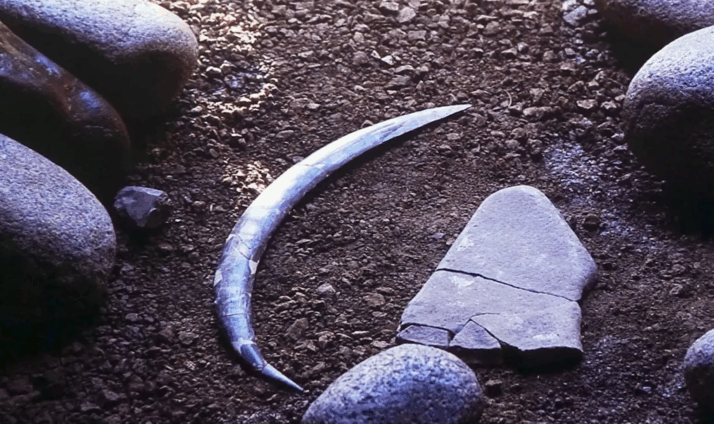
The tool, which was found in a cave in Poland in 1985, is now thought to be 40,000 years old.
Archaeologists say it was fashioned from a mammoth's tusk with an astonishing level of skill.
Researchers worked out from its shape that it would have flown when thrown, but would not have come back to the thrower.
It was probably used in hunting, though it might have had cultural or artistic value, perhaps being used in some kind of ritual.
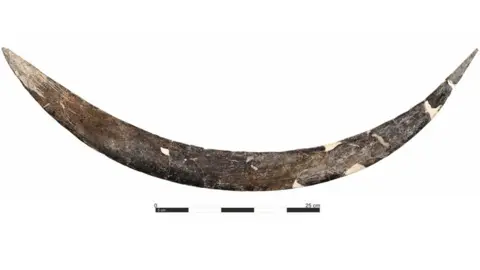
The mammoth ivory boomerang was unearthed in Oblazowa Cave in southern Poland.
It was originally thought to be about 30,000 years old. But new, more reliable radiocarbon dating of human and animal bones found at the site puts the age at between 39,000 and 42,000 years old.
"It's the oldest boomerang in the world, and the only one in the world made of this shape and this long to be found in Poland," said Dr Sahra Talamo of the University of Bologna, Italy.
It gives a "remarkable insight" into human behaviour, she said, particularly how Homo sapiens living as long as 42,000 years ago could shape "such a perfect object" with the knowledge it could be used to hunt animals.
The boomerang is exceptionally well preserved, with score marks suggesting it had been polished and carved for use by a right-handed individual.

Boomerangs are generally associated with Aboriginal culture in Australia.
However, rare finds in the historical record outside Australia suggest they were used across different continents.
The oldest known boomerang from Australia dates to about 10,500 years ago, made from wood. But the oldest images of boomerangs in Australia are rock art paintings 20,000 years old, according to the National Museum of Australia.
A wooden boomerang dating back 7,000 years has been found in Jutland, a peninsula between Denmark and Germany, while fragments of a 2,000-year-old oak boomerang, which does come back, has been found in The Netherlands.
The research by a team of scientists from Poland, Italy, Germany, France, Switzerland and the UK is published in the journal PLOS One.
Latest Stories
-
Trump ‘does not care’ if Iran play at World Cup
34 minutes -
Burna Boy’s associate, Rahman Jago confirms singer converted to Islam
40 minutes -
Amazon says drones damaged three facilities in UAE and Bahrain
50 minutes -
NDC’s Baba Jamal wins Ayawaso East by-election
58 minutes -
Integrity over individuals: Economic Fighters League maintains vote-buying stance in Ayawaso East
60 minutes -
How to follow European football
2 hours -
A new dawn: Formula One charges into an unpredictable 2026
2 hours -
Trump threatens to halt trade with Spain over military base access
2 hours -
Trump says US Navy will protect ships in Middle East ‘if necessary’
2 hours -
Ghana shines in GSMA DNSI and DPRI 2025 report due to E-Levy repeal and tech neutrality
3 hours -
NJA College of Education inducts 379 students amidst infrastructure gains and calls for professional discipline
3 hours -
GJA President, executives join Sammy Gyamfi to observe One-Week memorial of father-in-law
3 hours -
FDA bans mixed alcoholic energy drinks: VAST-Ghana demands ‘Name and Shame’ list for public safety
3 hours -
Police probe deaths of teacher and farmer in Assin Fosu
4 hours -
Gov’t reaffirms commitment to safeguard Ghana’s energy supply amid Middle East crisis
4 hours