

Audio By Carbonatix
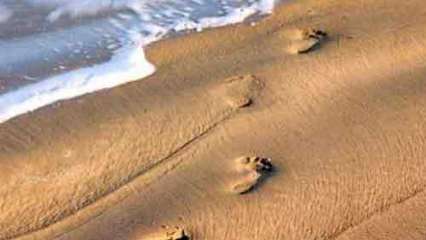
Sets of 120,000-year-old footprints belonging to humans have been discovered in Saudi Arabia.
The set of seven human footprints, found around an ancient dry lake in the northern region of Tabuk, are the earliest evidence of humans in the Arabian peninsula.
Experts believe they are the footprints of at least two people, and say they could help understand the routes taken by humans out of Africa.
The new research suggests "inland routes, following lakes and rivers, may have been particularly important to humans" leaving the continent, according to Mathew Stewart from the Max Planck Institute for Chemical Ecology.
The “first genuine human footprints of Arabia” have been identified and dated to around 120,000 years ago. https://t.co/yQjA2CTDCC
— News from Science (@NewsfromScience) September 18, 2020
He added: "Footprints are a unique form of fossil evidence in that they provide snapshots in time, typically representing a few hours or days, a resolution we tend not to get from other records."Advertisement
The researchers think the footprints belong to modern humans, on the basis of stature and mass inferred from them, rather than Neanderthals, who aren't known to have been in the region at the time.
Mr Stewart said: "We know that humans were visiting this lake at the same time these animals were, and, unusually for the area, there's no stone tools.
"It appears that these people were visiting the lake for water resources and just to forage at the same time as the animals."
Footprints of elephants and other animals were also identified alongside 233 fossils.
Human and animal footprints dating back 120,000 years have been found in the province of Tabuk, north-western Saudi Arabia. https://t.co/TZ4thL6YQO
— Gulf News (@gulf_news) September 17, 2020
Today, the Arabian peninsula consists of vast deserts which would have been uninhabitable for early humans and the animals that they hunted.
However, over the last decade, researchers have found that the area experienced much greener and humid conditions due to natural variation in the climate.
Richard Clark-Wilson, from Royal Holloway, University of London, said: "At certain times in the past, the deserts that dominate the interior of the peninsula transformed into expansive grasslands with permanent freshwater lakes and rivers."
"The presence of large animals such as elephants and hippos, together with open grasslands and large water resources, may have made northern Arabia a particularly attractive place to humans moving between Africa and Eurasia," added Michael Petraglia, from the Max Planck Institute for the Science of Human History.
Latest Stories
-
After more than 14 years at Atletico Madrid, what next for Simeone?
1 hour -
Conquering the World – Building on the foundations laid by Otto Addo
1 hour -
[Watch Live] Obrafour, Kwaw Kese, Tinny, Keche and others thrill fans at Gomoa Easter Carnival
2 hours -
Gomoa Easter Carnival: Experts charge indigenes to own festival to ensure sustainability
3 hours -
Gomoa Easter Carnival: Edem Agbana and Joy Prime fans shower festival with huge endorsements
4 hours -
Gov’t to overhaul free zones into manufacturing hubs for local production – Trade Minister
5 hours -
Ghana losing $2.5bn yearly from raw exports – Trade Minister reveals
5 hours -
Mahama unveils plans for Kwahu Airport, Convention Centre
5 hours -
World’s oldest leader, Paul Biya to get a deputy for first time in 43-year rule
5 hours -
Search for missing US airman continues as Trump threatens ‘hell’ if Iran does not reach deal
6 hours -
US says it has arrested relatives of late Iranian general Qasem Soleimani
6 hours -
La Liga: Real Madrid’s title hopes hang in the balance as Mallorca snatch stoppage-time winner
6 hours -
FA Cup: Haaland hat-trick powers Man City past Liverpool into semi-finals
6 hours -
FA Cup: Chelsea thrash Port Vale to reach Wembley semi-final
6 hours -
Gov’t to boost tourism in coastal communities through infrastructure, sanitation – Vice President
6 hours