

Audio By Carbonatix
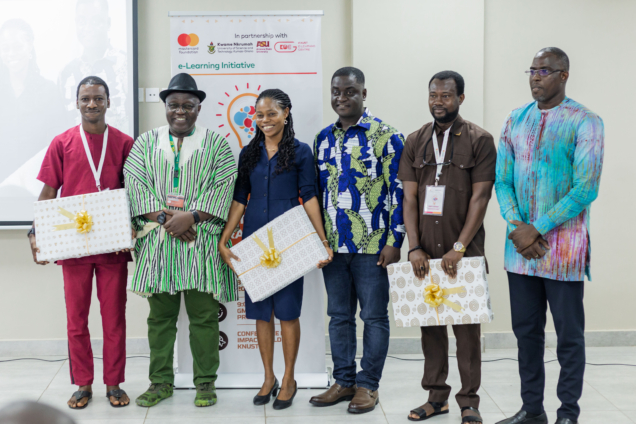
Selected faculty members at the Kwame Nkrumah University of Science and Technology and its affiliate institutions have been equipped with essential skills to utilise the Learning Management System and Blended Learning tools for teaching and learning.
The Mastercard Foundation E-Learning Initiative in partnership with KNUST E-Learning Centre provides quality education through E-Learning technologies.
Over 67 faculty members from various disciplines have been trained in content development for online teaching and learning.
The training is the second phase of the Faculty Capacity Building in E-Learning with a special focus on Instructional Design and Online Pedagogy.
In 2023, about 165 faculty members from KNUST and affiliate institutions were trained at the end of the exercise.
Currently, 67 faculty members have been trained.
Project lead Courage Julius Logah revealed the Mastercard Foundation aims to build robust institutions where post-pandemic teaching can be done beyond a physical classroom.
Speaking at the certificate ceremony he said this will enhance inclusivity in online education.
“Online teaching and learning offer a lot of benefits. If the courses are developed well and the videos and materials are online, it gives the opportunity for self-paced learning. But for this to be possible, both students and faculty have a role to play. Faculty needs to have the requisite skills to develop content so self-paced learning can be done.
“There are different standards and skills required to develop fully online courses. That is the training we are giving to faculty members. We are also hoping to train some students as online learning ambassadors or champions. The idea is to help them better navigate learning management systems using online digital tools to facilitate their studies and in the end, make them effective learners,” he explained
Participants engaged in face-to-face interactions, and practical hands-on sessions, and were taught on leveraging various virtual tools for interaction and collaboration.
Instructional designers facilitated the training which was structured into five modules.
Director of the E-Learning Centre, Professor Eric Appau Asante, is positive that equipping faculty with such skills is necessary for fostering more interactive and effective teaching practices in the digital space.
“The initial two weeks of the training, organized in a blended mode, offered a unique platform for participants to engage in face-to-face interactions, build connections, and immerse themselves in practical, hands-on sessions. The training and content creation period spans from 6th November 2023 to 26th January 2024.
"The first two weeks (6th to 17th November 2023) took the form of both in-person and hands-on sessions. Subsequent weeks were seamlessly transitioned to an online format, leveraging various virtual tools for interaction and collaboration,” he explained.
Samuel Nkansah Darko, a participant from the Department of Molecular Medicine, KNUST, said he has acquired the skill to use the online platform to reach out to his students, making the learner experience friendly.
“Though I pride myself on using online platforms to educate my learners, there are certain things I have added on since my experience began at this workshop. For us lecturers, most of us are oblivious of the challenges some of our students may encounter, especially when they are using online platforms. Through this training, I have learnt that I should have a grasp of my students’ demography to be able to know which platforms and tools will best suit a wide range of students who might have varied challenges with them,” he revealed.
Another participant, Prince Asempa Agyei, from Heritage Christian University College, Amasaman in the Greater Accra Region, added “Before coming for the programme, I have always been taken aback as to how bigger or public universities have managed to move so swiftly and adapted to online learning.
"I got here and realised KNUST has taken education a step further away from the brick-and-mortar classrooms. If I have been given the opportunity to implement a strategy that will help my student and myself, I should grab it,” he said.
Meanwhile, the Chairman of the Mastercard Foundation Scholars Program, Professor Kofi Owusu Daaku, wants participants to impact their various institutions with the skills acquired.,
“E-Learning has come to stay. In the next 5 to 10 years, if you are not E-Learning savvy, you are at a risk of lagging behind,” he advised.
Latest Stories
-
World Bank maintains Ghana’s growth rate forecast at 4.8% in 2026
57 minutes -
Cedi was worst African currency in quarter 2, 2026 – World Bank
1 hour -
AI gains can lift three times as many people out of poverty in Ghana – World Bank
2 hours -
Police arrest suspect over jewellery theft during fire outbreak
4 hours -
EOCO returns Hanan’s £6,700, GH¢2,750 and devices after defence challenge
4 hours -
Opplift Youth Entrepreneurs Summit 2026 equips entrepreneurs with skills, mentorship and support
4 hours -
Rival clubs want range of punishments for Man City
5 hours -
Tear gas in Paris and Marseille as school protests grow across France
5 hours -
Kane inspires England to win over Czech Republic in UEFA Nations League
5 hours -
Finland orders halt to work on two Google data centres
5 hours -
Substitute Merino scores twice as Spain win in Croatia
5 hours -
Ronaldo wants Portugal ‘punishment’ but not retiring
5 hours -
White House defends Trump comment to let Iran ‘take out’ LA and San Diego
5 hours -
Asos confirms hackers sent ‘unauthorised’ notification to app users
5 hours -
US televangelist Jim Bakker, disgraced from sex scandal and fraud, dies at 86
6 hours