


Audio By Carbonatix
The UK government has decided to allow Huawei to continue to in its 5G networks but with restrictions.
The Chinese company will be banned from supplying equipment to "sensitive parts" of the network, known as the core.
In addition, it will only be allowed to account for 35% of the kit in a network's periphery, which includes radio masts.
And it will be excluded from areas near military bases and nuclear sites.
"Huawei is reassured by the UK government's confirmation that we can continue working with our customers to keep the 5G roll-out on track," the firm's UK chief Victor Zhang said in a statement.
"It gives the UK access to world-leading technology and ensures a competitive market."
The Prime Minister had faced pressure from the US and some Conservative MPs to block the Chinese tech giant on the grounds of national security.
But Beijing had warned the UK there could be "substantial" repercussions to other trade and investment plans had the company been banned outright.
The decision has been described as the biggest test of Mr Johnson's post-Brexit strategy to date.
 Huawei has always denied that it would help the Chinese government attack one of its clients. The firm's founder has said he would "shut the company down" rather than aid "any spying activities".
The government has also said the UK needs to "improve the diversity in the supply of equipment" to the country's telecom networks.
At present, beyond Huawei, there are four main providers:
Huawei has always denied that it would help the Chinese government attack one of its clients. The firm's founder has said he would "shut the company down" rather than aid "any spying activities".
The government has also said the UK needs to "improve the diversity in the supply of equipment" to the country's telecom networks.
At present, beyond Huawei, there are four main providers:
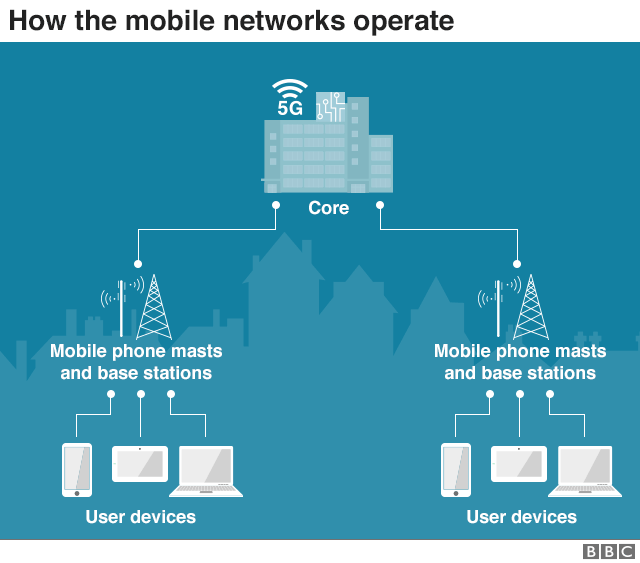 This involves:
- authenticating subscribers so that specific users only get access to the services they have paid for and opted into
- sending a call to the right radio tower to connect to another person's mobile phone
- managing facilities such as call-forwarding and voicemail
- delivering SMS messages and multimedia from one handset to another
- routing data back and forth to third-party services such as apps and websites
- keeping track of usage to calculate an individual's bill
While once, a lot of this involved physical equipment known as routers and switches, in the 5G world much of this kit has been "virtualised". That means software rather than specialised hardware now takes care of much of the job.
This opens the door to new capabilities. But a perceived risk is that it could also open the system up to new kinds of attack.
And even if encryption means the information being handled cannot be spied upon, the fear is that a rogue participant could still crash the network - or at least disrupt the data flow.
This involves:
- authenticating subscribers so that specific users only get access to the services they have paid for and opted into
- sending a call to the right radio tower to connect to another person's mobile phone
- managing facilities such as call-forwarding and voicemail
- delivering SMS messages and multimedia from one handset to another
- routing data back and forth to third-party services such as apps and websites
- keeping track of usage to calculate an individual's bill
While once, a lot of this involved physical equipment known as routers and switches, in the 5G world much of this kit has been "virtualised". That means software rather than specialised hardware now takes care of much of the job.
This opens the door to new capabilities. But a perceived risk is that it could also open the system up to new kinds of attack.
And even if encryption means the information being handled cannot be spied upon, the fear is that a rogue participant could still crash the network - or at least disrupt the data flow.
Huawei has always denied that it would help the Chinese government attack one of its clients. The firm's founder has said he would "shut the company down" rather than aid "any spying activities".
The government has also said the UK needs to "improve the diversity in the supply of equipment" to the country's telecom networks.
At present, beyond Huawei, there are four main providers:
- Nokia - a Finnish company
- Ericsson - a Swedish company
- Samsung - a South Korean company
- ZTE - a Chinese company that the government part-owns
What is the core and why is Huawei being kept out of it?
A mobile phone network's core is sometimes likened to its heart or brain. It is where voice and other data is routed across various sub-networks and computer servers to ensure it gets to its desired destination.
This involves:
- authenticating subscribers so that specific users only get access to the services they have paid for and opted into
- sending a call to the right radio tower to connect to another person's mobile phone
- managing facilities such as call-forwarding and voicemail
- delivering SMS messages and multimedia from one handset to another
- routing data back and forth to third-party services such as apps and websites
- keeping track of usage to calculate an individual's bill
While once, a lot of this involved physical equipment known as routers and switches, in the 5G world much of this kit has been "virtualised". That means software rather than specialised hardware now takes care of much of the job.
This opens the door to new capabilities. But a perceived risk is that it could also open the system up to new kinds of attack.
And even if encryption means the information being handled cannot be spied upon, the fear is that a rogue participant could still crash the network - or at least disrupt the data flow.
How does this differ from the rest of the network?
The core is distinct from the Radio Access Network, which is sometimes referred to as the "periphery". The RAN includes the base stations and antennas used to provide a link between individual mobile devices and the core. Insiders sometimes describe this as the "innovative but dumb" part of the network. That is because new traffic management software and other advances mean more traffic can be handled than before, but the equipment does not actually affect what happens to the data itself beyond transmitting it back and forth. Although it has commonly been reported that Huawei's advantage here is cost, industry insiders say a bigger advantage is that it can currently do the same job as its rivals using fewer antennas. That means fewer planning permission requests need to be approved, and 5G can be rolled out more quickly as a result. The theory is that by limiting Huawei to the RAN but banning it from the core, the authorities make the risk of its involvement more "manageable".So why are the Americans still worried?
The Trump administration's cyber-security chiefs, along with their Australian counterparts, contend that over time the "edge" - the name given to the boundary between the core and periphery - will disappear, as more and more sensitive operations are carried out closer to users. As a result, they claim it will no longer be possible to keep Huawei, and by extension the Chinese state, out of the network's most sensitive areas. UK network operators acknowledge that over time more functions will indeed move from centralised sites to individual exchanges and even base stations themselves. But they are adamant that they can still design the architecture of their networks to keep the core distinct and protected.DISCLAIMER: The Views, Comments, Opinions, Contributions and Statements made by Readers and Contributors on this platform do not necessarily represent the views or policy of Multimedia Group Limited.
DISCLAIMER: The Views, Comments, Opinions, Contributions and Statements made by Readers and Contributors on this platform do not necessarily represent the views or policy of Multimedia Group Limited.
Latest Stories
-
Walter Mosley visits W.E.B. Du Bois Centre in Accra: A New York Secretary’s homecoming story on where Du Bois spent his final years.
49 minutes -
MTN set to deploy 5G services after winning spectrum licenses worth US$202m
3 hours -
NPP national elections: 3,000–4,000 police to handle security, traffic in Kumasi – Karbo
5 hours -
Atta Akyea fumes as Manhyia MP is to spend another night in EOCO custody
6 hours -
SSNIT says La Beach clearance was to protect hotel investments, beaches to remain public
7 hours -
APSU congratulates St Augustine’s College after back-to-back National Investment Quiz wins
7 hours -
Renewed flood intervention at Mallam Junction raises hopes among residents, businesses
7 hours -
St Augustine’s College retain National Investment Quiz title after nail-biting grand finale
7 hours -
Education infrastructure investment will drive Banda’s development – Ahmed Ibrahim
8 hours -
Teacher unions strike: Gov’t presents fresh proposals as talks end inconclusively
8 hours -
51,000 teachers’ promotion arrears to be validated for October payment – Education Minister
9 hours -
Kwabena Boamah appointed Board Chair for Impact Investing Ghana
9 hours -
Striking teacher unions to meet Fair Wages and Salaries Commission on October 6
9 hours -
EOCO working with AG to arraign Nana Baffour Awuah before weekend court
9 hours -
Duraplast reassures customers after fire, announces October 5 reopening
9 hours