

Audio By Carbonatix
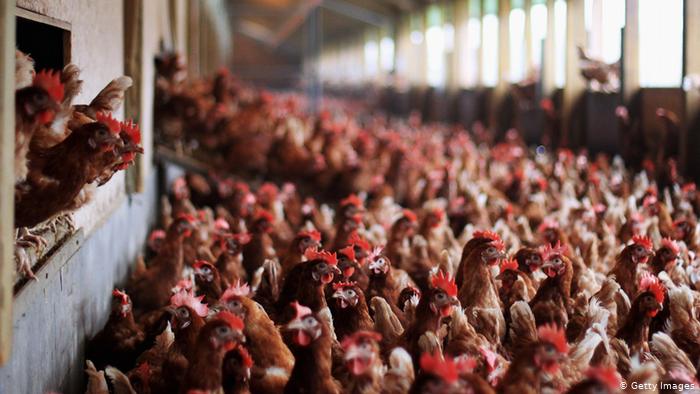
A report by the NGO Germanwatch found high levels of antimicrobial-resistant pathogens in chicken sold by Europe's largest poultry producers. Researchers say the pathogens present a major health risk.
A new report published by the non-governmental organization (NGO) Germanwatch on Tuesday outlines alarming levels of antimicrobial-resistant pathogens in chicken sold by Europe's three largest poultry producers.
The study was carried out on chicken produced by the companies and purchased from Aldi, Lidl and other discount supermarkets across Europe — in France, Germany, Poland, the Netherlands and Spain — as well as from the producers themselves.
Overall, Germanwatch researchers found that the most contaminated chickens were produced by Germany's PHW Group, which butchers roughly 4.5 million chickens per week (59% of samples tested), followed by France's LDC Group (57%) and the Netherlands' Plukon Food Group (36%).
Renders antibiotics useless when you need them
The threat posed by the presence of such pathogens is that humans may become infected while handling or consuming the tainted meat, yet the presence of antimicrobials in the chicken effectively renders antibiotics useless in fighting the infection.
The World Health Organization (WHO) says that critically important antimicrobials (CIA HP) like quinolones are of primary importance to human health. This group of antibiotics is used as a last line of defense when all other antibiotics prove ineffective. The Germanwatch report found traces of CIA HP in 35% of its samples.
The report points out that a lack of uniform EU rules has allowed the grave health risk of antibiotic-resistant pathogens in meat to flourish across Europe. Germanwatch argues that the tests show "the need for an EU-wide ban on CIA HP antibiotics in industrial livestock production."
The group argues that such antibiotics should be reserved for human use only and have no place in food production. Resistance rates in the US, says the NGO, have decreased significantly since the use of quinolones in poultry production was banned in 2005.
There are other ways
The Germanwatch report suggests that beyond banning the use of specific antibiotics, producers should practice more animal-friendly husbandry, thus avoiding the need to administer them in the first place.
The report's authors conclude by advising consumers to "avoid cheap chicken and switch to organic products from smaller, farm-based livestock farms," where few or no traces of antibiotics are to be found.
Latest Stories
-
Djokovic in tears during US Open first-round exit
3 minutes -
Yusuf Sulemana celebrates Gonja unity at Damba festival
3 minutes -
A Minister under watch: Zanetor’s burden of expectations
17 minutes -
Don’t make funding your starting point for green businesses – Entrepreneurs urged
23 minutes -
Skills gap in electric vehicles presents jobs opportunity for Ghanaian youth
29 minutes -
Mahama heads to Serbia for 65th anniversary of Non-Aligned Movement
35 minutes -
National Children’s Day 2026: Child Online Africa calls for child-led digital protection in Ghana
40 minutes -
Manasseh sets the record straight on Northshore Apparel GH; dispels 1D1F claim
41 minutes -
Supreme Court dismisses injunction bid seeking to halt Skytrain trial
45 minutes -
AU Chairperson reaffirms commitment to global African unity
53 minutes -
Air Pollution in Accra is not random; it is a burden carried by the poor
60 minutes -
GEXIM Bank grows loan portfolio to GH¢1.56bn as equity hits GH¢2.1bn in 2025 – SIGA Report
1 hour -
Ghana Shippers’ Authority grows surplus by 272% as assets reach GH¢979.92m
1 hour -
Government designates 13 blocked-out areas for small-scale mining to curb illegal mining
1 hour -
Number of advertised jobs increased significantly in half-year 2026 – BoG
1 hour