

Audio By Carbonatix
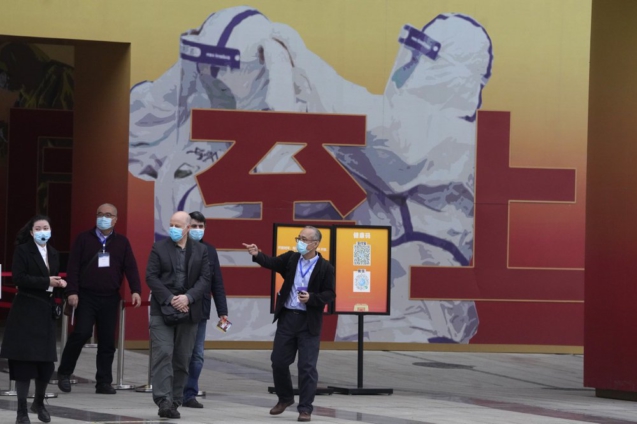
Members of a World Health Organization team investigating the origins of the coronavirus pandemic visited another Wuhan hospital that had treated early COVID-19 patients on their second full day of work Saturday.
Wuhan Jinyintan Hospital was one of the first in the Chinese city to deal with patients in early 2020 suffering from a then-unknown virus and is a key part of the epidemiological history of the disease.
“Just back from visit at Jinyintan hospital, that specialised in infectious diseases and was designated for treatment of the first cases in Wuhan,” Dutch virologist Marion Koopmans said in a post on Twitter. “Stories quite similar to what I have heard from our ICU doctors.”
Zoologist Peter Daszak of the U.S. group EcoHealth Alliance, who is a member of the team, said in a tweet that the visit was an “important opportunity to talk directly” with medics who were fighting the virus at the critical time.
The team’s first face-to-face meetings with Chinese scientists took place on Friday, before the experts who specialize in animal health, virology, food safety and epidemiology visited another early site of the outbreak, the Hubei Integrated Chinese and Western Medicine Hospital.
The Geneva-based WHO said late Thursday on Twitter that its team plans to visit hospitals, markets like the Huanan Seafood Market that was linked to many of the first cases, the Wuhan Institute of Virology, and laboratories at facilities including the Wuhan Center for Disease Control.
“All hypotheses are on the table as the team follows the science in their work to understand the origins of the COVID19 virus,” WHO tweeted. It said the team had already requested “detailed underlying data” and planned to speak with early responders and some of the first patients.
The mission has become politically charged, as China seeks to avoid blame for alleged missteps in its early response to the outbreak.
A single visit by scientists is unlikely to confirm the virus’s origins. Pinning down an outbreak’s animal reservoir is typically an exhaustive endeavor that takes years of research including taking animal samples, genetic analysis and epidemiological studies.
One possibility is that a wildlife poacher might have passed the virus to traders who carried it to Wuhan. The Chinese government has promoted theories, with little evidence, that the outbreak might have started with imports of frozen seafood tainted with the virus, a notion roundly rejected by international scientists and agencies.
A possible focus for investigators is the Wuhan Institute of Virology. One of China’s top virus research labs, it built an archive of genetic information about bat coronaviruses after the 2003 outbreak of SARS, or severe acute respiratory syndrome.
The story has been updated to correct the spelling of Wuhan Jinyintan Hospital.
Soo reported from Hong Kong. Associated Press video journalist Sam McNeil in Beijing contributed to this report.
Latest Stories
-
Education Ministry extends 2026 SHS placement exercise by one week
3 minutes -
Better roads will create sustainable jobs for Ghana’s youth – Joyce Bawah Mogtari
26 minutes -
Kumasi Expressway to cut travel time, boost economic activity – Joyce Bawah Mogtari
31 minutes -
GOIL could hold fuel prices despite $100 crude oil shock – Edward Bawa
32 minutes -
Fitch lifts Ghana’s 2026 current account surplus forecast to 7.8%
33 minutes -
Do not identify yourself as Ziavi Paramount Chief or Queen – Volta Region House of Chiefs warns
43 minutes -
Sosu demands probe into $260m cocaine shipment seized in France
48 minutes -
Mahama to receive cleared Accra-Kumasi Expressway right-of-way today
53 minutes -
Mahama to cut sod for US$1.3bn Sentuo Airport Garden City on Tuesday
58 minutes -
Ghana, China agree to tighten crackdown on illegal mining
1 hour -
Ghana, INTERPOL make strides in crime combat – CID boss
1 hour -
Fuel prices may rise, but GOIL says 30% transport fare hike doesn’t add up
1 hour -
Minority questions why alleged masterminds behind US$350m cocaine haul remain free
1 hour -
AGI calls for workplace training to boost youth employability
1 hour -
Mahama inspects proposed site for Upper West Regional Airport
1 hour