

Audio By Carbonatix
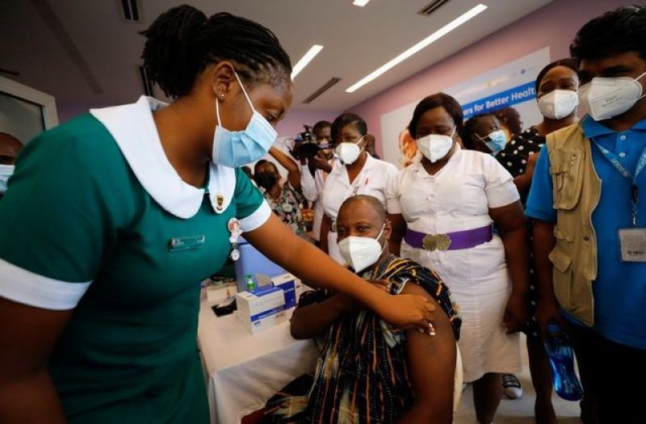
More than 100,000 people have received their second dose of the AstraZeneca Covid-19 vaccine as of Sunday, May 23, data from the Ghana Health Service (GHS) has shown.
The exercise, which began on May 19, is expected to inoculate about 360,000 persons who received their first jab from March 1 to 9, this year.
Dr Franklin Asiedu-Boeko, Director of Public Health at the GHS, said those who received their first jab from March 10, would have their second dose in the next phase.
He told the Ghana News Agency (GNA) in an interview in Accra that 380,000 doses of vaccine had been specifically allocated to those in the first phase and said the exercise would not end on May 26 as stated earlier.
Dr Asiedu-Boeko described the exercise as impressive despite the failure of an online application introduced to make the exercise more effective.
“We are happy about the process so far because, despite complaints about the side effects of the vaccine, people are still interested in getting inoculated," he said.
Dr Asiedu-Boeko assured the public that government was still making efforts to acquire more vaccines to get more people vaccinated.
He assured the public that the plan to vaccinate 20 million Ghanaians before the end of the year was on course.
Dr Asiedu-Boeko reiterated the need for the public to keep adhering to the COVID-19 safety protocols by wearing facemasks, using alcohol-based hand sanitizers, coughing or sneezing into tissues, and washing of hands with soap under running water.
Ghana, on Tuesday, March 2, kicked off its mass COVID-19 vaccination exercise in 42 selected districts in the Greater Accra, Kumasi, and Western regions.
As of Friday, April 30, a total of 849,527 AstraZeneca vaccines had been administered to the public.
Ghana recorded its first case of Covid-19 on March 12, 2020. So far 92,513 cases have been confirmed with 783 deaths. There are 1583 confirmed cases.
The novel coronavirus was first recorded in the Wuhan city of China in December 2019.
Coronaviruses are a large group of viruses that are common among animals. In rare cases, they are what scientists call zoonotic, meaning they can be transmitted from animals to humans, according to the US Centers for Disease Control and Prevention.
It has an incubation period of four to six days and fatal, especially for those with a weakened immune system – the elderly and the very young. It could also result in pneumonia and bronchitis.
Latest Stories
-
2026-27 Premier League: iLOTBET invites bettors and gamers to register on platform and earn up to GH₵10K
1 second -
Minority rejects 3-day timetable for Supreme Court nominees’ vetting
2 minutes -
Man who attacked nun on CCTV in Jerusalem acquitted on grounds of mental health
3 minutes -
Thieves steal Bronze Age artifacts from Spanish museum in four-minute heist
4 minutes -
Photos: Mahama cuts sod for new multi-storey Airport car park, other facilities
6 minutes -
Effective coordination key to fighting galamsey – Zanetor
10 minutes -
Tanzania ruling party expels Vice President after historic resignation
21 minutes -
Gov’t must fund CSIR to develop biological plastic alternatives – Zanetor
22 minutes -
Anger in Upper West over Dr Pelpuo reshuffle; residents demand cabinet slot
25 minutes -
New airport projects to ease congestion, improve passenger experience—Mahama
30 minutes -
Start waste segregation at household level – Zanetor
34 minutes -
Zanetor to resign as Pan-African Parliament Vice-President if approved as minister
34 minutes -
Landfills must have non-permeable bases to prevent groundwater contamination – Zanetor
35 minutes -
‘No Supreme Court seat is vacant’ — Afenyo-Markin objects to rushed Supreme Court nominees’ vetting
39 minutes -
Who’s Millicent Amankwah Yeboah, the 34-year-old first time MP married to Mahama Ayariga?
45 minutes