

Audio By Carbonatix
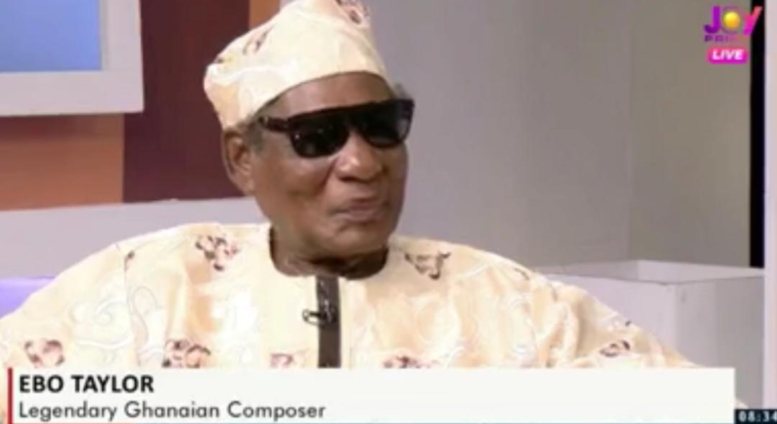
Legendary Ghanaian Composer, Ebo Taylor, has stated that the highlife music genre has not lost its relevance in the Ghanaian music industry.
According to him, the uniqueness of highlife music still holds and will continue to be felt for ages, despite varied opinions shared by many industry players about its gradual fade-out.
“People have the notion that highlife is fading out. Well, I don’t know what it means to people, but highlife has a long way to go; it will go on,” he said.
Speaking in an interview on Prime Morning on the Joy Prime channel Friday, June 18, Ebo Taylor indicated that he sees highlife music represented in the modern age.
“Some of them are sort of represented in modern highlife, I see one or two people,” he emphasised.
His comments follow recent claims by some music players that Ghana is gradually losing its unique highlife music genre.
In his “State of the Industry” address on June 2, 2021, Dancehall Artiste, Shatta Wale argued that “one of the things I find to be a major setback in the Ghana music industry is a unique genre that can be solely attributed to us as a people.”
He entreated his colleague musicians to focus on producing more highlife music, a statement which has since received opposing views.
For Entertainment journalist, Arnold Asamoh Baidoo, the industry’s setback is not the absence of a unique genre.
In his view, it would be beneficial for the industry to solve the many issues it has, which will in turn help to facilitate the growth of the industry.
Mr. Baidoo argued that the call for one genre in the industry is a fallacy, citing Nigeria and South African music industries as having many genres yet filled with global artistes.
“Go to Nigeria; they do not have one genre of music. Sunny Ade took juju music to the Grammys, Femi Kuti; another Grammy-nominated artiste took Afrobeat, Burna Boy who recently won a Grammy took Afrobeats,” he said on United Showbiz.
Life outside music
Ebo Taylor, however, revealed that his life out of music has been rough.
The father of 14 continued that “it is very difficult for a musician to keep a family. There are boys in the family who want to be like the father and they don’t know how to do it.”
Latest Stories
-
Prof. Kwofie urges publishers to use indigenous knowledge systems to decolonise AI
2 hours -
NDC’s two years of economic gains not enough to establish stability – Alan Kyerematen
2 hours -
AFCON 2027Q: Nine new call-up for Cote, The Gambia matches
2 hours -
Ghana’s MSMEs: Burdened by regulation and overtaxed; why the system isn’t working
3 hours -
Patience Akyianu, former Barclays Bank Ghana MD and Hollard Group CEO, reported dead
3 hours -
Mahama pushes ‘health sovereignty’ agenda, says Global South needs control over resources
3 hours -
Mahama: We are reforming systems, fighting corruption and improving use of public funds
3 hours -
Catholic Bishops welcome task force to tackle drug menace, acknowledge inter-agency efforts
3 hours -
Ghana Catholic Bishops demand urgent action against drug trafficking
3 hours -
Tamale: 5 arrested over suspected drug activities; police seize pistols, narcotics
3 hours -
We have lost a great developer – Mankranso residents pay tribute to late DCE
3 hours -
Ghana Law Society sets September 30 for maiden Bar Conference on legal reforms
4 hours -
GPL Week 3: Port City’s Gyetuah bags a brace as 9 outstanding players named NASCO Players of the Match
4 hours -
Visibility without substance is just noise; I don’t seek popularity—Dr Oppong-Fosu
4 hours -
The late Abubakar Sedik was an exceptional DCE – Ashanti Regional Minister
4 hours