

Audio By Carbonatix
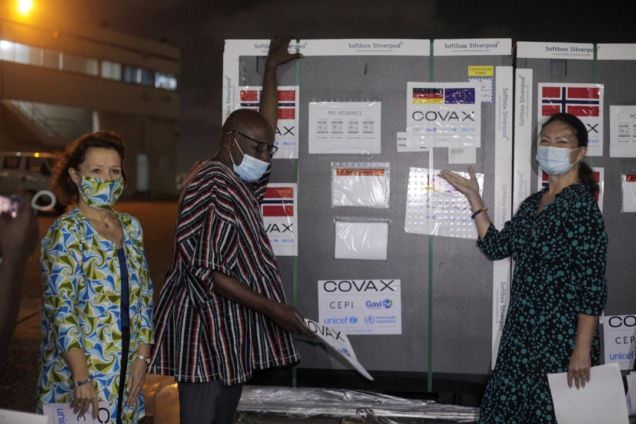
Ghana today received 98,400 doses of Covid-19 Vaccine AstraZeneca that were donated by Norway through the COVAX facility.
COVAX is a global initiative co-led by the Coalition for Epidemic Preparedness Innovations (CEPI), Gavi (the Vaccines Alliance) and the World Health Organization, which works with governments and manufacturers to accelerate the development, production and equitable access to Covid-19 vaccines around the world.
Country President for Africa, AstraZeneca, Barbara Nel, said: "I was delighted to see the arrival of 98,400 doses of the COVID-19 Vaccine AstraZeneca at Kotoka International Airport today.
"This donation from Norway will bolster Ghana’s vaccination programme and is wonderful news for the Ghanaian people.”
“Today’s arrival demonstrates the value of governments, industry and others working together to address our continent’s urgent needs to access vaccines.
"We will continue to advocate for equitable vaccine distribution and for more vaccines to get to Africa this year and into 2022. In this regard, AstraZeneca’s commitment to Africa remains steadfast,” she stated.
AstraZeneca was the first global pharmaceutical company to join COVAX in June 2020, and more than 113 million doses of the Company’s vaccine have been delivered through COVAX to date.
AstraZeneca is committed to supplying the vaccine broadly and equitably worldwide at no profit during the pandemic period.
To date, more than 1 billion doses of Covid-19 Vaccine AstraZeneca have been released for supply to over 170 countries around the world, and approximately two-thirds have gone to low- and lower-middle-income countries.
AstraZeneca is the third biggest supplier of Covid-19 vaccine doses in the world. Since the first international launch in early 2021, the vaccine has helped prevent hundreds of thousands of hospitalisations and helped save tens of thousands of lives.
Covid-19 Vaccine AstraZeneca
The Covid-19 Vaccine AstraZeneca (ChAdOx1-S [Recombinant]), formerly AZD1222, was co-invented by the University of Oxford and its spin-out company, Vaccitech.
It uses a replication-deficient chimpanzee viral vector based on a weakened version of a common cold virus (adenovirus) that causes infections in chimpanzees and contains the genetic material of the SARS-CoV-2 virus spike protein.
After vaccination, the surface spike protein is produced, priming the immune system to attack the SARS-CoV-2 virus if it later infects the body.
Latest Stories
-
Okai Mintah vows to strengthen NDC campaign machinery ahead of 2028
3 minutes -
Mother of four and Jasikan teacher among new Telecel M’ahitti Promo winners
4 minutes -
International Youth Shakers Conclave 2026 set to bring global young leaders to London
5 minutes -
Gov’t is committed to addressing teachers’ conditions of service, deprived-area allowance – Education Minister
9 minutes -
GoldBod’s structure encouraging galamsey – Afenyo-Markin
11 minutes -
Tullow starts selling Jubilee, TEN crude to Ghanaian refineries
13 minutes -
Local Government Service authorises rationalisation, redistribution of staff
16 minutes -
PURC assures consumers of working to ensure quality services in Northern Region
22 minutes -
Ghana develops US$4.28bn water financing framework
29 minutes -
Christian Council calls for protection of mission schools’ religious identity
36 minutes -
Mahama holds discussions with India’s External Affairs Minister
42 minutes -
Even when you cough, they come after you — Abanga accuses Mahama govt of criminalising free speech
48 minutes -
Mahama Ayariga proposes bank-adopted streets as part of stronger public-private partnership
56 minutes -
NPP will impose $500m bail bond on NDC offenders if we return to power — Abanga
1 hour -
Gov’t begins 175-hectare Anunuso irrigation project to raise rice production
1 hour