

Audio By Carbonatix
Acting Head of the Disease Surveillance Department of the Ghana Health Service (GHS), Dennis Laryea says door handles at public places do not necessarily spread Covid-19 infection.
He said some members of the public used their elbows to open doors at public places, insisting that “Don’t worry about touching door handles, what you do after touching the handles is the most important thing.”
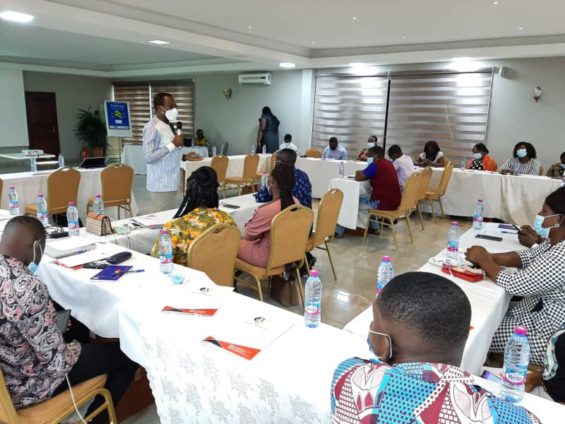
Dr Laryea, who was speaking at the opening of a two-day workshop in Kumasi for some selected journalists across the country, said people could open doors with their hands, but should properly sanitize their hands immediately.
He said most people sanitised their hands, and not their elbows which they inadvertently touched with their hands in the course of the day.
Contrary to some misconception that food could spread Covid-19 infection, the Acting Head of the Disease Surveillance Department emphasized that “There is no evidence that consuming food is associated with Covid-19 infection.
“Sometimes, people focus on the wrong information that when somebody has Covid-19 and sells food to you, you will get Covid-19. Is not eating the food that will give you Covid-19.
“If the person hands over money to you, you take it and don’t sanitise your hands, and touch your face, you might get the infection from that and not eating the food the person gave to you,” Dr Laryea said.
On the use of face masks, he insisted that face masks must be properly worn, and explained that the band on masks, especially the surgical and N95 masks was meant to be shaped around the contour of the nose for proper protection.
On the case count in the country, he said the cumulative cases in the country as of October 21, 2021 stood at 129, 948, discharges were 126, 813 with 1,170 deaths while active cases were 1,965.
Madam Offeibea Baddoo, the Communications Officer of UNICEF said Covid-19 was not peculiar to only adults but also affected children, and encouraged journalists to take interest in child protection issues, especially in the era of Covid-19.
An Official from the Ministry of Information, Mr Kweku Obeng-Adjei who spoke on the impact of Covid-19 pandemic and the role of journalists, reminded them of their responsibility to provide coverage of the pandemic to combat public misconception.
He said “The media must make conscious effort to verify source of information and report objectively the facts rather than opinions.
“Journalists need to collaborate with medical experts to carefully sift through the information to be shared with the public to enable them make informed choices to stay safe,” Mr Obeng-Adjei added.
Latest Stories
-
GNFS contains fire outbreak at Teshie Lekma Road near Lekma Hospital
57 minutes -
Samia Nkrumah rejects the narrative that Ghanaians were happy after Nkrumah’s overthrow
2 hours -
A Mother’s pain: Tribute by Ivan Baidoo’s mother
2 hours -
‘Forgive us for staying away’ — Samia Nkrumah leads family back to Nkroful, pledges to preserve Nkrumah’s legacy
3 hours -
Ernest Nuamah scores twice as Lyon beat Rennes
3 hours -
‘My dear Ivan’ – A father’s tribute to a son tragically killed
3 hours -
GNPC Explorco advances Voltaian Basin drilling preparations with 13.5km access road
3 hours -
Cabinet approves facility manager for Borteyman Sports Complex – Kofi Adams
4 hours -
Sanitation is improving; critics may be ‘living in another world’ – Salaga South MP replies Bekwai MP
4 hours -
Government must do more to tackle sanitation crisis – Bekwai MP
4 hours -
World Cleanup Day: GFF begins sanitation education in local communities
4 hours -
EU Ambassador, IGP discuss stronger cooperation on policing and security
4 hours -
Africa Nations Volleyball Championship: Ghana set up quarterfinal clash with Cameroon after beating Chad
5 hours -
Meet Dr Benjamin Appiah Osei — Ghana’s three-time tourism awards winner
5 hours -
UEFA & CONCACAF demand Fifa pays $10m to all 211 members
5 hours