

Audio By Carbonatix
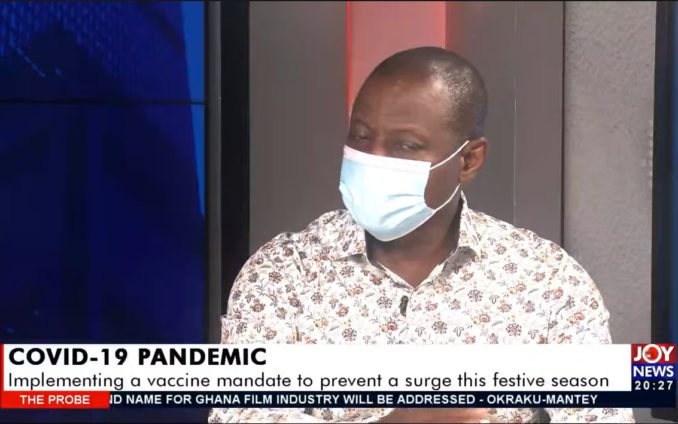
The Director-General of the Ghana Health Service has said that his outfit is committed to ensuring Covid-19 cases are reduced significantly with the new vaccine mandate for international travelers.
According to him, about 75% of people who are tested at the Kotoka international airport are unvaccinated, thus putting the country at risk.
Speaking on The Probe on Sunday, he said that it is essential to put in place measures to reduce the importation of Covid-19 cases to protect the people in the country.
“That airport testing is a very good indicator of what is coming. This year, as of November, we had recorded about 240, and if you saw what happened in January this year, that tells you that we need to be more cautious, about what is coming.”
“We need to do something to reduce the importation by ensuring that the people who are vaccinated are the ones who are coming in and data we are seeing shows that about 75% of all the people who test positive at the airport are unvaccinated,” he added.
This comes after the Ghana Health Service (GHS) made some modifications to its protocols regarding foreign travel through the Kotoka International Airport.
He said the Service deems it necessary based on the resurgence of Covid-19 cases in the wake of the new Omicron variant.
“The current increase in cases together with the detection of the Omicron variant among international arrivals and the expected increase during the festive season, call for urgent actions to prevent a major surge in COVID-19 cases in Ghana,” GHS said in a December 9 statement.
On the back of this, the GHS has directed that all persons 18 years and above arriving in Ghana from December 12 must provide proof of full vaccination.
Meanwhile, “all unvaccinated Ghanaians and residents who are currently outside the country and intend to return within 14 days from the midnight of 12th December, 2021, are exempted.”
On The Probe, Dr. Kuma-Aboagye told the host Emefa Apawu that implementing a new vaccine mandate for international travelers will help significantly reduce the number of imported cases into the country, which could efficiently reduce the risk of a new wave.
He added that even if vaccinated persons test positive, they recover fast or do not get ill, as compared to an unvaccinated person. Hence, vaccines have their own advantages in ensuring cases are reduced.
“That is why we need to push and make sure we also protect our people. We have about 14 million who should be vaccinated who are yet to be, so our policies must be strong in protecting them whiles we continue to vaccinate,” Dr. Kuma-Aboagye added.
Latest Stories
-
GNFS launches 2026/27 National Anti-Bushfire campaign in Atebubu, records 62.8% reduction in bushfire cases
14 minutes -
I’ll vote for a female president; women are less likely to steal from the state – Okyeame Kwame
15 minutes -
More public education needed to stop vote-buying – Savannah Region MP
24 minutes -
Absa Bank commissions new head office, commits to strengthening operations in Ghana
27 minutes -
Republic Bank-JoyNews Habitat Fair clinic: Day 1 ends on positive note as patrons explore housing solutions at Junction Mall
30 minutes -
Vanderpuye: NDC welfare system needed to support former officials, cadres
34 minutes -
Chamber of Mines extends support to Akropong, Mampong Special Schools
37 minutes -
Tumu chiefs, MP back clearance of road corridor for Ghana-Burkina road corridor
42 minutes -
‘Democracy Is Not For Sale’: Monetisation of elections could lead to wrong people entering Parliament – UDS lecturer
53 minutes -
COCOBOD increases cocoa producer price to GH¢42,400 for 2026/27 season
56 minutes -
Atebubu College of Education receives GETFund boost after years of infrastructure neglect
59 minutes -
64 arrested over alleged unlawful possession of firearms at Achimota lounge
1 hour -
Savannah Regional Minister calls for clear rules to distinguish generosity from vote-buying
1 hour -
TOR secures 950,000 barrels of Sankofa crude from GNPC
1 hour -
NAGRAT calls for probe into alleged inflation of School Feeding enrolment figures
1 hour