

Audio By Carbonatix
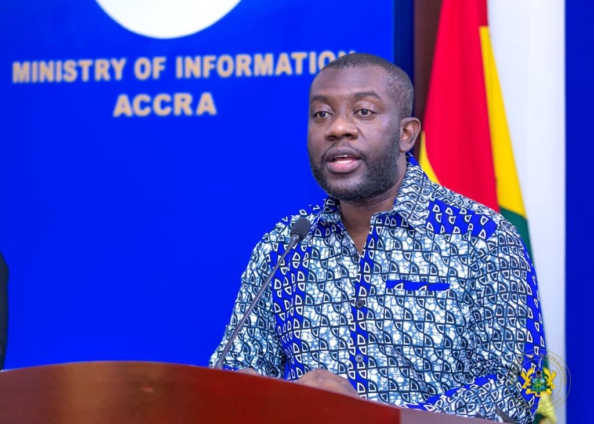
The Minister for Information, Kojo Oppong Nkrumah, says the government is engaging the telecommunications companies to reduce their charges on electronic transactions.
According to him, this reduction is to help the government maintain the 1.75% levy and reduce the impact of the tax on the ordinary Ghanaian.
Speaking to JoyNews’ Kwesi Parker Wilson, Mr. Nkrumah said “today, the Telcos are charging about 2%, so, if the government introduces an additional 1.75% (e-levy) the cumulative effect is 3.75% on the Ghanaian.”
However, in other to ensure Ghanaians are not burdened with the tax, the government has been exploring ways to reduce the cumulative effect, he noted.
Mr. Nkrumah said “the government has been engaging with the Telcos. So if the telcos reduce their 2% and even if the government stays at 1.75% that means the state is assured of the revenues of the 1.75% and the net effect on the Ghanaian will still be low.”
His comment follows weeks-long deliberations on the government’s proposal of e-levy, expected to be charged on electronic transactions.
Since Mr. Ofori-Atta announced the government’s decision to introduce a 1.75% levy on all electronic transactions effective January 1, 2022, stakeholders have been divided on the initiative.
Although the government has argued that it is an innovative way to generate revenue, scores of citizens have expressed varied sentiments on its appropriateness.
Even though others have argued in support of the levy, a section of the populace believe that the 1.75% e-levy is an insensitive tax policy that will deepen the already prevailing hardship in the country.
Meanwhile, the Minority in Parliament, according to Minority Chief Whip, Mohammed Mubarak Muntaka, is unwavering in its position to reject the imposition of the e-levy by government.
However, Mr. Nkrumah believes that the levy will aid the government to mobilise revenue to deliver on its commitment to the Ghanaian people.
He said that the commitment to fulfil the promises made to Ghanaians should not be met with debt only but with domestic revenues.
“Hypothetically, if the telcos reduce [their charge] by say 0.25% and the government still stays at 1.75%, the net effect is 3.5% as against what would have been 3.75% initially,” he stated.
“So these are some of the engagements we have been doing behind the scenes to ensure that government will still get the revenue but in the end, the impact on the Ghanaian is watered down. We are very optimistic that we will get to a positive conclusion.”Mr. Nkrumah added.
Latest Stories
-
UHAS halts semester exams over administrative, logistical issues
2 hours -
ECG announces planned maintenance outages in parts of Ashanti Region
2 hours -
Sexual harassment has no place in educational institutions – Education Ministry
3 hours -
The growing culture of vacation classes in Ghana: Should students rest or continue schoolwork?
3 hours -
E.P. Church secures radio frequency, prepares to launch Bremen Radio
4 hours -
Two dead and hundreds evacuated as twin fires break out on Greek island
4 hours -
EPCG clears over GH¢11.7m in debt as outgoing moderator calls for tighter controls on borrowing
4 hours -
Mövenpick Ambassador Hotel Accra marks 15 years of premium hospitality
4 hours -
T-bills auction: Government exceeds target by 88%, interest rates tumble
5 hours -
Western North: Confusion erupts over NPP chairmanship election results
5 hours -
Bawumia congratulates newly elected NPP regional executives
5 hours -
Bawumia urges unity after NPP regional elections ahead of 2028
6 hours -
Russia says at least seven killed in largest Ukrainian attack of 2026
6 hours -
Ghana and Netherlands sign pact to combat illicit drugs and drug markets
6 hours -
Akandoh warns Boards against interfering in day-to-day management of health institutions
6 hours