

Audio By Carbonatix
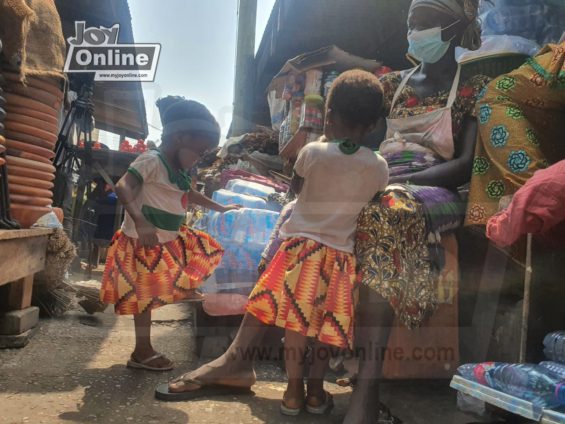
Mma Abiba says she has thick skin. People chide her many times every day, but she says she is not moved. “They say why would I comb the streets of Makola in this scorching sun with these babies strapped to my back”.
Abiba is 37-year-old. She has five children. Two of them, Seyram and Sefakor, aged two years, are twins and her youngest. Her husband is jobless and has been forced out of their home because of hardships. She caters for all five children.
“They say giving birth to twins is a blessing. I know these children see me every day and see my sweat; that is why I would put my life on the line for them. Even if I have ¢10, I will give it to them”.
But why do you have to come into this market to hawk with your twins strapped to your back?
“I cannot look on for my children to die of hunger. I have no choice,” she says.
Abiba travels from Ablekuma - another suburb or Accra, more than 2 hours travel time with public transport- her twins strapped to her back to come and hawk sachet water.
Mma’s story, which was shared on social media, is just one of the thousands of other vulnerable women who brave the odds in Accra’s scorching sun hawking or doing what is called 'Kayayie'.
Aid workers have estimated that up to 50,000 young women are trapped in this life in Ghana. Sights of women using twins as pawns to beg for alms are popular on Accra's streets. However, Mma Adiza is breaking the norm.
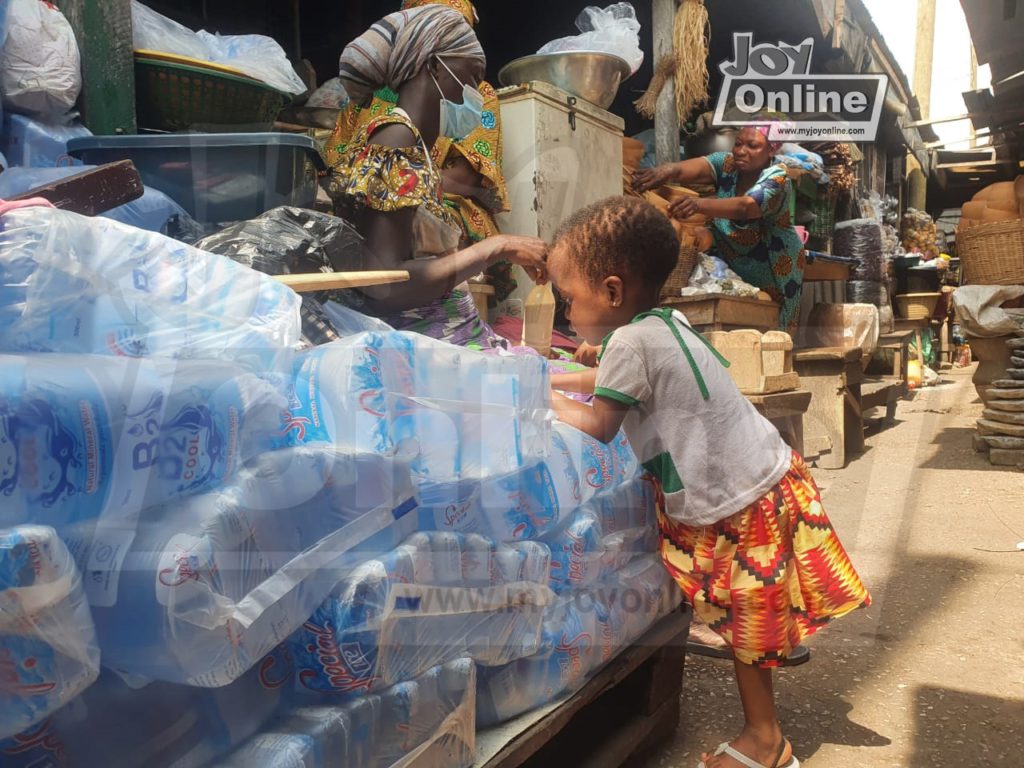
“She used to come here every day with the twins strapped to her back. People would usually pity her and give her money. But at some point she realised that that wasn’t sustainable so she decided to start this pure water business,” says Hajia Fatimatu Ibrahim Adam, who gives her the water to sell.
Fatimatu gives Mma the water to sell on a commission basis, and the more she sells, the more she earns, which requires that she does long hours of walking, combing through the nook and crannies of the bustling Makola market.
“I see so many women suffer like Adiza in this market. It is sometimes painful to look at the struggles women go through. It is not easy to have even one baby at your back, so I can’t imagine the pain of carrying two at the same time,” she says.
Like many of Accra’s thousands of hawkers, Mma doesn’t know her future or that of her children, but she hopes against all odds that someday, somehow, she can get herself and her children off the streets and give them a life better than what she has had her entire life.
“I want my children to do well. When I see the President on TV, I think about my children. The president was once a child like mine, and I believe they too can become president,” she said.
Latest Stories
-
‘October 3 is the only poll I believe in’ – Paul Afoko dismisses NPP chairmanship survey
11 minutes -
Contractors who delay projects risk losing Big Push contracts – Agbodza
13 minutes -
NPA uses Fetu Afahye to educate consumers on petroleum safety
28 minutes -
Roads Minister orders contractors to keep working during official visits
38 minutes -
New 4-year bond attracts GH¢4.46bn in bids
38 minutes -
AIA VIP Lounge to be completed without taxpayer funds – Ablakwa
42 minutes -
KEEA Assembly disburses GH¢267,518 to 94 PPCs in third quarter
45 minutes -
GAF clears 175.6km corridor for Accra-Kumasi Expressway ahead of schedule
50 minutes -
Dr Abu Sakara urges African youth to lead economic freedom
50 minutes -
24-Hour Economy mobilises GH¢1bn for poultry value-chain transformation
56 minutes -
From working in his room to building a business group – Michael Bartlett-Vanderpuye’s journey
57 minutes -
SOEs dividend contributions fall 45.5% in 2025- Report
1 hour -
DBG steps up textile industry financing with new investor-ready projects
1 hour -
GPL: Hearts make emphatic winning start, Debibi United hold Kotoko
1 hour -
Middle East conflict disrupts Ghana’s gold exports as first-half volumes dip
1 hour