

Audio By Carbonatix
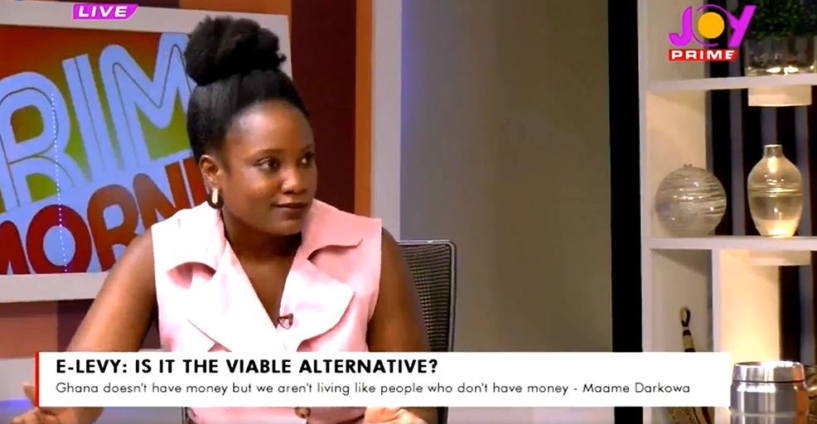
An International Trade Law Expert, Maame Darkowa Awinador-Kanyirige, has bemoaned what she calls the high level of wastefulness in the country and government’s unwillingness to cut down its expenditure.
She emphasised that for many years, the state has been unable to institute pragmatic strategies and solutions to increase revenue generation, a reason the country’s economy has been in crisis.
Speaking in an interview on Prime Morning on Thursday, February 3, she stated unequivocally that “being broke [as a country] is just the reality of what is happening on the bigger scale but the reality also is that we don’t have money but we are also not living like people who don’t have money.”
Maame Awinador-Kanyirige added that the Electronic Transactions Levy (e-levy) may help the state to raise some revenue in the immediate term; however, the best approach is for government to reduce its expenditure and boost local production.
On the e-levy, she noted that “if you look at the estimate of how much to expect, it is not even enough…we have debts to pay.”
“People already pay taxes but the cost of living is high that is why people are not understanding. What GHC100 could do last year, it cannot do this year. What is a ¢1,000 these days? We have to be honest as to what the cost of living is to even be able to say if you’re spending this money a day, you should be able to pay the e-levy.”
“It [e-levy] is not the only way but the thing is that it’s going to require heavy adjustments; are we willing to make? If we go to the IMF, the first thing the IMF will do or say is ‘cut expenditure’ – the very thing that we don’t want to do. We are spending on things that are not necessities for people who are where we are at,” she added.
Meanwhile, a Professor of Economics and Finance, Prof. Godfred Bokpin, has blamed the government for its failure to address the inefficiencies and low compliance with existing tax policies over the years.
He says government’s inability to block the leakages in tax revenues is what has rendered the economy weak, a development he warns could deprive the state of its objective to remain competitive on the digital economy market.
“You want to look at the overall drive of the country and you realise that imposing this tax is more or less to reverse or redirect the direction of this economy and you’re going to lose massively in terms of competitiveness in the digital economy,” he spoke on the same show.
Latest Stories
-
Anwelle Foundation launched in Jirapa to tackle poverty, youth unemployment
15 minutes -
Joy Sports Editor Fentuo Tahiru Fentuo to moderate inaugural Music Meets Football Summit in Zambia
20 minutes -
Court premises too volatile for Baffour Awuah’s attempted arrest by EOCO – Inusah Fuseini
27 minutes -
Drug bust: Under no circumstances will NACOC leadership be compromised – Twum-Barimah
28 minutes -
VIDEO: EOCO’s attempted arrest of Baffour Awuah was flawed beyond saving – Law Lecturer
28 minutes -
Genuine Ghanaian exporters may face heightened foreign inspections over drug busts – Lawyer
28 minutes -
Stakeholders demand action against foreign-led illegal mining in Ahafo Region
2 hours -
Ghana handed tricky draw at 2026 Amputee World Cup
2 hours -
2024 Nyankpala election violence: Youth group petitions authorities over slow probe
2 hours -
Ghana, UNICEF strengthen partnership to advance child protection
3 hours -
Day Two of 3rd Republic Bank-JoyNews Habitat Fair ends with great homeownership offers and financing solutions
3 hours -
Guinness Ghana DJ Awards 2026 Pub Fest celebrates Ghana’s DJ culture as Accra turns up the energy
3 hours -
10th woman found dead in South Africa’s string of killings
3 hours -
French Embassy trains Ghana Police CTU in counter-terrorism operations
4 hours -
UPSA uncovers mass results manipulation involving 178 students, over 500 results compromised
4 hours