

Audio By Carbonatix
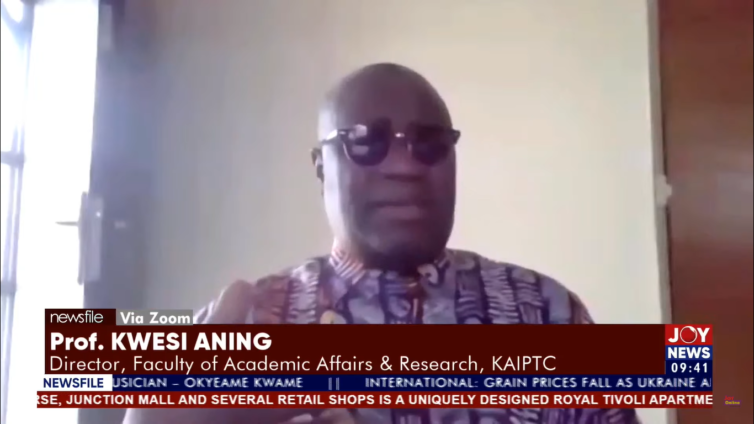
Director of the Faculty of Academic Affairs and Research at the Kofi Annan International Peacekeeping Training Centre (KAIPTC) has likened corruption to a glue that binds the country together.
Prof. Emmanuel Kwesi Aning said without corruption, the "edifice called Ghana Enterprise will collapse."
His comment comes after the Ghana Statistical Service (GSS) unearthed the extent of corruption in the country in its latest survey.
Titled ‘2021 Ghana Integrity of Public Services Survey’, GSS revealed that Ghana lost ¢5 billion in cash through the payment of bribes to both private and public officials in 2021 in order to access basic services.
The latest report also indicated that 26.7% of public sector officials were engaged in bribery acts, whilst 9.1% were officials from the private sector.
Although Prof Aning said he is not surprised by the findings, he decried the extent of the canker.
Speaking on JoyNews’ Newsfile on Saturday, the security analyst noted that corruption creates a serious threat to national security.
"And I think the critical aspect is that this is a problem; we’ve quantified it and we have brought it and we’ve brought it down to developmental terms. How many schools, roads, clinics can we build with this money.
“Also the fact that, this cuts across different shades of individuals and institutions. So yes, Corruption creates insecurity and creates a sense of social injustice. It creates inequality in societies," he noted.
Prof Aning further commended the Statistical Service for providing such a scientific data for reference as far as graft is concerned.
“I think this report quantifies in a very practical commonsensical manner what corruption means and what bribery means. The extent of the problem, the category or categories of individuals and institutions involved.
“So for me, this is one of the few times that a state agent is bold enough to scientifically prove this allegation that people have been engaging in,” he noted.
Prevalence of bribery in Ghana
The report also showed that the prevalence of bribery in Ghana is 26.7%, meaning one out of four people who had contact with a public official in the 12 months prior to the survey, had been asked to pay a bribe by a public official, or asked to pay bribe but refused to do so.
The report also showed that the prevalence of bribery in Ghana is 26.7%, meaning one out of four people who had contact with a public official in the 12 months prior to the survey, had been asked to pay a bribe by a public official, or asked to pay bribe but refused to do so.
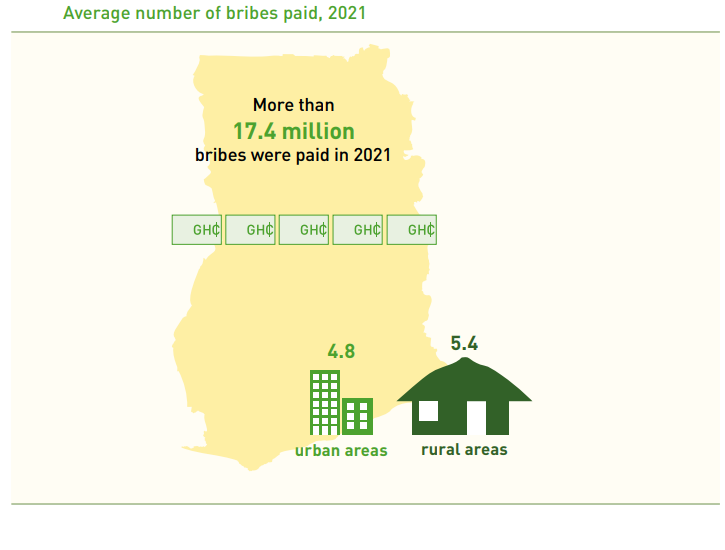
The survey revealed that, on average, there is no difference in the prevalence of bribery in rural and urban areas of Ghana. There are, however, sizable variations across the 16 regions of the country.
On regional basis, the prevalence of bribery in the Bono East, Savannah and Volta regions, for example, were substantially lower than the national rate. The three regions recorded corruption cases of 11.8%, 14.5% and 19.1% respectively.
In the Western North, Ahafo and North East regions, the corrupt cases reported were substantially higher, at 53.4%, 47.0% and 41.9% respectively.
Latest Stories
-
Judiciary urged to expedite corruption cases
9 minutes -
Adenta-Accra travel time improves significantly under contra-flow – GAPTE
13 minutes -
SEND-Ghana, UCC students march for mandatory food warning labels
20 minutes -
Auditor-General vows tough surcharges, unveils tracker, AI audits
26 minutes -
Government clarifies Interior Minister’s ‘involvement’ comment in drug probe
57 minutes -
Mahama orders security agencies to make Ghana’s ports ‘ironclad’ against drug trafficking
1 hour -
Government admits turf war among security agencies is undermining port security
2 hours -
Government rejects ‘Cocaine Coast’ label, says drug busts show security agencies are working
2 hours -
Banks NPL ratio of 16.1% is still too high – S&P
2 hours -
US death row inmate Christa Pike taken to hospital after surviving two lethal injections, says lawyer
2 hours -
Japan raises residency fee for foreign nationals by twenty-fold
2 hours -
Nollywood actor CJay Nwoks dies in Lagos hospital
3 hours -
Guidelines, regulations of cryptocurrency in Ghana fall short of comprehensive oversight – IMF
3 hours -
Don’t stand and just criticise, propose solutions – RMD urges Nigerians
3 hours -
I didn’t want to be in the spotlight – Tems
3 hours