

Audio By Carbonatix
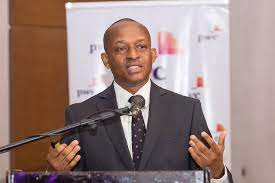
Accounting and auditing firm, PwC, has reminded the government to review the rate for the Electronic Transaction Levy (E-levy) to not more than 0.75%.
It also wants the implementation of the levy to be reviewed.
This according to the firm, is due to the downward adjustment of the e-levy revenue target by over 91%, from ₵6.9 billion to ₵0.6 billion.
"The downward revision of the e-levy revenue target by over 91% (from ₵6.9 billion to ₵0.6 billion) indicates the need for a review of the policy and its implementation. We wish to remind government of our call for the e-levy rate to not exceed the rates typically charged by resident platform operators of not more than 0.75%."
In its commentary on the 2022 Mid-Year Budget, PwC said while the benefit of increased global oil prices has helped to support the budget in the short term, the fundamental and perennial challenge around revenue mobilisation, and the need to significantly improve the country’s tax to Gross Domestic Product (GDP) ratio persists and still needs to be confronted.
“This, in our view, continues to be the driver for the additional revenue measures, which government has indicated it will pursue in the second half of 2022”.
The previous revenue and grants target of GH₵100.5 billion for 2022 has been revised to GH₵96.8 billion, a 3.7% reduction. This still translates into a growth target of 37% relative to the 2021 performance (GH₵70.9 billion).
PwC said the revised target is expected to be achieved mainly as a result of the windfall in revenue from oil production and exports, a result of increased global oil prices. This it believes will help to significantly offset shortfalls from other revenue sources, particularly tax revenues.
It is also expected to enhance government’s fiscal consolidation programme.
Given that government’s engagement with the International Monetary Fund has only just commenced, PwC, said it is too early to expect a detailed plan for the recovery of the economy in the medium term.
“It is therefore not surprising that the mid-year review does not provide such a plan; however, the review makes it clear that any eventual agreement with the IMF will be based on an Enhanced Domestic programme that will complement the previously announced Ghana COVID-19 Alleviation and Revitalisation of Enterprises Support (CARES) “Obaatan Pa” programme”.
Cedi depreciation pushes Ghana’s debt high
Ghana’s total debt stood at GH₵393.5 billion, representing 78.3% of GDP as of 30th June, 2022, with about 51.7% of this position being financed by external debt.
Despite the country’s debt stock in dollar terms reducing by 7.2% from $58.6 billion as of June 2021 to US$54.4 billion as of June 2022, PwC said the significant depreciation of the cedi by about 16% over the period has contributed significantly to the rising debt position.
Overall, PwC said the mid-year review indicates clearly where the current challenges lie for the Ghanaian economy.
“These are not new challenges - revenue generation continues to require additional impetus as does an overall rebalancing of our expenditure prolife, which has resulted in the current debt burden. For 2022, thanks mainly to increased global oil prices, the measures and revised budgets outlined in the mid-year review look achievable.”
“The real question is what the medium to long term plan is to deal with the fundamental challenges we need to confront. The Ghana CARES programme sets out government’s plan for the transformation of the economy. An Enhanced Domestic Programme, which we understand that government is currently developing, will complement the Ghana CARES Programme. These will form the basis of discussion and ultimately, agreement with the IMF on a medium-term road map and the IMF’s support to Ghana’s economy”, it added.
“While we await the details of the plan and the outcome of discussions with the IMF, we encourage government to maintain its resolve on the implementation of the expenditure cuts that it has identified and to the implementations of the revenue measures that have been approved as part of the 2022 Budget”, it concluded.
Latest Stories
-
Stakeholders demand action against foreign-led illegal mining in Ahafo Region
20 minutes -
Ghana handed tricky draw at 2026 Amputee World Cup
28 minutes -
2024 Nyankpala election violence: Youth group petitions authorities over slow probe
32 minutes -
Ghana, UNICEF strengthen partnership to advance child protection
55 minutes -
Day Two of 3rd Republic Bank-JoyNews Habitat Fair ends with great homeownership offers and financing solutions
59 minutes -
Guinness Ghana DJ Awards 2026 Pub Fest celebrates Ghana’s DJ culture as Accra turns up the energy
1 hour -
10th woman found dead in South Africa’s string of killings
1 hour -
French Embassy trains Ghana Police CTU in counter-terrorism operations
2 hours -
UPSA uncovers mass results manipulation involving 178 students, over 500 results compromised
2 hours -
ECG announces planned power outages in parts of Tema from Sept. 29 to October 1
3 hours -
Sylvester Mensah urges Latenu FM to promote trade, export opportunities in Ga
3 hours -
Ga language under threat of decline as children shy away from speaking it – Sylvester Mensah
3 hours -
‘Let every Ga child you raise know the Ga language and story’ – Sylvester Mensah
3 hours -
‘We are not deterred’ – Ablakwa responds to backlash over South Africa evacuation
3 hours -
Day Two: Republic Bank-JoyNews Habitat Fair gains momentum at Junction Mall
4 hours