

Audio By Carbonatix
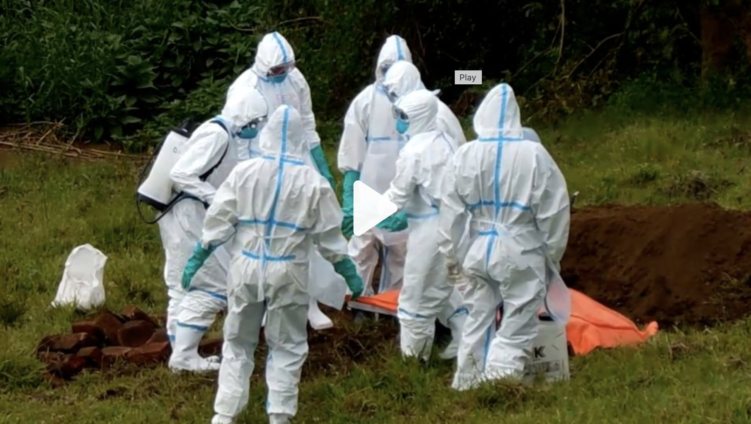
Ugandan President Yoweri Museveni has declared an immediate three-week lockdown in two high-risk districts as the country battles a rise in Ebola infections.
All movement in and out of the Mubende and Kassanda districts will be halted, Museveni said in a televised address on Saturday – although cargo trucks will be allowed to enter and leave the areas.
Curfews will also be imposed. Places of worship, bars, gyms, saunas and other entertainment venues will close but schools will remain open, he added.
“Given the gravity of the problem and to prevent further spread and protect lives and livelihoods, the government is taking extra measures that require action from all of us,” Museveni said.
The Ugandan health ministry will also increase contact tracing and assistance to local health facilities.
Ebola is a rare but deadly disease. It spreads through direct contact with body fluids and is not transmitted through airborne viral particles, the US Centers for Disease Control and Prevention (CDC) says.
It has no cure, and there is no approved vaccine, although there is a concerted effort to create one.
Speaking at a media briefing earlier this month, World Health Organisation Director-General Tedros Adhanom Ghebreyesus said the vaccines used successfully to curb recent Ebola outbreaks in the Democratic Republic of the Congo are not effective against the type of Ebola virus now circulating in Uganda.
“However, several vaccines are in various stages of development against this virus, two of which could begin clinical trials in Uganda in the coming weeks, pending regulatory and ethics approvals from the Ugandan government,” said Tedros.
Uganda has experienced four Ebola outbreaks. The deadliest left more than 200 people dead in 2000.
Museveni declared an Ebola outbreak in September after a case of the relatively rare Sudan strain was confirmed and cases began to rise across districts.
The latest outbreak has so far killed 29 amid 63 recorded cases.
According to the CDC, a person infected with Ebola “is not contagious until symptoms appear (including fever, headache, muscle and joint pain, fatigue, loss of appetite, gastrointestinal symptoms, and unexplained bleeding).”
The virus spreads through direct contact with body fluids and is not transmitted through airborne viral particles, the CDC says.
Latest Stories
-
From Kantamanto to the TEDx Stage: How waste became innovation
5 seconds -
MMDCEs charged to ensure Landing Beach Committees do not sell premix fuel beyond approved prices
52 minutes -
The Inconvenient Truth: Democracy does not fail in The Chamber, it fails in the Committee Room
1 hour -
There is absolutely nothing wrong with what the Chief Justice said
1 hour -
App launched to help Ghanaians verify prospective partners’ marital status before marriage
2 hours -
‘I have gone through a lot these past 2 days’ – A-Plus reveals after New Winneba violence
2 hours -
DBG takes GH¢2.5bn development funding beyond Accra as it pushes industrial transformation
2 hours -
Vice President Jane Opoku-Agyemang calls for accurate teaching of slavery history in schools
2 hours -
Ghana has duty to preserve slave-trade sites and tell their full story – Vice President
2 hours -
West Africa can be self-sufficient in rice production – John Dumelo
2 hours -
Over 300 arrested over extremist recruitment attempts along northern border – Agalga
2 hours -
Housing Minister seeks shorter construction period for Kaneshie–First Light Road works
2 hours -
Ghana cannot afford complacency over extremist threats – Agalga
2 hours -
African leaders call for decisive investments to deliver a more sustainable food system for the continent
2 hours -
Ahmed Ibrahim orders traffic plan ahead of Pamprom Junction road closure
2 hours