


Audio By Carbonatix
Manual planting is one of the potential hindrances to boosting agricultural productivity in Ghana.
These old techniques of planting are time-consuming, labour-intensive and contribute to the observed crop failures.
The situation calls for the adoption of more scientific and mechanistic farm practices to ensure sustainable food production.
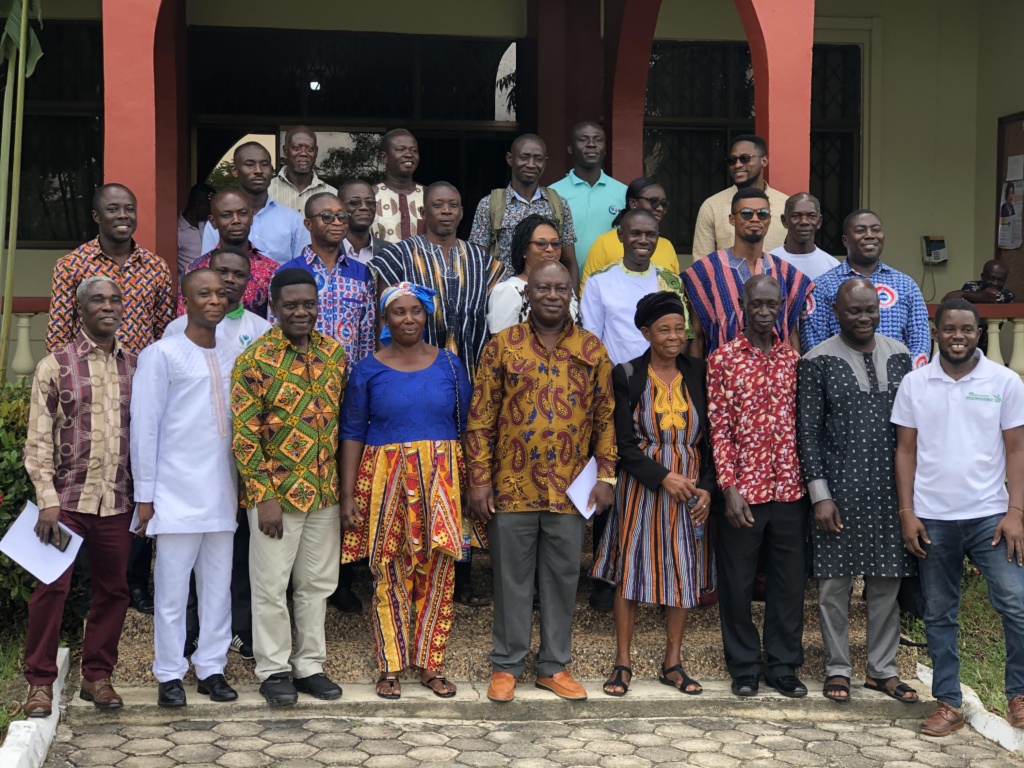
Over 20 multi-purpose roller planters have been distributed to farmers across 10 communities in the Ashanti, Bono and Bono East Regions.
The donated machines will mechanise agricultural activities, save farmers' sowing period and increase yield returns.
The gesture forms part of the PAIRED project by the West and Central African Council for Agricultural Research and Development (CORAF) and CSIR-Crops Research Institute.
It is part of the strategies of the institute to heighten farming technology dissemination among agriculturalists.
It also aims to pave the way for the stabilization of the Ghanaian currency for economic and agricultural growth and development.
The machine was invented by the crop doctor Micromec agricultural company.
Director of the CSIR-CRI, Prof. Moses Mochiah explains the technology will enable farmers to plant more seeds within a short time.
Given that, he urged the youth to engage in farming, as many plans have been put in place to assist them.
“We are giving this technology to farmers, those who are into maize planting and maize seed growers. We want to donate this multi-purpose roller planting, to reduce drudgery. Also, manual planting is labour-intensive, and the costs involved are enormous. What we have done today is to ease the way for farmers to go through.
“All things being equal, farmers would use only hours on average to plant on one acre of land. The farmers also say on the same piece of land, it would take two or three days,” he said.
“We want to encourage the youth to go into farming. We have realised that farming has to be attractive before they can venture. Going forward we have instituted a sustainability plan, so that they will not be found wanting,” he added.
Mary Alamisi from Nkronsa in the Bono East region says that technology will ensure correct planting and germination periods.
“You may take two or three days to plant one acre, with this we can use it one day. It will reduce the cost and you will get it to the plant at the right time. If you fail to plant after rainfall, it will dry up so planting and germination will not be uniform. With this you can plant at the appropriate time and you would have the correct germination too,” she said.
From the Mampong municipality, the farmer believes that the machine will ensure accurate planting measurements and cut cost of labour.
“Now I am a seed grower. With the machine, I would be more efficient. I am old and I can't even bend to plant seeds properly,” he said.
Latest Stories
-
Stonebwoy makes history at OVO Arena Wembley with monumental BHIM Festival
24 minutes -
Qatar denies capturing three Iranian pilots after downing fighter jets
35 minutes -
Tano North chiefs petition Mahama over galamsey destruction in River Tano
59 minutes -
Kalpohin SHS, NOBISCO qualify to represent Northern Region at National Public Speaking Competition
1 hour -
Missing records of illegal gold purchases in Ghana raise concern – Duncan-Williams
1 hour -
Duncan-Williams warns of powerful interests targeting GoldBod
2 hours -
We need to pray for GoldBod – Duncan-Williams
2 hours -
Strong favourites or tougher task – will Arsenal defend their title?
3 hours -
Passengers escape death as VIP travelling from Kumasi to Sunyani catches fire
3 hours -
Ariana Grande leaves problems at home as her tour hits the UK
3 hours -
Multiple suspects at large after five shot at Virginia State University, police say
3 hours -
Three killed as Russia launches fresh aerial attacks across Ukraine
3 hours -
Boxing: John Laryea disqualified in WBA Featherweight title eliminator
4 hours -
Hawaii battles strong winds and rain as Hurricane Lala threat looms
4 hours -
Twelve killed as Polish bus veers off Hungarian motorway
5 hours