

Audio By Carbonatix
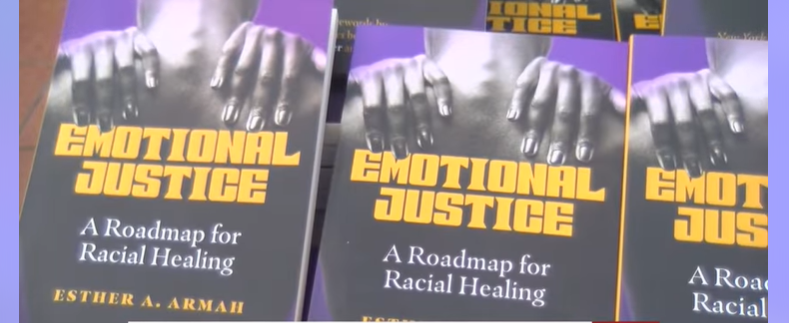
Award-winning International Journalist, Esther Armah, has launched her book, ‘Emotional Justice: A Roadmap for Racial Healing’ at the Webster University Ghana, East Legon.
The author, who doubles as the Chief Executive Officer of the Armah Institute of Emotional Justice, speaking on the sideline of her book launch impressed on the fact that Africans need to take deliberate efforts to emotionally heal from the trauma of colonialism.
According to her, the emotional wound left by colonialism has affected all spheres of African life, particularly the economy, and thus, it is essential to begin healing now.
Taking a cue from the inflation-hit economy of Ghana which has partly been occasioned by the Russia-Ukraine war as well as other international factors, she advised Africans to begin to restructure the way they think as a people.
“The reality is our physical economy, the spiraling prices of everything from food to rent to electricity is connected to the untreated trauma from colonialism. What does that mean? It means that a healed people-centre is the best for their own identity, for their own African identity.
“So that means that Ghana and Cote D’Ivoire will be the chocolate capital of the entire world. It means that we would construct, create, build and add value to our own resources as rich as we are.”
Esther Armah believes that one of the strategic ways to deal with emotional trauma is to revamp the Year of Return.
According to her, the 2019 Year of Return was merely a reiteration of African diaspora returning since Ghana gained independence in 1957.
“The year of return is crucial to emotional justice because it is part of an ongoing journey of return. We should always remember that return did not start in 2019. We saw it in the Presidency of Kwame Nkrumah when we saw people from all over the world travel to Ghana.
“African Americans like Martin Luther King, Maya Angelou, etc people travelling to Ghana and other African nations as part of an ongoing return. So 2019 is the latest iteration of a return that began many many years ago,” she said.
Esther Armah’s book connects and highlights the histories of oppression to what is happening now, what is going wrong, and how it can be put right.
"Putting the two words together is about highlighting that this is a collective work, a group focus – not an individual effort, that it is about highlighting and addressing injustice," she explained.
Latest Stories
-
Savio scores on debut as Spurs bounce back to beat Charlton
18 minutes -
Uefa to push to remove Infantino after dropping boycott
27 minutes -
GH¢1.7bn GoldBod loss misconstrued – IEA
38 minutes -
Mahama unveils Bawku Revitalisation Fund Committee
49 minutes -
Christians urged not to hide their gifts for church development
60 minutes -
Deputy AG punches holes in Hannan’s counsels’ letters, medical reports
1 hour -
Field cashier of Cooperative Credit Union remanded for stealing
1 hour -
Ghana Armwrestling Federation engages Egyptian Ambassador over sports collaboration
2 hours -
NSMQ 2026: Augusco declared winners, book quarter-final spot after Anlo, Kumasi High walk off
2 hours -
Mourinho says hat-trick hero Mbappe hungry for Real Madrid history
2 hours -
Democracy Cup 2026: Winner to play in the United States in May 2027
2 hours -
NSMQ 2026: St. John’s Grammar knocks Mpraeso SHS off seeded spot, advances to quarter-finals
2 hours -
Rashid Pelpuo welcomes new role, thanks Mahama for keeping him in government
2 hours -
Mahama inaugurates committee to oversee GH¢1bn Bawku Revitalisation Fund
3 hours -
Berko’s US conviction does not automatically establish Ghana bribery claims – OSP
3 hours