

Audio By Carbonatix
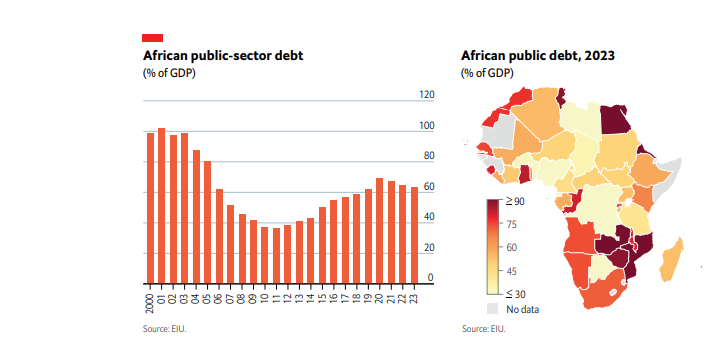
The Economist Intelligence Unit (EIU) says Ghana and six African countries have enormous amounts of debt relative to Gross Domestic Product (GDP) and their governments will grapple with debt-servicing burdens that would eat up a substantial share of their revenue in 2023.
Tunisia, Egypt, Congo-Brazzaville, Zambia, Zimbabwe and Mozambique are the other African countries.
In its Africa Outlook 2023 Report, the EIU said the public-sector debt/GDP ratio will remain above 60% for Africa in 2022 and 2023 and some African countries will far exceed this level.
“The need to service and roll over large amounts of debt at a time when domestic and international borrowing costs are on the rise will weigh heavily on some countries in 2023 and things could get even more painful in 2024 when more capital repayments fall due”, it mentioned.
“African governments have ramped up their borrowing—domestically and internationally — and public sector debt ratios (relative to GDP) have pushed back towards the highs, last seen in the early 2000s just before the enormous debt restructuring of 2005, implemented under the umbrella of the heavily indebted poor countries (HIPC) initiative”, it explained.
More African nations to head towards external debt distress
The EIU also said more African states will head towards external debt distress in 2023 and 2024.
“African states are required to repay about US$75bn of external borrowing (medium- and long-term capital repayments that fall due) in 2023 and a similar amount in 2024. Foreign creditors have offered pandemic-related debt relief and relatively low—by historical standards—interest rates in recent years, but these lines of international financial support have come to an end”.
It further said the debt-servicing burden will become more painful because of higher interest rates, weaker currencies against the US dollar and softer capital inflows, while rolling over existing debt or accruing new debt will become much more of a challenge.
Already, it added many African states have found it difficult to issue new Eurobonds in 2022 and yields in secondary markets—which indicate where future refinancing costs are headed—have risen sharply.
“A widespread external debt crisis across the continent seems unlikely, but some highly leveraged states will face acute financing difficulties and a very uncertain period”, it concluded.
Latest Stories
-
Aksa bribery scandal: Ghana’s probe must be pursued with speed – Dafeamekpor
3 seconds -
Samson’s Take: When religion threatens peace, sanity must prevail
31 minutes -
Friendship: Why time matters less than continuity
40 minutes -
Africa’s AI moment: They say data is the new gold. But who is drilling it?
41 minutes -
Ghana delivers strong performance in retail market in half-year; value up 15.6% – Maverick Research
47 minutes -
The world’s oldest president left for a ‘brief stay’ in Europe. He hasn’t returned in two months
1 hour -
Parliamentary committee commends GIPA’s investment drive, backs key reforms
1 hour -
Livestream: Newsfile discusses AKSA energy deal, legal vacation and GoldBod losses
1 hour -
Jason Arday: 10 things you may not know about British-born Ghanaian former Cambridge professor found dead at 41
4 hours -
KNUST partners with government to manufacture locally-made agricultural machines and smart traffic lights
4 hours -
Government to add constitutional referendum to 2027 District Assembly elections
5 hours -
Ambassador Nancy Sam meets South Africa’s Thanda to strengthen Africa tourism collaboration
5 hours -
Government disburses GH¢23.1 billion to clear road contractors’ arrears – Roads Minister
5 hours -
NPP Ashanti elections: 1,020 delegates to choose 11 regional executives
6 hours -
Galamsey: ‘Challenge is prosecution, not arrest’ — Lands Minister
7 hours