

Audio By Carbonatix
The Monetary Policy Committee of the Bank of Ghana believes fiscal measures implemented by government and captured in the International Monetary Fund (IMF) Staff Level Agreement (SLA) will help restore fiscal and debt sustainability, bring down inflation and help stabilise the currency.
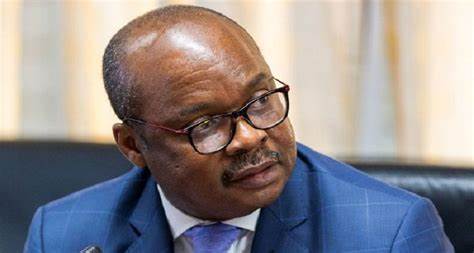
Briefing Financial Journalists on developments in the Ghanaian economy, the Governor of the Bank of Ghana, Dr. Ernest Addison said revenue-enhanced measures such as the VAT increase of 2.5%, the complete removal of benchmark values on imports, and the review of the Electronic Transaction Levy should help improve the revenue outlook.
On the expenditure side, the Chairman of the MPC said the lower capping on transfers to earmarked funds from 25 to 17.5%, and the reduction of budgetary allocation to goods and services, as well as rationalisation of executive compensation should help contain expenditures in 2023, adding, “The concerns being expressed in the public domain relating to high government expenditures have been addressed in the SLA and reflected in the 2023 Budge”.
“The SLA is also contingent on the Domestic Debt Exchange Programme and external debt restructuring, which when concluded and the necessary financial commitment obtained, will allow the presentation of the SLA to the IMF Board.”
The MPC, the Governor, pointed out, said it sees the need to remain vigilant and moderate liquidity in the system to underpin macroeconomic adjustments taking place to drive inflation on a downward path.
Fiscal deficit to GDP stood at 9.8% in 11-months of 2023
Meanwhile, provisional data on budget execution for the period January to November 2022 indicated an overall broad fiscal deficit (cash) of 9.8% of Gross Domestic Product, against the programmed target of 6.7% of GDP.
The corresponding primary balance for the period was a deficit of ¢18.8 billion (3.1%of GDP), against a deficit target of ¢3.1 billion (0.5% of GDP).
Over the review period, total revenue and grants was ¢81.8 billion (13.3% of GDP), short of the projected target of GH¢84.0 billion (13.6% of GDP).
Total expenditure of ¢142.2 billion (23.1% of GDP) was above the programmed target of ¢125.4 billion (20.4% of GDP).
The deficit of ¢60.4 billion was financed mainly from the domestic sector.
Latest Stories
-
Chiefs can help stop galamsey where government enforcement struggles – KNUST Professor
24 seconds -
Mahama’s rekindling Ghana’s Pan-African role echoing Nkrumah’s vision – P.L.O. Lumumba
38 seconds -
Gov’t already in advanced talks to buy Teshie desalination plant to avert $235m payout
4 minutes -
Tema-Kpone road had no valid contract or approved scope of work – Roads Minister
14 minutes -
You pay for electricity, water but not roads – Roads Minister chides Tema companies
16 minutes -
Political independence earned under Nkrumah is being eroded – P.L.O Lumumba
18 minutes -
Oro Oil CEO urges decentralised use of $500m World Bank oil palm fund
18 minutes -
Busuama MA Basic School in crisis: 120 KG pupils stranded as teacher deficit bites
28 minutes -
Churches are not exempt from paying music royalties – GHAMRO CEO
29 minutes -
Gender Ministry expresses condolences over death of child in Cantonments fire
30 minutes -
Nkrumah foresaw Africa’s vulnerability without unity – P.L.O. Lumumba
33 minutes -
Alhaji Faisal Abdullah Masud installed as Tema’s first Sariki Zongo
37 minutes -
Mahama’s UN address to mark 25th by a Ghanaian president
38 minutes -
AFCON 2027Q: J.E. Sarpong slams sidelining of GPL players in Black Stars call-up
39 minutes -
GRA’s ITAS and other digital platforms set to strengthen tax compliance
40 minutes