

Audio By Carbonatix
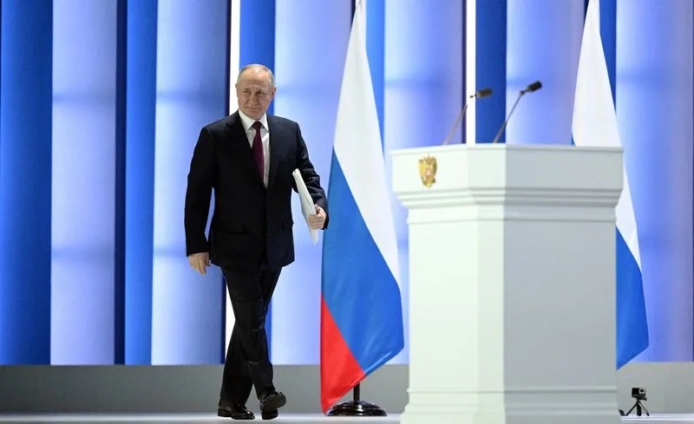
President Vladimir Putin revoked on Tuesday a 2012 decree that in part underpinned Moldova's sovereignty in resolving the future of the Transdniestria region - a Moscow-backed separatist region which borders Ukraine and where Russia keeps troops.
The decree, which included a Moldova component, outlined Russia's foreign policy 11 years ago which assumed Moscow's closer relations with the European Union and the United States.
The order revoking the 2012 document was published on the Kremlin's website and states that the decision was taken to "ensure the national interests of Russia in connection with the profound changes taking place in international relations".
It is part of a series of anti-Western moves announced by Putin on Tuesday.
Alexandru Flenchea, Moldovan chairman of the joint control commission in the security zone around Transdniestria, said the cancellation did not mean that Putin was abandoning the notion of Moldovan sovereignty.
"The decree is a policy document that implements the concept of Russia's foreign policy," Flenchea told Publika-TV. "Moldova and Russia have a basic political agreement that provides for mutual respect for the territorial integrity of our countries."
The Kremlin has said that Russia's relations with Moldova, which last week approved a new pro-Western prime minister that vowed to pursue a drive to join the EU, were very tense. It accused Moldova of pursuing an anti-Russian agenda.
Wedged between Romania and Ukraine, Moldova, one of Europe's poorest nations, has been led since 2020 by President Maia Sandu with strong U.S. and European Union backing. U.S. President Joe Biden met her in Poland on Tuesday affirming his support.
The 2012 decree committed Russia to seeking ways to resolve the separatist issue "based on respect for the sovereignty, territorial integrity and neutral status of the Republic of Moldova in determining the special status of Transdniestria".
The Russian-speakers of Transdniestria seceded from Moldova in 1990, one year before the dissolution of the Soviet Union, amid fears that Moldova would merge with Romania, whose language and culture it broadly shares.
A brief war pitted newly independent Moldova against the separatists in 1992. But there has been virtually no violence in the past 30 years, with Russian "peacekeepers" still posted in the tiny sliver of land, which has no international recognition.
Moldova's foreign ministry said it would "carefully study" the document.
Latest Stories
-
UMB, ORC partner to make business registration easier for entrepreneurs
24 seconds -
Cedi is ‘long overdue for a refresh’ – Mahama
3 minutes -
GenCED urges NPP to extend 50% nomination fee reduction to women, youth and PWDs
8 minutes -
The source of cedi appreciation matters more than the appreciation itself
15 minutes -
Ashanti cocoa farmers welcome new COCOBOD Bill, back key reforms
18 minutes -
‘GoldBod is a very big scandal awaiting us’ – Afenyo-Markin
19 minutes -
‘GoldBod is failing’ – Afenyo-Markin cites IMF report on $1.7bn losses
20 minutes -
Fire destroys ICT lab at Gushegu Midwifery Training School, threatens licensure exams
21 minutes -
Defence Ministry welcomes Kenneth Gilbert Adjei as new Defence Minister
22 minutes -
Bawumia charges NPP executives to rebuild party for 2028 victory
24 minutes -
Unite the region and deliver victory in 2028 – Dr. Bawumia to new Greater Accra NPP executives
25 minutes -
Ukrainian strikes kill six in Russia, acting governor says
25 minutes -
The goal is to win 2028 polls – Bawumia
25 minutes -
GoldBod secures 30% of large-scale gold output for Ghana’s strategic reserves
26 minutes -
FDA warns against unauthorised chemicals for ripening plantain
27 minutes