

Audio By Carbonatix
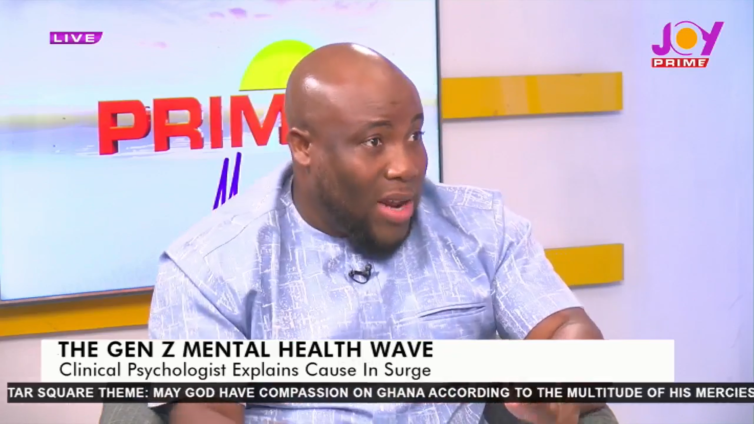
A clinical psychologist says a lot of people confuse mental health with mental illness but there is a vast difference between the two.
Seth Asafo said mental illness is an extreme depletion of the mind where an individual exhausts all their resources to keep surviving.
“Mental health is not a mental illness and perhaps that’s the reason the field is so stigmatised because when people hear mental health, all they hear is mental illness.
“Mental illness will normally look at falling below 0, so if I had a speedometer, it starts at 0 and that’s neutral because you’re starting off and you’re progressing but if you fall below 0 that’s where an illness comes in.
“Typically you can wake up on a day and you don’t feel 100% but you’re not sick, you’re just not yourself, that’s where the mental health component comes in and the sickness comes in when you have depleted your resources for coping and you’re struggling, so let’s not confuse the two,” he said.
Speaking on Joy Prime’s Prime Morning on Tuesday, April 11, Mr Asafo said most of the activities that enhance both physical and mental health are free, however, people mostly resort to taking pills because they assume taking medication is the only solution.
“Staying active or exercising is free, it’s within everyone’s capability, sleep is free, staying connected is free and those are exactly the things that we aren’t doing," he stressed.
The psychologist emphasised the need for constant communication and physical interaction with people to help stabilise the mind.
He explained that this exposes the individual to a lot of problems which will require solutions and while working towards solving the problem, resilience is built which goes a long way in improving their mental health.
“Mental health thrives on a principle we call resilience and resilience is your ability to bounce back even when you’re facing adversity or when you take a hit, your ability to get back and do what you have to do,” he stated.
Mr Asafo who is also a lecturer at the University of Ghana Medical School advised the reduction of screen time and more physical engagement, building more social interactions and being exposed to life problems that will get their brains more functional in finding solutions to them.
He also advised parents to think long-term and not be overly protective of their children and said that parents should allow their kids to face certain challenges and guide them through them rather than solve the problems for them.
Latest Stories
-
Conflicts among care providers linked to maternal, neonatal deaths – Expert
3 minutes -
GIS marks 10th TIME conference, champions improved teaching practices
10 minutes -
BRICS Or Balance? What Ghana’s bid really means
36 minutes -
GPRTU wants full TRAFFITECH-GH implementation to start in 2027
55 minutes -
Mahama announces plans to import electric wheelchairs for PWDs
59 minutes -
KGL U17 Colts 2026: Western beat Prempeh Elite Academy to set up final final with Greater Accra Region
1 hour -
Late Solanke strike salvages 10-man Spurs draw at Man United
1 hour -
Gender Ministry to monitor welfare of Nana Akua Addo’s children amid domestic violence case
2 hours -
Benedict Okyere Yeboah: Ghana’s football problem goes beyond sacking a coach
2 hours -
GPL 2026/27: Darkwah Wiafe’s winner sees All Blacks beat Kotoko
2 hours -
ITF World Tour : Patel Wins Boys’ Singles Final at J100 Accra
2 hours -
Ghana must pursue BRICS partnership if it brings economic benefits – Kpebu
2 hours -
Success and Wright Claims J100 Accra Girls’ Doubles Championship
2 hours -
ITF J100: America’s Wright wins J100 Accra Girls’ Singles Title
2 hours -
Expedition hopes to find aviator Amelia Earhart’s plane on remote island
2 hours