

Audio By Carbonatix
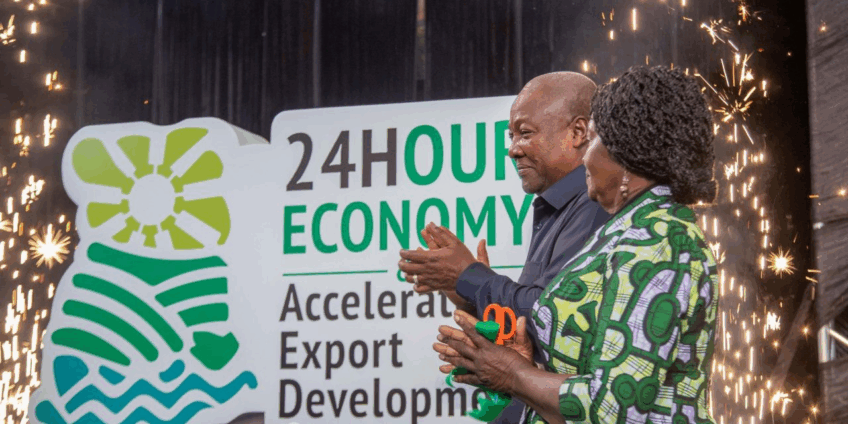
The CEO of the Ghana National Chamber of Commerce and Industry (GNCCI), Mark Badu Aboagye, has raised concerns about the viability of the proposed 24-hour economy, warning that without proper incentives and execution, it risks becoming another policy slogan.
Speaking on PM Express on Joy News, he acknowledged that policies like the 24-hour economy are often well thought through but suffer from poor implementation.
“Interesting listening to the two politicians from the two sides. Well-documented policies, well-articulated policies, but implementation has always been the challenge. The things that he said about the 24-Hour economy and 1D1F all need a private sector to implement them,” he said.
Mr Badu Aboagye stressed that the private sector remains central to the success of any such policy, noting that government alone cannot drive job creation.
“There is no way government alone can solve the unemployment problem we have. The government employs just 6% of the total labour.
"For just 6%, the 94% or so is being employed by the private sector. So just create the right environment…So it’s the private sector that we must empower. We must create the right conditions.”
On whether the GNCCI had been engaged on the 24-hour economy policy, he confirmed ongoing consultations but suggested more needed to be done.
“Obviously, there’s always an engagement for us to understand what it is, for us to understand the role that we will play, and all those things. Last Friday, we were actually supposed to meet Gossie Tannoh, but I think he travelled. So okay, so we have had that engagement with them.”
He pointed to the One District One Factory (1D1F) initiative as an example of a strong policy that fell short due to execution gaps.
“When it comes to policies, as I said, it is implementation, the 1D1F. It’s been said that it was a very brilliant policy. If governments had even implemented just 50% of it, all these employment issues would have been solved.”
Mr Badu Aboagye also questioned whether the 24-hour economy is truly being positioned as a private sector-driven initiative beyond rhetoric.
“That is what they always say, it is private sector-driven. And, of course, it should be private sector-driven. But what incentives are they providing?”
He noted that previous policies had built-in incentives but raised concerns about access and political influence.
“We had a similar incentive with 1D1F, where they say, if you go for a facility, we’ll pay a percentage of the interest. So the collateral point he talks about was also built into 1D1F. Let’s say the policies are brilliant; it is the implementation.
"And obviously, you get some political undertones. And people who can assess this funding, the real private sector people find out from them, whether they were able to get some of this funding.”
He warned that without deliberate effort, the 24-hour economy could fail to deliver results.
“So to solve this problem, it shouldn’t be just a political slogan and say, 24-hour economy. They are a brilliant idea. But how is the private sector taking it up? I think that to be able to solve this, one approach is to also look at our investors.”
Latest Stories
-
Spotify makes fandom the ticket with debut Surround Sound experience in Lagos
9 minutes -
Deputy Interior Minister calls for joint action to strengthen Ghana’s cybercrime response
19 minutes -
Gov’t announces plans to create 20,000 jobs in waste management, circular economy
24 minutes -
T-bills auction: Government exceeds target by 30%, but demand to remain relatively soft at next auction
25 minutes -
Election Watch Ghana raises concern over low female representation in NPP leadership
32 minutes -
Four drinks that help manage blood sugar
32 minutes -
Ray Michael Djan Jr puts Ghanaian creativity on global stage with Chelsea anthem
42 minutes -
Matilda Dibloni Kokar elected USAG president after two-year dormancy
45 minutes -
NPP delegates wanted youthful energy with Kojo Bamba’s election – Political scientist
48 minutes -
Zenith Bank supports Childhood Cancer Unit at Greater Accra Regional Hospital
48 minutes -
KMA empowers 64 persons with disabilities; Mayor unveils plan for sustainable skills centre
50 minutes -
DJs Union urges musicians to prioritise respect, communication amid industry tensions
58 minutes -
“Ghanaian DJs deserve their flowers” – Lasmid
58 minutes -
Zenith Bank supports childhood cancer unit at Greater Accra Regional Hospital
60 minutes -
‘Who’s in charge doesn’t really matter; we’re all servants’ – John Boadu on leader of NPP
1 hour