

Audio By Carbonatix
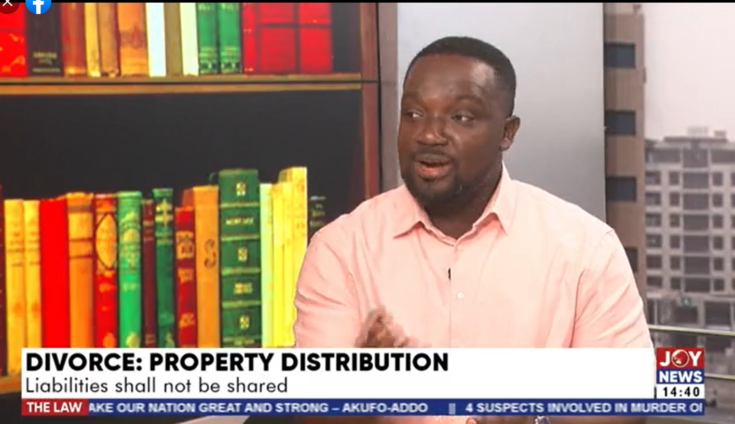
Legal practitioner and a partner at Morrison, Twunasi & Partners, Reindorf Twumasi Ankrah, has indicated that the law presumes that assets acquired during a marriage is joint property.
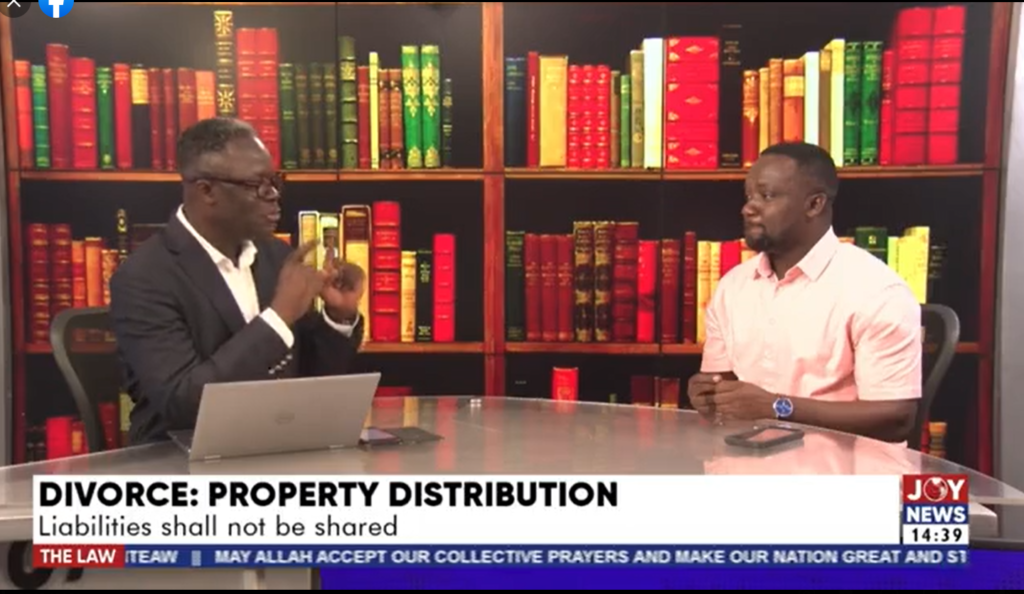
Speaking on The Law on JoyNews, he explained that in the process of a divorce, unless a party can prove otherwise, all joint property will be shared equitably among the divorcees.
“The law now as we have operates on the presumption that property acquired in the course of a marriage is a property jointly acquired by the spouses. So, if a party is disputing the joint ownership of that property, then the burden is on that party to give evidence to establish that with this particular property, we cannot add it to the pool. So, I am rebutting this presumption," he said.
Speaking on the topic 'Divorce: Property Distribution', Mr Ankrah highlighted that in the past, the law was designed such that women were expected to have offered monetary assistance before they were acknowledged to have a right to property in the marriage.
However, since that was disadvantageous to most women, the law had been revised such that a spouse’s right to property in a marriage was not considered solely on monetary contributions, but also on qualitative contributions, he stated.
Mr Ankrah noted that activities that were undertaken by a spouse in managing the home, such as cooking and cleaning among others, comprised qualitative contributions.
These qualitative contributions, he highlighted, were acknowledged by law as a form of assistance that aided a spouse to earn money, even if one of the parties did offer a financial contribution to the marriage.
The legal private practitioner added that should persons such as nannies, cooks, and chefs be employed to render services in the house, they would have been paid.
He also contended that if the woman were to render those services elsewhere, she would have been paid - this contributed to the reason why at the Supreme Court, qualitative contribution is also acknowledged in the determination of a spouse’s share in property distribution.
Subsequently, the lawyer raised the issue of instances where the husband makes his wife quit her job to manage the home.
Mr Ankrah stated that the husband in such a scenario cannot claim that all the properties acquired in the marriage are entirely his.
He explained that “she was an earner and you asked her to come and stay home so effectively you have stopped her from earning money to manage the house. If you were to pay her for that service possibly would even be more than what was earning at work."
“So, if you've asked her to, stay home with all her certificates and all the education she has acquired, you should be ready to accept the fact that if properties are built in the course of the marriage, you cannot claim it to be entirely yours,” he stressed.
Latest Stories
-
Assemblies of God requires pastors to resign before entering partisan politics – Rev. Wengam
4 minutes -
Ghana targets 20% annual reduction in maternal deaths – Health Minister
9 minutes -
Cyber attacks in Africa grow faster than global rate, report finds
11 minutes -
Ghana signs UAE deal to create 5,000 overseas jobs
18 minutes -
One Million Coders Programme targets 100,000 digital jobs in two years – Sam George
21 minutes -
John Jinapor, Italian Ambassador explore opportunities for energy sector investment
23 minutes -
NHIA seeks legal reforms to support Free Primary Healthcare
27 minutes -
Beatrice Annan defends Afi Agbenyo’s EC appointment, cites record of gender advocacy
30 minutes -
Ghana seeks investment deals in Bangkok amid global economic crises
34 minutes -
IMF raises Ghana’s 2026 growth forecast to 5.7%, sees inflation falling to 4.8%
35 minutes -
Ablakwa urges Africans not to view immigrants as threat to national progress
40 minutes -
Mahama Cares must fund treatment, not looting – Asogli chiefs
41 minutes -
Ghana’s economic salvation lies not in shifting geo-political allegiances – Dr Atuahene
44 minutes -
BoG proposes tougher rules on loan repayment assessment
49 minutes -
Government plans mandatory drug tests for public service jobs — Muntaka
54 minutes