

Audio By Carbonatix
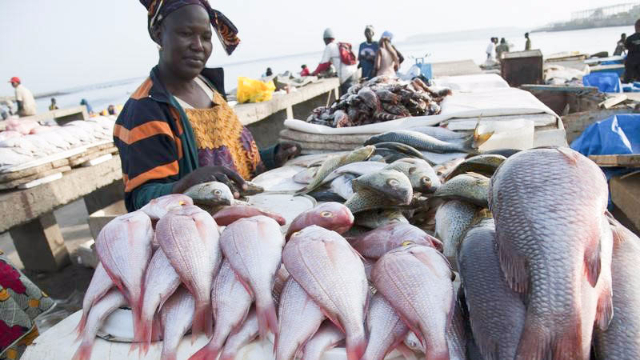
The Ministry of Fisheries and Aquaculture Development has pledged to cut the importation of fish into the country.
According to its Deputy Minister, Moses Anim, it will adequately support local fish farmers to boost fish production.
“Let me reiterate that where we are today, with all the challenges of post-covid, the countries that will survive are those that will increase their import substitution. We need to reduce importation of fish”, he said.
He stated that Ghana cannot generate foreign income for the purposes of importing fish.
“I still stand by the word that if you want to import fish, look for your forex to do that. We cannot generate forex in this country and others will use it to go and import. It will mean we would have to increase production in aquaculture here,” he said
Speaking at a Dinner and Awards Night organised by the Chamber of Aquaculture Ghana under the auspices of the Ministry and the Fisheries Commission, Mr. Anim called on researchers and academia to partner industry players in improving the sector.
“I decided to keep some catfish, not for commercial purposes but to learn about the difficulties in the sector. I can say for a fact that experiencing the challenges firsthand has enlightened me. What do we do then? It’s up to us to work together. Academia, researchers and stakeholders need to come together and solve the bottlenecks, remove the hurdles on the way and make sure that cost of production come down,” he stated.
Chairperson of the Chamber for Aquaculture Ghana, Dr. Ruby Asmah indicated the maiden edition of the Aquaculture Awards was to acknowledge stakeholders that have survived the turbulence of the sector and industry players that have contributed to the recovery process.
“This programme is to acknowledge the efforts of people who have worked tirelessly in the sector. The aquaculture sector in Ghana has had its ups and downs and I think the most difficult period was when the disease outbreak occurred in 2018”.
Dr. Asmah said the situation compelled some farmers to go down while others gradually recovered.
“To a lot of people, that appeared to be a critical moment. Some went down and never came up again but others survived. We’re seeing some of them recovering”.
He maintained that there is the need to critically observe players in the industry to support them.
“I was looking at the production figures and I was really pleased to see how that they are going up again. There are people in the background who have worked tirelessly to see the industry progress,” she said.
Joy Business’s Emma Davies was crowned the Aquaculture Journalist of the year 2022.
Latest Stories
-
Ghana eyes stronger trade ties as Australia hosts multicultural trade and investment forum
3 minutes -
Margaret-Marie Krakue
6 minutes -
Ayariga announces plans for live broadcast of MMDAs’ meetings on local radio stations
9 minutes -
Mrs Anna Tackie
11 minutes -
Ghana links Afghan heroin and Brazilian cocaine to global drug markets – Global Organised Crime Index
18 minutes -
NHIA launches nationwide inter-school quiz to deepen students’ knowledge of NHIS
25 minutes -
Political protection could be masking Ghana’s cocaine trade – Global Organised Crime Index
30 minutes -
AFCON 2027Q: ‘We have to dissolve the GFA’ – Effia MP after Black Stars lose to Gambia
32 minutes -
NPP announces voting schedule and ID requirements for October 3 national elections
34 minutes -
Lupus can mimic HIV symptoms and damage kidneys if untreated – KNUST expert
37 minutes -
Focus on Sickle Cell Foundation seeks to introduce sickle cell education through comics in Ghanaian schools
42 minutes -
NPP rewrites the campaign playbok as opposition reality shapes National Executive contest
44 minutes -
Road safety education will fail without enforcement – NRSA boss
45 minutes -
Daily Insight for CEOs: Finishing Q3 strong and entering Q4 with purpose
46 minutes -
National Ambulance Service begins ‘Operation Restore Fleet’ to restore grounded ambulances
47 minutes