

Audio By Carbonatix
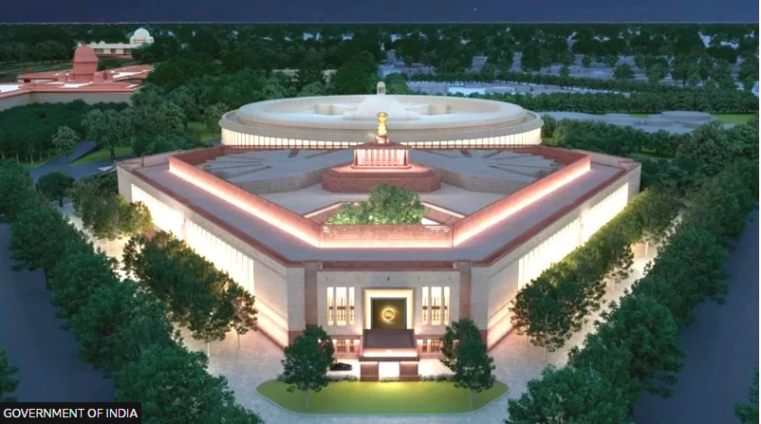
Prime Minister Narendra Modi has inaugurated India's new parliament building amid protests and boycotts.
Most opposition parties did not participate, saying they wanted the president instead of Mr Modi to open the building.
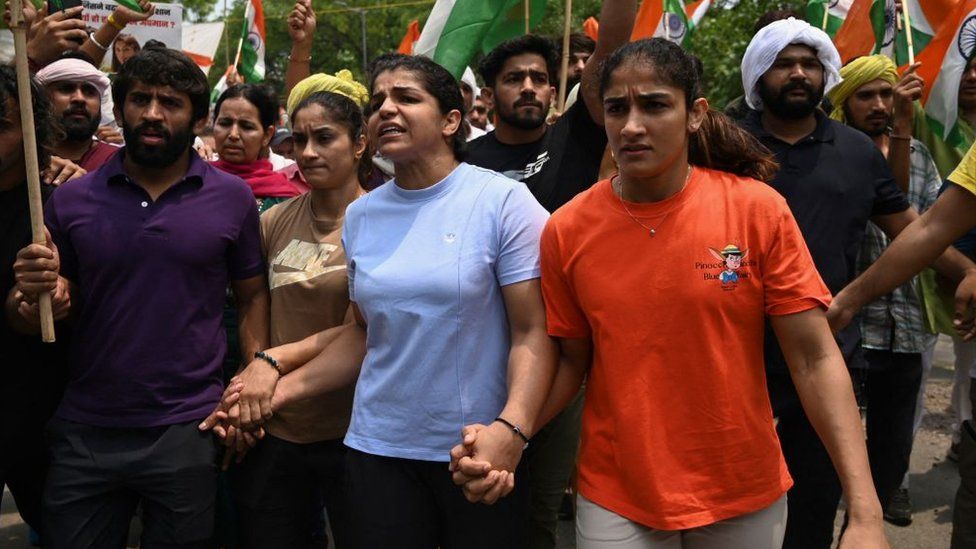
During the ceremony, some of India's top wrestlers were detained when they tried to reach the new parliament to protest.
The new building has replaced the British-era parliament.
Ceremonies leading up to a formal inauguration began at 07:00 (02:00 GMT) on Sunday.
Mr Modi unveiled a plaque dedicating the building to the nation and later addressed a gathering of lawmakers.
"This is not just a building. It is a reflection of the aspirations and dreams of 1.4 billion Indians. This is the temple of our democracy and it's giving the message of India's determination to the world," he said.
Rahul Gandhi, the leader of the main opposition Congress party, tweeted that Mr Modi was treating the parliament inauguration as a coronation ceremony.
Last week, 19 parties - including the Congress - announced their "collective decision" to boycott the ceremony.
They criticised the government for not asking President Droupadi Murmu, who is head of state, to open the new building. They also denounced the decision to hold the event on the birth anniversary of Hindu nationalist ideologue VD Savarkar. Opposition parties consider Savarkar a divisive figure, while the ruling Bharatiya Janata Party (BJP) hails him as a hero.
The BJP said the opposition's boycott was a "disrespect to democracy".
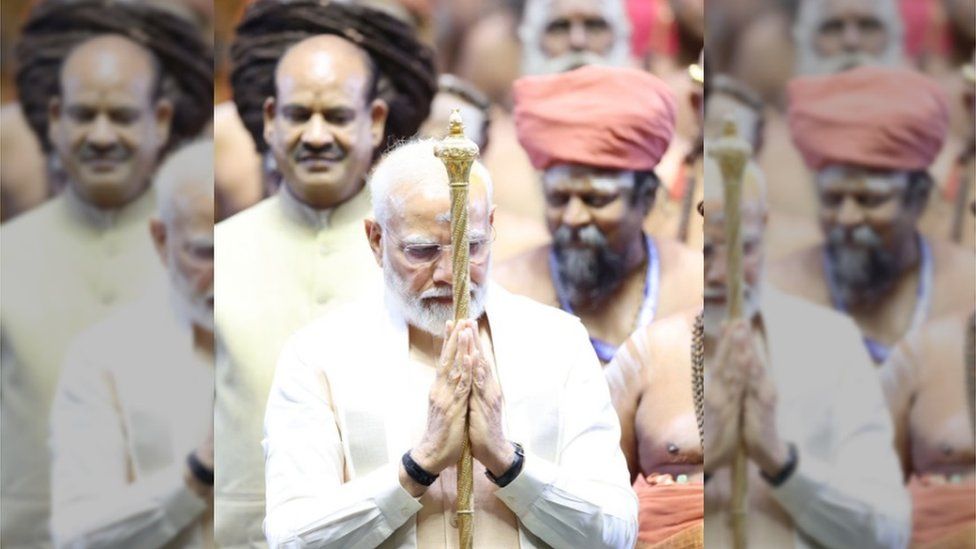
Mr Modi also installed what the government said was a historically significant gold sceptre, called the sengol, in the new parliament building.
He said that the presence of the "holy sengol" in the new building would inspire lawmakers.
The government said the gold sceptre was given to India's first prime minister Jawaharlal Nehru by priests from a prominent Hindu sect. It added that the sengol was "the symbol of the transfer of power to India from the Britishers on the 14th of August in 1947".
Opposition parties, however, said that the government's claims about the sceptre's importance were exaggerated.
The new parliament building is part of the government's ambitious project to develop the Central Vista complex in Delhi to replace colonial-era government buildings.
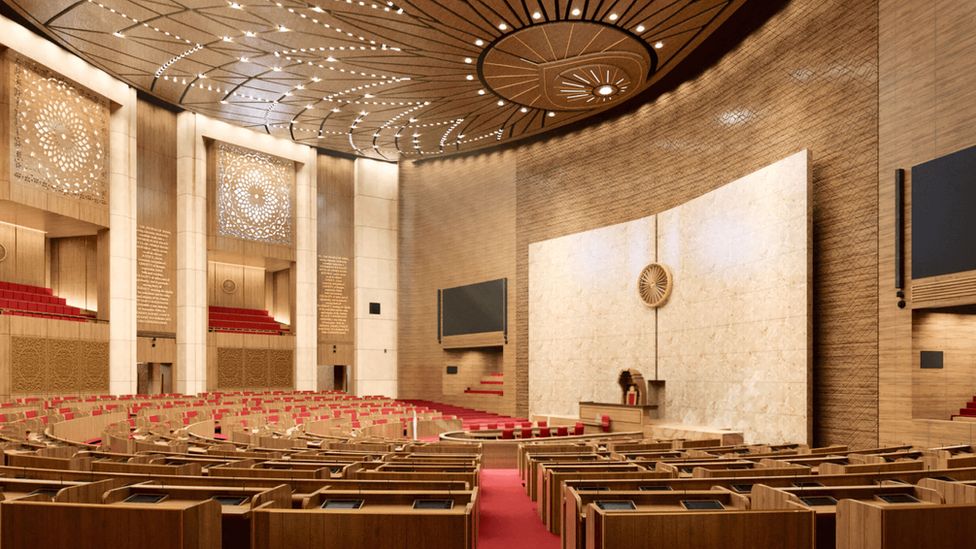
Built in front of the old parliament, the new four-storey building - built at an estimated cost of 9.7bn rupees ($117.1m, £94.2m) - is much bigger and has the capacity to seat 1,272 MPs.
The Lok Sabha chamber, which will seat the lower house of the parliament, is designed in the likeness of a peacock, India's national bird. The Rajya Sabha chamber, which will seat the upper house, is designed to resemble the lotus, India's national flower.
The current parliament building will be converted into a museum.
The government said that the new parliament was necessary as the older building was "showing signs of distress and over utilization".
But it was criticised by many opposition politicians, environmentalists and civil society groups. They decried its cost, its construction during the pandemic and alleged that the government had not consulted other lawmakers and the public.
The Congress had also stayed away from the foundation stone-laying event of the new parliament in 2020.
Commentators said that the ongoing political row reflected a fractious milieu where India's ruling party and the opposition were unable to reach an agreement on most issues.
"Both sides need to find a way out of the separate corners they have backed themselves into. They must do so because history will not forgive them if they won't," The Indian Express newspaper argued in an editorial.
Latest Stories
-
Mahama demands permanent UN Security Council seat for Africa
2 minutes -
Mahama calls for structural repair after UN slavery resolution
7 minutes -
Mahama condemns Gaza carnage, backs Palestine and two-state solution
10 minutes -
Fund Accra-Kumasi Expressway with private capital, not state funds — Alan Kyerematen urges gov’t
14 minutes -
TUC calls for stronger funding and labour representation in TVET system
16 minutes -
GES threatens removal of SHS heads over illegal fees
20 minutes -
Youth power to explode at 2026 Global Changemakers Summit in Accra
27 minutes -
SIU community remembers Kofi Akamani at vigil as memorial fund is announced
29 minutes -
Shot and killed in the US: Who was Dr Kofi Akamani?
37 minutes -
Sosu challenges EOCO’s basis for attempted arrest of Manhyia South MP
44 minutes -
KMA plans to convert Adum railway enclave into cargo truck terminal
45 minutes -
2026/27 cocoa season: COCOBOD engages international trading partners in London
1 hour -
Fire contained at Dansoman’s Dayspring School, no casualties reported
1 hour -
Nyankyerenease gets furnished CHPS compound to improve healthcare access
1 hour -
Sky Train trial moves to defence as Asamoah, Ameyaw-Akumfi file witness statements
1 hour