

Audio By Carbonatix
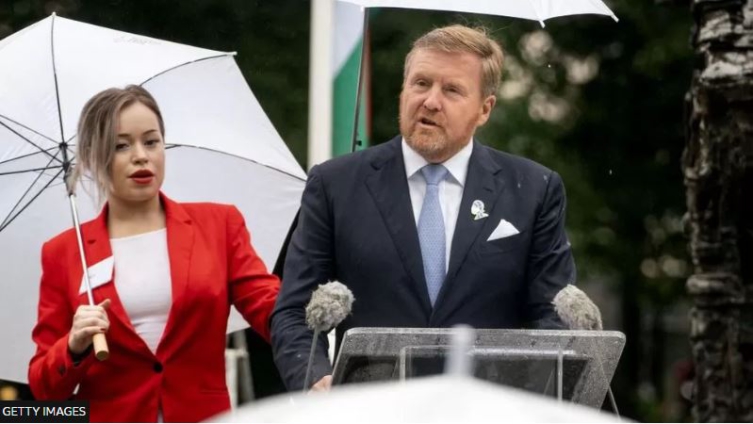
The King of the Netherlands has formally apologised for his country's role in the slave trade, saying he felt "personally and intensely" affected.
The country became a major colonial power after the 17th Century, holding territories across the globe, and Dutch slave traders trafficked more than 600,000 people.
King Willem-Alexander on Saturday called the practice a "horror".
The royal family did nothing to stop it, he said.
He was speaking at an event marking the 160th anniversary of the abolition of slavery in the country - it was unclear ahead of the event whether the King would apologise for the Royal Family's role in the practice.
In June, a new study revealed that Dutch rulers received the equivalent of €545m ($595m) in today's money between 1675 and 1770 from colonies where slavery was enforced.
During his speech in Amsterdam, King Willem-Alexander conceded that the "monarchs and rulers of the House of Orange took no steps against [slavery]".
"Today I'm standing here in front of you as your King and as part of the government. Today I am apologising myself," he said.
"Today, I am asking for forgiveness for the crystal-clear lack of action."
Accompanied by his wife Queen Maxima, the King acknowledged that he could not speak for the entire nation, but he told the crowd that "the vast majority" of Dutch citizens "do support the fight for equality for all people, regardless of colour or cultural background".
"After acknowledgment and apology, we can work together on healing, reconciliation and restoration," the King added.
His speech received cheers from the crowd at the Keti Koti Festival - the country's annual commemoration of the abolition of slavery.
During the 17th Century the Netherlands conquered large swathes of territory in regions that now make up Indonesia, South Africa, Curaçao and West Papua, and became a key player in the transatlantic slave trade.
Thousands of people were trafficked from Africa to Dutch colonies in the Caribbean and South America - amounting to around 5% of the entire transatlantic slave trade - before the practice was banned in 1863.
But in the nation of Suriname it continued during a mandatory 10-year transition period, causing untold grief and pain.
The Netherlands generated huge wealth from the slave trade, and in the western province of Holland alone a Dutch Research Council study found that 40% of economic growth between 1738 and 1780 could be attributed to the trade.
Last year, Prime Minister Mark Rutte also apologised for the country's historical role in the slave trade, saying in a speech at the Hague that it must be recognised in "the clearest terms" as "a crime against humanity".
And several Dutch cities, including Amsterdam and Rotterdam, have issued apologies for their role in the trade.
But the country has taken time to address its colonial past, and it was not until 2006 that the history of Dutch slavery was added to the school curriculum.
Latest Stories
-
Arrest of Manhyia South MP should involve Parliament, not police station – Kpebu
13 minutes -
Two Nigerians sentenced to 189 months in US prison over $2.4m cyber fraud
37 minutes -
Cristiano Ronaldo leaves Portugal’s training camp after rift with Head Coach
37 minutes -
Ghana Energy Awards opens nominations for landmark 10th anniversary edition
38 minutes -
Aayalolo contra-flow: Are we treating the symptom instead of the disease?
42 minutes -
GTEC orders Colleges of Education to begin 2026/2027 admissions despite fees approval delay
45 minutes -
Legal reforms must solve real problems, improve justice – Bagbin
47 minutes -
Ofori-Sarpong named Alumni President of the Year, honoured for PRESEC dormitory project
1 hour -
Germany commits $132m to Ghana for skills development and training university – Pelpuo
1 hour -
‘Influence should go beyond visibility’ – Taadi Banyinba GH launches The TB Impact
2 hours -
Videos: Government announces emergency LEAP package for Hohoe flood victims
2 hours -
Salomey Baffoe’s children are crying for their mother – Family appeals for her release
2 hours -
Shortage of trained investigators and prosecutors hampers Ghana’s fight against money laundering – Report
2 hours -
GoldBod generates US$1.87bn in September FX operations, exceeding monthly target
2 hours -
Roads Minister says it is time to change one-year defect liability period for contractors, consultants
2 hours