

Audio By Carbonatix
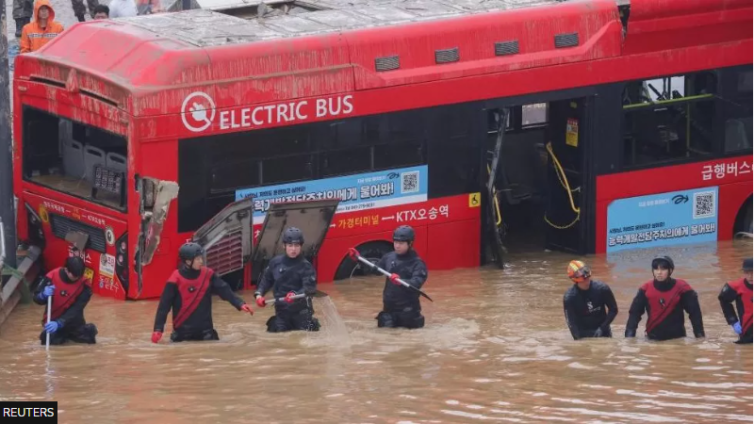
Rescuers working to reach cars trapped in a flooded tunnel near the South Korean city of Cheongiu have recovered nine bodies.
Flood water caused by days of torrential rain poured so quickly into the underpass that passengers and drivers were trapped in their cars, unable to escape.
At least 35 people have died in total after flooding, landslides and power cuts across much of the country.
More than ten people are missing.
It is unclear how many people are still trapped in the 685-metre long tunnel in the town of Osong, but 15 vehicles are thought to be submerged.
Several of the bodies were recovered from inside a bus. Nine survivors were rescued on Saturday.
Most of the other fatalities have been in the mountainous North Gyeongsang region, where landslides have swept away whole houses.
Almost 300mm (11.8in) of rain is reported to have fallen across South Korea on Saturday.
The country typically sees 1,000mm (39.4in) to 1,800mm (70.9in) a year, according to the Korean Meteorological Association - although much of that does fall during the summer months.
Aerial pictures from flood-affected areas show brown mud and flood waters so deep, only the tops of roofs can been seen sticking out.
Thousands of people have been affected by evacuation orders issued by various local governments and Prime Minister Han Duck-soo has asked the military to help with the rescue efforts.
Early on Saturday morning local time, some 6,400 residents were evacuated after the Goesan Dam, also in North Chungcheong, began to overflow, the agency said.
A number of low-lying villages near the dam as well as many of the roads connecting them were submerged, leaving some residents trapped in their homes.
Late on Friday, a landslide caused a train to derail in North Chungcheong. One engineer was injured, but the train was not carrying passengers at the time.
Korail, the country's national rail operator, has announced the suspension of all slow trains and some bullet trains, and said other bullet services would be disrupted.
The Korea Meteorological Administration forecast more rainfall through to Wednesday next week. It warned that the weather conditions pose a "grave" danger.
Extreme rain has caused floods and landslides across several countries - including India, China and Japan - over the past fortnight.
While many factors contribute to flooding, scientists say a warming atmosphere caused by climate change makes extreme rainfall more likely.
The warmer it becomes, the more moisture the atmosphere can hold, resulting in more droplets and heavier rainfall, sometimes in a shorter space of time and over a smaller area.
Latest Stories
-
Gauff’s flaw forgotten on winning US Open return
1 hour -
Birds stop play but Medvedev flies into third round
1 hour -
LA Clippers fined $30m by NBA over Leonard scandal
1 hour -
Uber to cut over 3,000 jobs in major global restructuring
2 hours -
Tiger Woods gets five-year driving ban after reckless driving plea
2 hours -
South African airline behind daring stadium stunt cancels next flyby
2 hours -
PURC urges ECG to address outages, metering delays
2 hours -
Police engage traders over alleged harassment, extortion on Aflao-Accra highway
2 hours -
Uber shuts operations in Nigeria and Uganda with immediate effect
2 hours -
Netherlands moves billions in gold to London in ‘crisis preparedness’ move
3 hours -
Legal vacation does not halt urgent court cases – Chief Justice
3 hours -
Keta residents react with mixed feelings to fresh fuel price hike
3 hours -
Managing Director on GH¢150,000 bail over five dud cheques
3 hours -
BOSTenergies reports strong 2025 performance, pays first-ever dividend to government
4 hours -
Carlos Queiroz reappointed as Black Stars head coach
4 hours