

Audio By Carbonatix
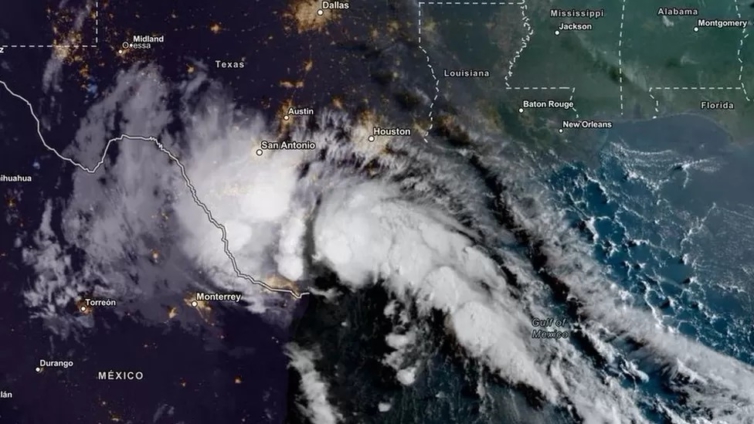
Tropical Storm Harold made landfall on the south-east coast of Texas on Tuesday, bringing more heavy rain and high winds to the southern US.
The storm has dumped up to 7in (17.7cm) of rain in some parts of the state.
By late Tuesday afternoon, the storm had been downgraded to a tropical depression, but heavy rains continued.
More than 23,000 people were without power in the Lone Star state on Tuesday night.
The Texas deluge arrived a day after historic amounts of rain flooded parts of the south-western US.
California and Nevada were cleaning up on Tuesday after seeing historic amounts of rain from Storm Hilary, which caused widespread flooding.
Tropical Storm Harold made landfall on Tuesday morning local time on Texas' Padre Island in the Gulf of Mexico.
Tropical storm warnings had been issued from the Rio Grande river - along the state's southern boundary - to roughly 250 miles (400km) north, to the community of Port O'Connor.
Scattered instances of flash flooding were still a threat, the NWS warned.
Texas Governor Greg Abbott said the state had deployed emergency resources including rescue boats, search-and-rescue teams and platoons from the state National Guard.
Wind gusts of 59 mph were reported outside of Corpus Christi.
The storm was expected to continue to carry rain, wind and hail farther inland as it tracks westward across the hot and dry Texas landscape.
Rain was expected to taper off on Wednesday.
As Texans endure the deluge, weather officials have warned of yet another tropical storm - Franklin - currently some 230 miles east off the coast of the Dominican Republican.
Up to 6in of rain from Franklin is predicted to fall in Puerto Rico from Wednesday.
The impact of climate change on the frequency of storms is still unclear, but we know that increased sea surface temperatures warm the air above and make more energy available to drive hurricanes, cyclones and typhoons. As a result, they are likely to be more intense with more extreme rainfall.
The world has already warmed by about 1.1C since the industrial era began and temperatures will keep rising unless governments around the world make steep cuts to emissions.
Latest Stories
-
NPP cannot question EC appointment after appointing own people to Commission – Kwakye Ofosu
5 minutes -
BoG deepens public trust with regional stakeholder forum in Techiman
14 minutes -
‘We have turned the tide’ – Ato Forson says Ghana is ready to take off
19 minutes -
Police arrest man captured in viral video assaulting wife in Agona Nkwanta
21 minutes -
KATH Mother and Baby Unit construction stalled for 14 months over unpaid contractor arrears
35 minutes -
Government wanted to ‘tilt the balance’ with new EC appointments – Kwakye Ofosu
41 minutes -
Angry Tema Community 25 residents threaten to sleep at GWL over water shortage
54 minutes -
BoG takes financial literacy drive to Techiman, vows to protect depositors
55 minutes -
‘Stop the distractions’ – Akosua Manu demands answers over GH¢49.7m South Africa evacuation cost
55 minutes -
Formula 1 to return to Africa with Rwanda Grand Prix in early 2030s
1 hour -
Mahama says Ghana is safer today as he commissions 85-bed ward at Police Hospital
1 hour -
LA 2028: Black Queens face Zambia in final Olympic qualifier
1 hour -
WAFU Zone B: Black Starlets seal semifinal place with 3-1 win over Benin
1 hour -
Black Queens thrash Mauritius 7-0 to advance 10-0 on aggregate in Olympic Qualifiers
2 hours -
Kaizen as a strategic pathway for micro business scale-up in Ghana
2 hours