

Audio By Carbonatix
The Director of Faculty for Academic Affairs and Research at the Kofi Annan International Peacekeeping Training Centre (KAIPTC), Professor Kwesi Aning says under-performing African leaders should step down voluntarily to prevent military takeovers.
According to him, there is always a potential crisis when older leaders govern young populations who feel hopeless and devoid of opportunities for a better life.
Speaking to JoyNews on Wednesday, August 30, Prof Aning explained that when these circumstances arise, then the only option available to restore democracy and peace is military takeovers.
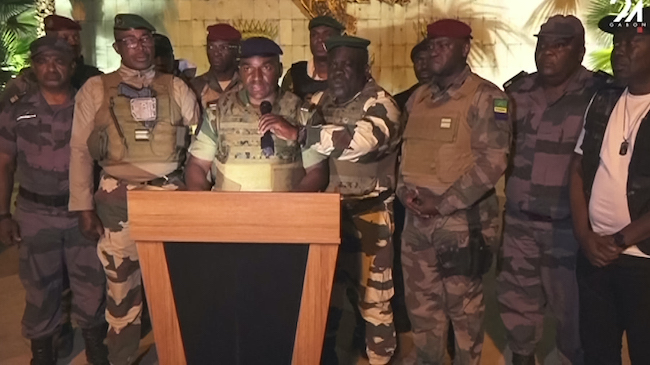
The KAIPTC professor's comment follows the coup d’état in Gabon on Wednesday where a group of senior military officers announced that they had seized power.
Addressing the nation, the military officers stated that their action followed the country’s electoral body's announcement of President Ali Bongo’s victory for a third term after his 14-year rule in Saturday's general election.
The electoral commission reported that Mr Bongo’s victory in the election, which the opposition claimed was marred by fraud, constituted just under two-thirds of the total votes.
However, the soldiers said that decision to take over was motivated by the goal of upholding peace by bringing an end to the existing regime.
On the back of this, Prof Aning said African leaders must be honest with themselves and acknowledge when their time to leave office comes.
He maintained that if these leaders refuse to hand over power after their term of office is over, then “the continent is going to face yet another decade of military coups, counter-coups and more violence leading to under-development, deeper poverty and the lack of jobs, health, education.”
To this end, the Chief Executive Officer of the African Peace Support Trainers Association, Col. Festus Aboagye asserted that the coup in Gabon serves as a stark warning to African leaders who resort to manipulating election outcomes in order to cling to power.
"..The only way that you can access power in a democracy is through elections and the elections must be free, they must be fair, they must be transparent.
"If they are not, then you are creating conditions for coups to happen. And indeed, I'm hearing that he's flown out of the country in four aircraft. The Constitutional court leader has gone to Morocco. Why are they running away if indeed elections were free, fair and transparent," he said.
Col Aboagye warned leaders who manipulate and rig elections to stay in power, saying "We must go to elections feeling confident that the outcomes will reflect the will of the people."
Latest Stories
-
Promotion pay row: Gov’t gives teachers September to complete salary adjustments
6 minutes -
Financial irregularities plummet by 62.9% as state tightens fiscal controls
7 minutes -
DVLA to expand mobile services to underserved communities in Ghana’s Eastern Corridor of the Northern Region
23 minutes -
GUTA urges GPHA to act swiftly to end Tema Port congestion to avert rising business costs
23 minutes -
Port congestion could undermine 24-hour economy policy – GUTA
23 minutes -
NSA opens three-day window to resolve national service biodata mismatches
33 minutes -
Abu Jinapor highlights increased gold exports after Domestic Gold Purchase Programme
37 minutes -
NPP UK branch calls for independent audit into gold purchasing operations and parliamentary probe
1 hour -
Zanetor Agyeman-Rawlings pledges decisive action on climate change, galamsey and environmental degradation
1 hour -
Bawumia was brainchild behind Domestic Gold Purchase Programme – Samuel Jinapor
1 hour -
Fuel prices set to go up from September 1, Petrol to sell at GHC 16.69 and Diesel, GHC 17.90 – COMAC
1 hour -
Our World Our People withdrawn due to curriculum duplication, not politics – Adutwum’s spokesperson
1 hour -
GANRAP is essentially a rebranding of Domestic Gold Purchase Programme – Abu Jinapor
1 hour -
I am tired of being in opposition, my goal is to win in 2028 – Boakye Agyarko
2 hours -
Ghana’s road maintenance funding gap deepens as only 37% of needs met – World Bank
2 hours