

Audio By Carbonatix
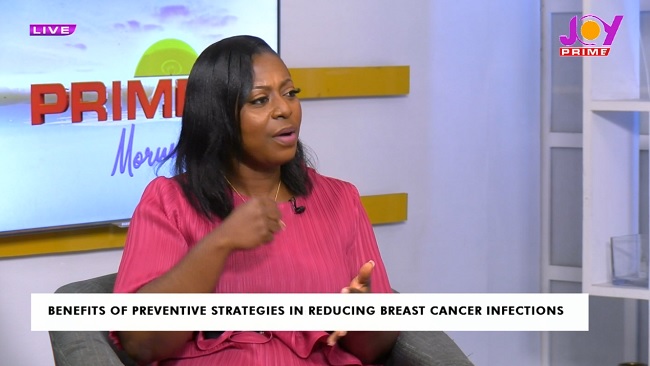
Women’s health educator and Executive Director of Glitz Medical Centre, Stephana Sefa-Boateng, has cautioned ladies to stop relying on emergency contraceptive pills as their basic means to prevent pregnancy after sexual intercourse.
She said it is not a regular pattern of family planning and is one of the major predisposing factors to breast cancer.
According to her, most oestrogen-based emergency post-sexual intimacy pills contain oestrogen, which spikes breast cancer in females.
The public health practitioner said this while sharing insight about the benefits of preventive strategies in reducing breast cancer infections on Joy Prime’s Prime Morning on Tuesday.
"For people who take oestrogen-based contraceptives, my major concern is emergency contraception. The contraceptives you take for three days post-sexual intercourse to prevent pregnancy are not a regular pattern of family planning. That cannot be your basic means of family planning your entire life,” she told the host, Asieduwaa Akumia.
She has therefore recommended that those who need any form of contraception take a better or safer family planning option by seeking guidelines from experts rather than taking the emergency pills.
The majority of ladies depend on these contraceptives after every sexual encounter without bothering about the consequences. But the women’s health educator noted that it is ideally supposed to be taken once in a menstrual cycle.
Mrs. Sefa-Boateng also pointed out that ladies who have elongated exposure to female oestrogen are at risk of developing breast cancer based on the duration between their menstruation and menopausal ages.
“If you had your menses at 15 and you’re having your menopause at 55, that is a 40-year-old span of estrogen. So, that is the natural pathway. People who have early or very late menstruation are at big risk because oestrogen promotes breast cancer,” she said.
Nevertheless, the health practitioner pointed out that there is no concrete cause of breast cancer that is scientifically proven.
Often called the morning-after pill, emergency contraceptive pills (ECPs) are pills that can be taken up to 120 hours (5 days) after having unprotected sex. Some types of emergency contraception work best when taken within 72 hours (3 days) after intercourse.
These pills can cause some minor side effects for a few days, including nausea, vomiting, breast tenderness, headaches, and spotting. Most of these health conditions improve within 1 to 2 days. A girl's menstrual period is also likely to be temporarily irregular after she takes ECPs.
Meanwhile, people who experience the following symptoms after using emergency contraception are urged to call the doctor: have a change in the smell or colour of her vaginal discharge; have unexplained fever or chills; have belly or pelvic pain; have pain during sex; have heavy or long-lasting vaginal bleeding; or miss their period within 4 weeks of using emergency contraception.
Latest Stories
-
Chef Abbys: Feeding 50,000 people, putting food security on Ghana’s agenda
5 minutes -
Ho set to host Republic Bank–JoyNews Habitat Fair as multiple firms prepare to showcase housing solutions
12 minutes -
NPP demands public inquiry into alleged $600,000 World Cup visa fraud, wants Sports Minister, GTA CEO summoned
19 minutes -
I want my brand to be bigger than just music – Yaw Wazinga
23 minutes -
Houthi missile attack on Yemeni presidential palace kills two, minister says
23 minutes -
I hoped to win an award; I worked hard – 2026 Best Graduating Law Student
33 minutes -
Fraudsters increasingly target bank customers instead of banking systems – Fraud detection expert
34 minutes -
44 teacher sexual abuse cases tracked since 2015; school heads feature in 40% of recent cases — JoyNews Research
37 minutes -
Unchecked imports and the Middle East crisis threaten Ghana’s fragile food inflation anchor
55 minutes -
Ecobank Junior Saver Big Pitch to reward 10 winners with GH¢2,000 each
60 minutes -
AMA demolishes unauthorised pigsty obstructing Agbogbloshie waste evacuation exercise
60 minutes -
I was filled with disbelief – Akosua Achia Sarpong Esq. shares her first reaction
1 hour -
Snake Village: A look at Volta Region’s hidden snake village and its tourism potential (Video)
1 hour -
Election Watch Ghana calls for constitutional reforms to strengthen Electoral Commission independence
1 hour -
NACOC, Postal and Courier Services Regulatory Commission intensify efforts to curb drug trafficking
1 hour