

Audio By Carbonatix
Ghana and other African countries could potentially generate around $82 billion annually from carbon credits, as indicated by the United Nations Economic Commission for Africa.
The commission is urging African member states, currently convening at the 2023 United Nations Climate Change Conference COP 28 in Dubai, to establish a fully-fledged carbon market.
This market could serve as a sustainable financing arrangement, replacing the traditional official development assistance.
The Government of Ghana has already authorized the transfer of mitigation outcomes for a second project to Switzerland during the ongoing Climate Change Conference (COP 28).
This project involves Ghana exchanging carbon credits for payment while retaining the developmental benefits within the country.
It is part of the government's efforts to transform Ghana’s waste sector by creating high-quality organic fertilizer and generating over 1000 direct jobs, particularly for women.
At an official ceremony to sign the agreement, Minister for Environment, Science, Technology, and Innovation (MESTI) Dr.Kwaku Afriyie indicated that "Ghana is the only country in Africa to authorise two projects under the same agreement on Article 6 with Switzerland. "
"The presentation of the letter of authorization for the “Integrated Waste Recycling and Composting for Methane Reduction in Ghana” project signifies the formal pre-approval of the project to achieve emission reduction, advance sustainable waste management and create green jobs”, he noted.
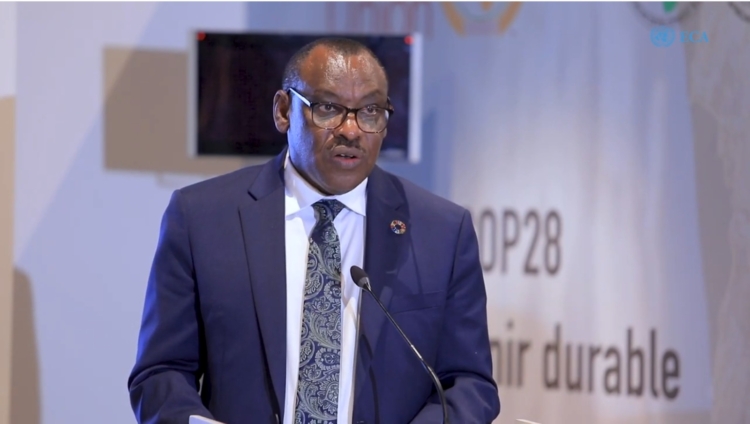
Speaking at the Africa Day sideline event at COP 28, Executive Secretary of the United Nations Economic Commission for Africa, Claver Gatete indicated that “there is a great potential in developing the African carbon Market carbon credit Market to unlock additional green financing for Africa.”
He added that “Africa's research shows that at $20 per ton of nature-based carbon credits could generate 82 billion on the annual basis which is about one and a half times the amount of money that we (Africa) get in terms of the official development aid.”
The Executive Secretary further explained that caution must not be exercised when it comes to relying on voluntary carbon credits from nature-based Solutions as a key source of climate Finance in Africa.
"Instead we must equip Our member states with the necessary data-driven evidence to gain a better understanding of the nuances and risks involved with this approach. We must address our symmetry between demand and Supply to ensure that Africa's participation in carbon markets involves high integrity credits."
Because of this, the Economic Commission says it plans to play its role by supporting the Climate Commission of the Congo Basin to develop a carbon registry and protocols for transparency.
Latest Stories
-
Empower Vault Summit challenges Ghana’s youth to embrace purpose, leadership and opportunity
19 seconds -
Fuel prices set to witness mixed reviews at pumps from August 16, 2026
2 minutes -
GRA signs partnership with UK counterpart to strengthen customs protection
20 minutes -
Rethink MMDCE elections – Dr Tando proposes MP-led appointment model
34 minutes -
Rethink MMDCE elections – Dr Tando proposes MP-led appointment model
59 minutes -
GSTS honours former Chief of Naval Staff Commodore Stephen Obimpeh at 117th Founders’ Day
1 hour -
Togbe Afrika, Enam, Jah Phinga to light up Dzodze-Penyi at “Togbe Afrila Homecoming” Concert
1 hour -
Otumfuo pushes for funding to complete Boankra Inland Port
1 hour -
Mahama announces rehabilitation of Pwalugu tomato factory, $5bn boost for agriculture
1 hour -
MTN Ghana’s growing economic footprint puts spotlight on telecom sector
2 hours -
Free Primary Health Care to reach all districts by 2028 – Health Minister
2 hours -
Mahama commissions Paga SHS E-Block, promises facilities to end double-track by 2027
2 hours -
Zambia resumes vote counting after security concerns halt electoral process
2 hours -
Overall unemployment decline shows government policies are working – Opare-Addo
2 hours -
GHS boss calls for stronger commitment to make Free Primary Health Care work
2 hours