

Audio By Carbonatix
A study report published by the Ghana Statistical Service has revealed a decline in the fertility rate from 6.4 children per woman in 1988 to 3.9 in 2022.
On a regional level, fertility ranges from 2.9 children per woman in Greater Accra to 6.6 children per woman in the North East Region.
Women in the lowest wealth bracket have an average of 5.9 children, whereas the average is 2.7.
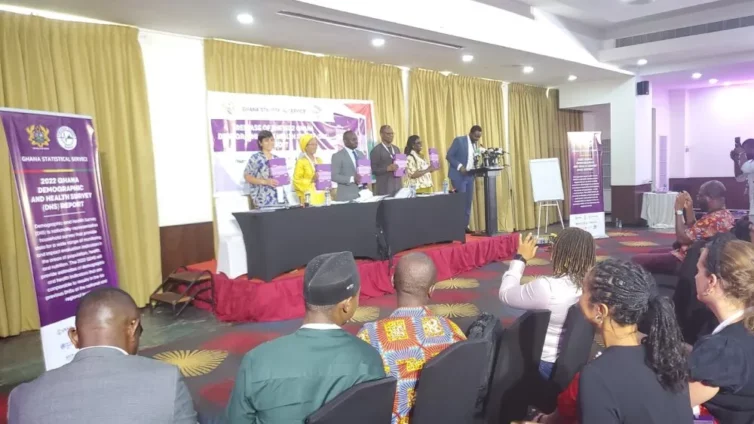
Professor Samuel Annim, Government Statistician, disclosed this in Accra during the release of the 2022 Demographic and Health Survey.
The survey is the seventh conducted across the country since 1988, to provide data for monitoring Ghana’s population and health situation.
Concerning drinking water, the survey found that 84% of households in Ghana’s had access to at least basic drinking water services.
This includes drinking water from an improved source, either on the premises or with a round-trip collection time of less than 30 minutes.
Furthermore, 95 per cent of urban households have access to at least basic drinking water services, compared to 72 per cent of rural households.
The availability of sufficient quantities of drinking water is lowest in the Northern region with 68 per cent and highest in the Upper East and Ashanti regions with 86 per cent.
On menstrual hygiene, the survey found that 88 per cent of women aged 15 to 49 used disposable sanitary pads, nine per cent used cloth, and two per cent used reusable sanitary pads.
Regarding sanitation, the survey indicated that 24 per cent of Ghanaians had access to at least basic sanitation services, implying they used improved facilities which were not shared with other households.
According to the survey, 15 per cent of adolescent women aged 15 to 19 have ever been pregnant, with 11 per cent giving birth, two per cent pregnant at the time of the survey, and four per cent having lost a pregnancy.
Teenage pregnancy rates vary by region, with Savannah reporting six per cent of young women.
Of all pregnancies that ended in the three years preceding the survey, 82 per cent resulted in live births and 18 per cent in pregnancy losses.
In terms of infant mortality, the Survey found that the neonatal mortality rate was 17 deaths per 1,000 live births, with one in every 25 children in the country dying before the age of five.
Since 1988, under-five mortality has declined from 155 deaths per 1,000 live births to the current rate of 40 deaths per 1,000 births.
For malaria prevalence, the survey indicated that nine per cent of the population aged 6 to 59 tested positive for malaria by microscopy and 17 per cent by RDT.
Dr. Patrick Kuma-Aboagye commended GSS for the survey, which he said would help shape health policies and improve societal well-being.
The survey was funded by USAID, UNICEF, UNFPA, the World Bank, the Global Fund, KOICA, the World Health Organisation, and the Foreign, Commonwealth, and Development Office.
A nationally representative sample of 15,014 women aged 15 to 49 from 17,933 households, as well as 7,044 men aged 15 to 49 from half of the selected households, were interviewed.
The survey represents a response rate of 98 per cent of women and 97 per cent of men.
Latest Stories
-
Crowds, deals and home solutions as Republic Bank-JoyNews Habitat Fair enters final day
2 hours -
Fire Service finds only five functional hydrants in Ministries enclave
2 hours -
Government to sign 1,200MW gas power deal before end of 2026 – Mahama
2 hours -
West Mamprusi launches community-led WASH and livelihoods project across 100 communities
2 hours -
Iran says it will wait for official US response after Trump rejects Strait of Hormuz proposal
2 hours -
90 Oti communities to benefit from government electrification project
2 hours -
Floods leave 246 without shelter as 93 houses collapse in North East Gonja
2 hours -
Labour Minister wants SOEs to help shape new public pay system
7 hours -
IPEC will ensure Equity and Sustainability in SOEs Compensation
8 hours -
White House bars CNN from travelling with Trump on Air Force One
8 hours -
Fennis wins second consecutive ITF J60 title in Accra
8 hours -
Spain beat England in thriller after Kane penalty miss
9 hours -
GPL 2026/27: Zaidan’s late goal ends Hearts of Oak unbeaten start
9 hours -
CEOs demand clarity on pay harmonisation, board autonomy as FWSC engages SOEs bosses over IPEC transition
9 hours -
2026 Women’s Super Cup: FC Savannah, Epiphany Warriors maintain top spots ahead of final group games
9 hours