

Audio By Carbonatix
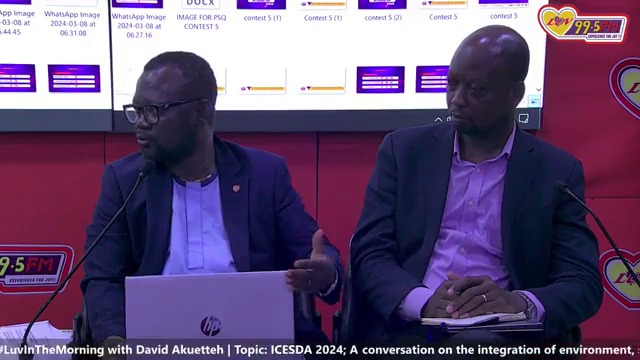
Executive Director for the Centre for Business Incubation, Dr Christian Sewordor Mensah, has observed a low enthusiasm in Ghana’s quest to militate against actions that degrade the environment, bringing about a climate crisis.
According to him, the country’s failure to take drastic measures to achieve the 17 Sustainable Development Goals by 2030 could plunge the economy into food insecurity.
Speaking on Luv FM, Dr Mensah emphasised that collective focus and consideration are needed to take proactive measures for environmental progress.
"If we don't take bold and intentional steps to confront the issues that have been identified and categorised as global challenges, we will soon find ourselves without any food to eat due to the adverse effects of the environment," he said.
He observed environmental challenges, such as illegal mining and destruction of wetlands, pose threats to human existence.
“The society could be drained and ultimately face extinction and encounter challenges that can't be quickly resolved, potentially leading to our demise,” he said.
Dr Mensah made the submission ahead of a three-day international conference that would gather stakeholders in academia and industry to delve into pressing matters about the environment and sustainable development in Africa.
The event dubbed ICESDA2024 is on the theme, “Enhancing Environment, Social, Governance and Sustainability for Africa’s Development.”
The maiden edition would see deliberations and recommended solutions to address environmental and climate challenges in Ghana and on the African continent.
Professor De-graft Owusu Manu of the KNUST says the country's attitude and perception in finding pragmatic solutions to tackle environment and climate destruction are not good enough.
“The recent Akosombo water spillage and the illegal mining menace is affecting us badly. We need solutions to solve these problems. If we don’t take action. There’s going to be problems for our future,” he said.
Advocating for a more robust system to fight the climate menace, the Conference Manager for ICESDA2024, Dr Appiah Kenneth, acknowledged that despite the existence of sanitation and environmental laws, their implementations are faced with setbacks.
“There are laws regarding sanitation, but the real issue lies in the enforcement. Enforcing these regulations requires adequate resources because it is not as simple as just implementing laws. We need to provide the necessary resources to empower those responsible for enforcing such laws,” he said.
Latest Stories
-
Haruna Iddrisu calls for limits on annual university accommodation fee increases
35 minutes -
Today’s front pages: Tuesday, October 13, 2026
1 hour -
Wealth Over Water: How Galamsey Is Threatening Ghana’s Water Security
2 hours -
LA 2028: Black Queens pumped up for second leg of Mauritius tie
2 hours -
LA 2028: Black Queens hold final training session ahead of second leg against Mauritius
3 hours -
Standards are not Seasonal: What the EC appointments teach both sides
3 hours -
King Mohammed VI urges private sector to create youth jobs and spread benefits of growth
3 hours -
KGL U17 Colts 2026: Greater Accra win title after penalties win over Western Region
3 hours -
UK Investment Roadshow opens in London to advance UK-Ghana growth partnership
3 hours -
Assemblies of God requires pastors to resign before entering partisan politics – Rev. Wengam
3 hours -
Ghana targets 20% annual reduction in maternal deaths – Health Minister
3 hours -
Cyber attacks in Africa grow faster than global rate, report finds
3 hours -
Ghana signs UAE deal to create 5,000 overseas jobs
3 hours -
One Million Coders Programme targets 100,000 digital jobs in two years – Sam George
4 hours -
John Jinapor, Italian Ambassador explore opportunities for energy sector investment
4 hours