

Audio By Carbonatix
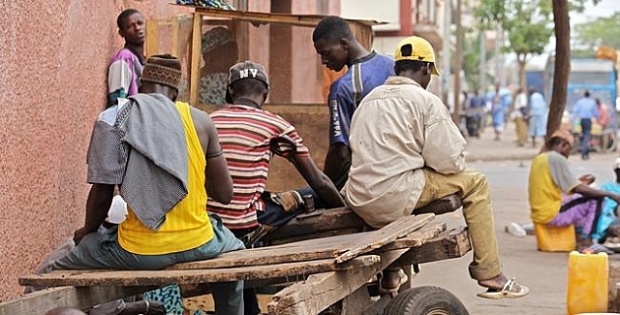
The increasing rate of unemployment in Ghana has becoming alarming in subsequent weeks.
From the staggering 1.85 million Ghanaians being unemployed in the third quarter of 2023, as reported by the Ghana Statistical Service to the silence of the President on the matter during the presentation of the 2024 State of the Nation Address (SONA), unemployment remains a major threat in Ghana.
But recent development has escalated these concerns even more as “unemployment” is now considered the highest risk factor in Ghana, according to the World Economic Forum 2024 Global Risk Report.
This report shows the possibility of the occurrence of an event or condition which could negatively impact a significant proportion of global GDP, country specific GDP, population or natural resources.
It looks at the economic, environmental, geopolitical, societal and technological risk areas with 34 risk factors.
With regards to Ghana, the Global Risk Report indicated a structural deterioration of work prospects or standards of work which includes, but is not limited to: erosion of workers' rights; stagnating wages; rising unemployment and underemployment; displacement due to automation or the green transition; and stagnant social mobility.
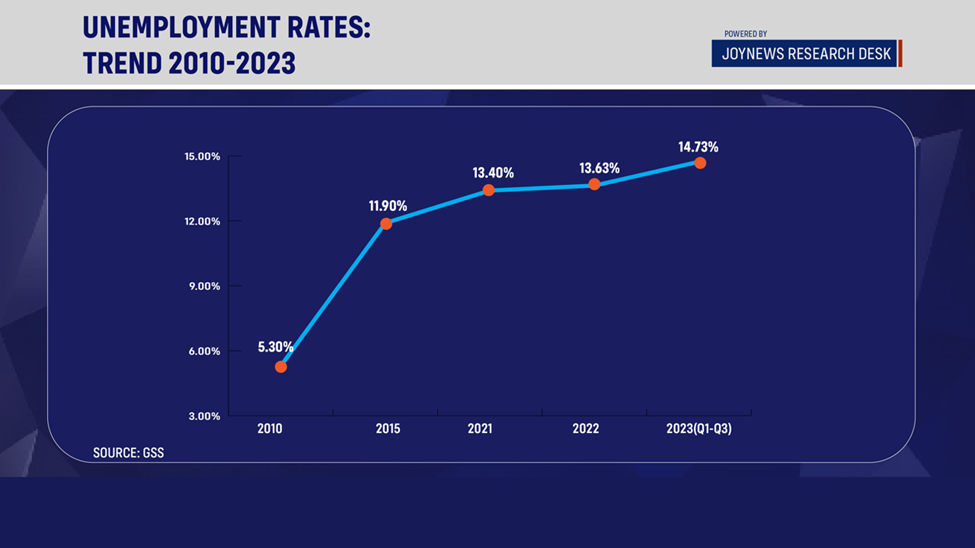
The Ghana Statistical Service in their third quarter 2023 labour statistics showed that Ghana’s unemployment rate has been on an upward trajectory from a rate of 5.3% in 2010 to 14.7% as at the third quarter of 2023.
This translates to about 1.85 million Ghanaians not having jobs.
Details of the report indicates that public debt, inflation, cybercrime and cyber insecurity, and economic downturn occupy the 2nd, 3rd, 4th and 5th risk factors respectively.
Currently, the nation’s total public debt stands at GHS 567.3 billion. This means every Ghanaian on per capita basis owes GHS 18,300. Inflation continues as a double digit at 23.2% as of February 2024.
Meanwhile, Ghana ranks third in cyber security readiness in Africa behind Mauritius and Tanzania according to the latest cyber security report by the International Telecommunications Union.
Globally, the nation ranked 43rd with a score of 86.69 out of 100. This means that Ghana is 86.69% ready in the event of a cyber-security attack.
The Media Foundation for West Africa in their Internet Freedom Report 2021 indicted that Ghana lost $105 million in 2019 and $9.8 million in 2018 due to internet fraud and cybercrime.
The Bank of Ghana financial fraud report 2023 also showed about GH¢4.3 million in 2022 as compared to GH¢2.6 million in 2021, an increase of 65.55%.
These statistics show a pressing need to look at the cyber security concern.
Latest Stories
-
Manasseh Writes: The shift in the NPP
2 minutes -
The price of a seat: Financial barriers and the structural quality of Ghana’s Parliament
8 minutes -
Government targets October 16 for first tranche of teacher arrears – Haruna Iddrisu
11 minutes -
Daily Insight for CEOs: The CEO’s role in driving innovation
15 minutes -
Audit existing sanitary sites to address waste management land shortages – WasteCare CEO urges assemblies
18 minutes -
Two-bin household waste system could support waste-to-energy in Ghana – Waste Care Associates CEO
24 minutes -
Dealing with political and social media insults
26 minutes -
Essi Donkor urges stronger support for girls’ education, announces GH¢2,000 BECE reward
26 minutes -
Ghana still needs landfills but Accra should prioritise waste-to-energy – Waste Care Associates CEO
34 minutes -
Godwin Mahama declares bid for NDC Greater Accra Regional Secretary
38 minutes -
Bawumia unveils NPP plan to scout parliamentary candidates capable of winning parliamentary seats
42 minutes -
NPP Chairmanship race: How APL’s survey made a near-perfect prediction
42 minutes -
Remember Adomako-Boateng: Aduana right-back regains consciousness after collapsing during a league match
42 minutes -
Today’s front pages: Monday, October 5, 2026
43 minutes -
Families still selling homes, exhausting savings to pay for specialised care – GMTF Administrator
1 hour