


Audio By Carbonatix
Banks in Ghana remain in a solid position despite Ghana’s challenging economic environment and the ongoing efforts of the Domestic Debt Exchange Programme (DDEP), Fitch Solutions has stated in its new report dubbed “Ghana’s New CRRs To Have Muted Impact On Loan Growth And Weigh On Profits”.
According to the London-based firm, the banking sector has reported strong growth in balance sheet items despite unfavourable conditions.
It added that capital levels, which had fallen close to the minimum requirement, are beginning to improve again, and banks are recording robust profits.
However, it explained that the recently introduced linking of banks’ cash reserve ratio (CRR) requirement to their loan-to-deposit ratio (LDR) will have several unfavourable consequences.
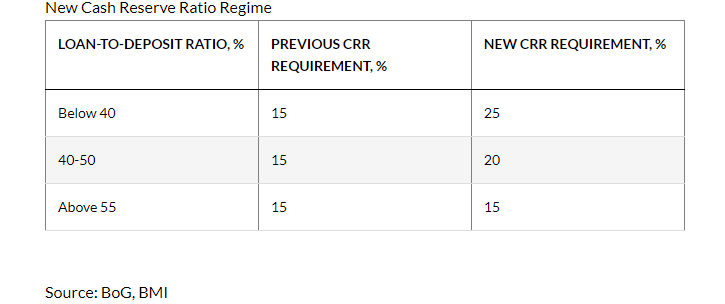
On March 25 2024, the Bank of Ghana (BoG) introduced a new regime aiming to boost lending and reduce excess local-currency liquidity to control inflation by linking the CRR to the LDR. “While we believe this will compel some banks to extend more credit, very poor loan quality will keep lending too risky for others, who will instead prefer to hold high cedi cash reserves at the central bank”, it stressed.
The table below shows the new requirements, which took effect at the end of April 204.
CRR to spur loan growth
Furthermore, Fitch Solutions said “We believe this new regime will support loan growth for some banks”.
Institutions with currently low ratios of non-performing loans (NPLs) to total loans, will have room to increase their lending and, therefore, their LDR, which will boost industry credit growth in 2024. For instance, Zenith Bank, Access Bank, and GTBank – the seventh, eighth, and ninth largest banks in Ghana, respectively – recorded NPL ratios between 2-4% in quarter one 2024.
It said, this will allow them to increase lending, with an average LDR of 20.2% for the same period.
The growth will be supported by an improving economic environment characterised by interest rate cuts, falling inflation, and strong economic growth, which will boost credit demand. Additionally, these diminishing headwinds will make it easier for households and businesses to repay their debts, improving banks' loan quality and incentivising further credit extension.
Latest Stories
-
GEA and UNIDO celebrate enterprise excellence and productivity at 3rd National Kaizen Awards
5 minutes -
Over 300,000 candidates chose Category A schools despite 76,417 vacancies – Education Ministry
6 minutes -
Sarkodie urges SarkNation to reject toxic fan wars
7 minutes -
Ghana Jazz Orchestra cooks tasty fare at launch
26 minutes -
Jerry Aye: The life & times of Robert Mugabe
36 minutes -
Asiedu Nketiah says better government begins before Election Day
45 minutes -
Colleges of Education call for National AI Policy and digital resources for teachers
45 minutes -
AngloGold Ashanti empowers 22 Sanso women through apprenticeship to entrepreneurship programme
55 minutes -
Gov’t advances National Data Exchange Hub under US$50m digital project – Sam George
1 hour -
Alex Asmah Foundation launched in Kumasi to support youth development across Ghana
1 hour -
School placement is absolutely free – Education Ministry
1 hour -
Burkina Faso FA Prez Oumarou Sawadogo takes over as WAFU B President
1 hour -
CSSPS self-placement portal opens for candidates unable to secure choices
1 hour -
James Korsah-Brown calls for Tourism Minister to be changed
1 hour -
Death in the dark: Family demands answers after dialysis patient dies at TTH during power outage
1 hour