

Audio By Carbonatix
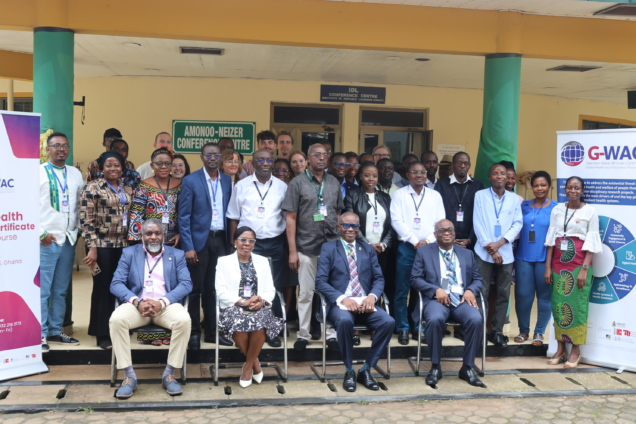
Twenty-five health personnel across the sub-region and Germany are receiving training on the One Health concept from the German-West Africa Centre for Global Health and Pandemic Prevention (G-WAC) at the Kwame Nkrumah University of Science and Technology (KNUST).
The five-day workshop which is in its second year will delve into the interconnectedness of human, animal, and environmental health, stating the importance of a collaborative approach in addressing health threats in the African setting and elsewhere.
The One Health concept is an approach being used to address the existential threat of global pandemics to the health and welfare of people.
The Director of the German-West Africa Centre for Global Health and Pandemic Prevention (G-WAC), Dr. John Amuasi stated that the course will explore interventions needed to address the threats posed by these pandemics.
“This course will explore what we need to put in place by way of research and also to understand how to develop various interventions and solutions as well as how to monitor the outcome of what we are doing so that we can do them better.
"And hope to protect not only humans but animals and the entire environment from some these pathogens and ultimately the problems they cause us," he said.
He also noted the course's uniqueness and practicality.
“This is very unique because it will cut across food issues, environmental issues and pathogens. Most of the time is going to be spent practically visiting important places, for example, the Kumasi Abattoir, and the Barekese Dam because these are critical points of confluence of humans and animals and it will help us address what risk is and also put I place the right measures to address these risk and diseases,” he said.
The short course offers competency-based training, multidisciplinary learning and will enhance networking and partnership opportunities for policy-makers, global health practitioners, and researchers.
The scientific coordinator for G-WAC, German-Berlin, Verena Struckmann expects the participants to be well accustomed to the One Health approach practically.
“The participants should be well acquainted with the one health approach not only in their theoretical manner. We are going to the field and it’s the first time they are going to apply the gained knowledge in their local, national and workplace context but in the end, they should get the concept in a way they will be able to insert it in their work in a long term manner and contribute to acknowledge this concept more than it has been done before,” she said.
The course is supported by the German Academic Exchange Service (DAAD) with funding from the budget of the Federal Foreign Office.
Latest Stories
-
La Beach demolition: Senyo Hosi condemns lack of consultation
7 minutes -
Russian glide bomb attack on Zaporizhzhia kills at least 15 people
22 minutes -
Jinapor warns underperforming energy sector CEOs of consequences, says no protection for failure
24 minutes -
Fire destroys head of tipper truck on Lower Volta Bridge
28 minutes -
Palmer signs new Chelsea contract until 2034
30 minutes -
World Cup visa scandal: Mahama will act on corruption allegations – Abass Nurudeen
32 minutes -
Abass Nurudeen accuses Minority of ‘scandal scavenging’ over World Cup visa controversy
33 minutes -
US Embassy recognised NSA, GFA and GTA as separate entities for visa applications – Sports Minister’s aide
40 minutes -
Only 30% of Ghanaian teachers satisfied with their jobs – CAPCOE data reveals
51 minutes -
Communities affected by construction of Akosombo Dam urge government to speed up compensation process
1 hour -
World Cup visa scandal: Sports Ministry not shielding anyone – Sports Minister’s special aide
2 hours -
World Cup visa scandal: Over 30 people misrepresented as GTA board members to US Embassy – Vincent Assafuah alleges
2 hours -
Fire destroys wooden structure near Yesu Mo Villa at Bush Road
2 hours -
NDC threatens sanctions over oversized campaign posters, gives aspirants 5 days to comply
2 hours -
Star Oil paid GH¢2.7bn in taxes, levies in nine months of 2026
3 hours